

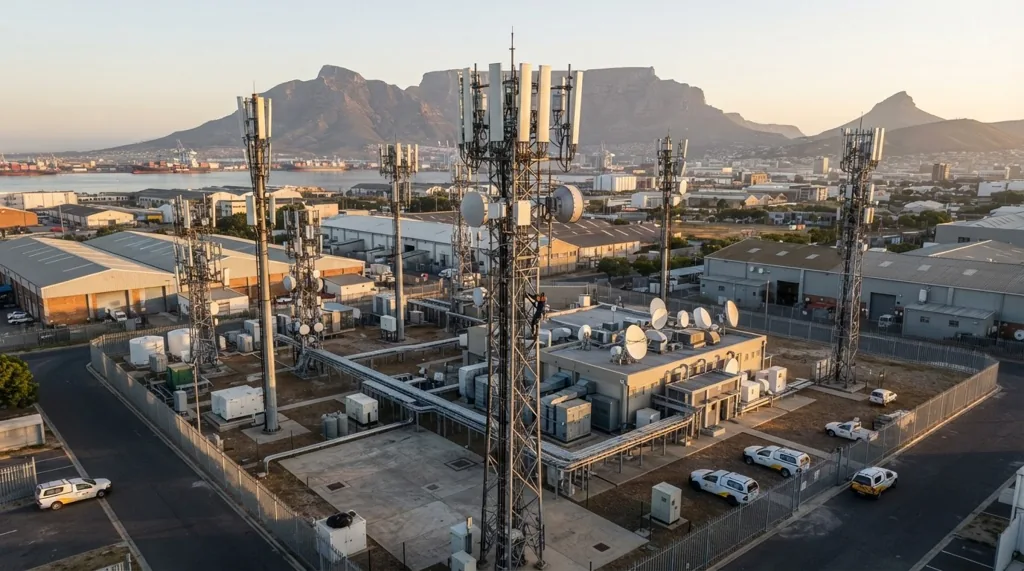
South Africa withdrew the 2019 reservation of 700, 800, 2600 and 3500 MHz spectrum for a wholesale open access network, making it available for ICASA licensing from Sept. 25, 2026.
South Africa’s Minister of Communications and Digital Technologies has withdrawn the 2019 reservation of high-demand mobile spectrum for a single wholesale open access network, making those airwaves available for licensing to telecom operators from the notice’s publication on Sept. 25, 20261.
The notice was published as General Notice 4163 of 2026 in Government Gazette No. 55438, and Minister Solly Malatsi signed it on Sept. 14, 20261. It amends the Policy on High Demand Spectrum and Policy Direction on the Licensing of a Wireless Open Access Network, issued in July 20191.
In short, airwaves held back for seven years for a state-backed shared network that was never licensed can now be licensed by ICASA, the national communications regulator. Any operator that wins this spectrum will have to lease network capacity to other licensees, under strict oversight by ICASA.
What does the WOAN spectrum notice change?
The 2019 policy set aside high-demand spectrum for "prior assignment" to a wireless open access network, or WOAN1. A WOAN is a single shared network that sells capacity wholesale to other operators rather than to consumers. The new amendment states that this reservation "is withdrawn"1.
High-demand spectrum, before and after
| Question | 2019 policy | 2026 amendment |
|---|---|---|
| 700, 800, 2600, 3500 MHz | Reserved for a WOAN | Reservation withdrawn |
| Who can be licensed | A single WOAN first | Licensed by ICASA |
| Wholesale access | Through the WOAN | Leasing duty on licensees |
The withdrawn reservation covers spectrum in the 700 MHz, 800 MHz, 2600 MHz and 3500 MHz bands1. These are the bands used for mobile broadband. The amendment says the spectrum is "with immediate effect, available for licensing by the Authority"1.
The notice also deletes several parts of the 2019 policy outright, including paragraph 3 and paragraphs 1.2 to 1.51. It renames the instrument simply the Policy on High Demand Spectrum1. The amendment’s formal title is the Policy Amendment on High Demand Spectrum, 20261.
Why did the communications ministry drop the WOAN?
The amendment states that the reservation has not led to a licensed WOAN in more than seven years1. The spectrum set aside for it "has remained substantially unassigned," according to the notice1. The minister concluded that keeping the reservation is "no longer justified"1.
From reservation to withdrawal
An explanatory note published with the notice sets out the history. On March 11, 2022, the minister issued a draft amendment proposing the same withdrawal in Gazette 460311. Cabinet approved that draft for consultation in March 2022, but the process was never concluded and no final policy was published1.
The draft argued that the WOAN spectrum did not meet the viability threshold set by a study from the CSIR, the national science research council1. It expected a separate spectrum policy to deliver the WOAN’s goals instead1. That policy, published on May 28, 2024, did not address the WOAN at all, leaving the reserved spectrum’s status unresolved1.
The note also cites a 2015 discussion paper for the International Telecommunication Union1. That paper warned there was "insufficient international experience" to identify best practice for wholesale open-access wireless networks1.
What must ICASA require of new spectrum licensees?
ICASA will license the freed spectrum under its powers in sections 30 and 31 of the Electronic Communications Act, 20051. When it does, the amended policy lists objectives the regulator must achieve. The first is a wholesale duty on licensees:
- leasing of networks and facilities to other licensees
- provision of wholesale capacity to other licensees
- strict regulatory oversight by ICASA to enforce both
The amendment states that ICASA "must perform strict regulatory oversight" to ensure compliance with this leasing requirement1. In practice, wholesale access becomes a condition attached to each licence rather than the job of one dedicated network.
The policy also restates its goals. They include making sure high-demand spectrum is licensed "so as to realise its socio-economic value" and promoting competition in the ICT sector1. The notice says operators that hold network licences but cannot get spectrum face a barrier to entry, which raises the cost to communicate1.
How does the 2022 spectrum auction affect operators?
The explanatory note points to ICASA’s 2022 auction of the same bands, which excluded the portion reserved for the WOAN1. ICASA’s announcement of the result said six bidders took part: Cell C, Liquid Intelligent Technologies, MTN, Rain Networks, Telkom and Vodacom2. The main auction stage ran for 58 rounds of bidding2.
2022 auction commitments by bidder, R million
The auction raised more than R14.4 billion for the national treasury2. Total commitments by bidder, according to ICASA, were2:
- Vodacom: R5.38 billion
- MTN: R5.15 billion
- Telkom: R2.11 billion
- Rain: R1.43 billion
- Cell C: R288.2 million
- Liquid Telecom: R111 million
One lot of 2×10 MHz in the 800 MHz band went unsold, and ICASA said it would license that lot in future2. At the time, ICASA’s chairperson linked further licensing to the government’s revision of the WOAN policy2.
What happens to existing licence conditions?
The 2021 invitation to apply for that auction made winners collectively buy at least 30% of national capacity from the WOAN once it was running1. The overall spectrum cap in that process was also calculated on a pool that included the WOAN spectrum1.
The explanatory note says the withdrawal "leaves those conditions without practical object"1. In plain terms, the 2022 licensees’ duty to buy capacity from a WOAN no longer has a network to apply to.
Other licence conditions from the auction are described in the note as evidence that market-based licensing can meet development goals1. Winners had to hold at least 30% ownership by historically disadvantaged persons and keep at least level 4 B-BBEE status, South Africa’s black economic empowerment rating1. They also carry coverage, open access and social obligations1.
What did ICASA and the Competition Commission argue?
The note records that ICASA recommended keeping the title and clauses 1 to 3 of the 2019 policy1. The minister considered that view but was not persuaded, since no WOAN had been licensed1.
The Competition Commission, the national competition watchdog, asked for an express competition objective ranked above the others1. The minister declined, noting that competition is already an object of the act under section 2(f), which binds ICASA1. Stakeholder submissions from 2022 were split, with some backing the WOAN as workable and others questioning any change1.
The amendment took effect on publication on Sept. 25, 20261. The next step is for ICASA to license the 700 MHz, 800 MHz, 2600 MHz and 3500 MHz spectrum, with the wholesale leasing duty attached1.
Sources
- ↩ National Water: Proposed water resource classes and resource quality objectives for the Upper Orange River Catchment (Comments invited) https://www.gov.za/sites/default/files/gcis_document/202609/55438gon7960.pdf
- ↩ ICASA concludes successful spectrum auction and collects more than R14.4 billion proceeds — Independent Communications Authority of South Africa https://www.icasa.org.za/news/2022/icasa-concludes-successful-spectrum-auction-and-collects-more-than-r14-4-billion-proceeds