

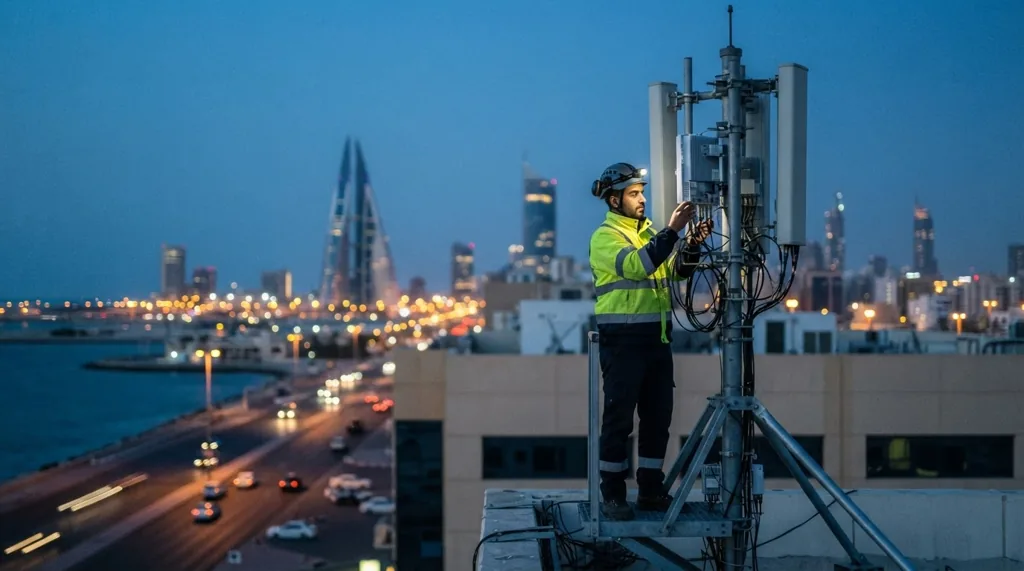
Bahrain’s telecoms regulator set a flat BD70 equipment approval fee and new local frequency charges, effective the day after gazette publication.
Bahrain’s Telecommunications Regulatory Authority (TRA) has set a single BD70 fee for equipment approval and created a new way to charge for local radio frequencies. The decision takes effect the day after it appears in the Official Gazette.
The TRA board chair signed Decision No. 6 of 2026 on 19 October 20261. It amends the TRA’s fee rules, first issued by Decision No. 6 of 2023, and affects equipment suppliers and holders of radio frequency licences1. The decision also adds a fee formula for frequencies granted for a defined area rather than the whole country1.
| At a glance | Details |
|---|---|
| What was published | Final decision amending TRA fee rules |
| Published on | 19 October 2026 (date signed) |
| Who must comply | Equipment approval applicants and radio frequency licence holders |
| Effective date | Day after publication in the Official Gazette |
| Next milestone | TRA public notices naming eligible local frequencies |
What is equipment approval, and why does it matter?
Equipment approval, which the TRA calls type approval, is the check that telecoms and radio devices must pass before use in Bahrain2. The TRA’s fee rules state that type approval has the same meaning as "equipment approval" in the Telecommunications Law2.
The rules cover terminal devices, meaning end-user equipment that connects to communications networks2. They also cover short-range devices, such as door openers, alarms, CCTV, wireless microphones and RFID tags2.
The new flat fee schedule
The decision replaces the fee table for type approval certificates with a single row1. Every applicant now pays BD70 to apply, BD10 to renew and BD40 to change a certificate1.
Under the TRA’s general fee rules, application fees are paid in advance when an application is filed2. They are not refunded, whether or not the application succeeds2.
How the local frequency fees work
The decision creates a new category: frequencies that are not assigned on a national basis1. These are granted under a licence that does not run for several years. The TRA will list them in public notices issued from time to time1.
The yearly fee is calculated with one formula1. It multiplies the unit price, the bandwidth, a frequency factor, a demand factor, an area coverage factor and the number of radio stations1.
- Bandwidth is the amount of spectrum used.
- The demand factor reflects how sought-after a band is.
- The area coverage factor reflects how much ground a signal covers.
When the TRA receives an application, it will study it and decide whether it covers an indoor or outdoor area1. The decision defines an indoor area as space inside a building with a roof and walls1. Outdoor areas include open spaces, streets and rooftops exposed to the open air1.
A lower factor means a lower fee. The indoor and outdoor factors are far below the factor of 1 used for all other cases1.
Short-term licences and satellite links
The decision also sets a temporary licence fee for these local frequencies1. It equals one-twelfth of the yearly fee for each month of use1. Any part of a month is rounded up to a full month1.
The updated coverage table also sets factors for satellite ground stations1. Transmitting stations pay a factor of 0.07 for geostationary satellites and 0.35 for other orbits1. Receiving stations pay 0.035 and 0.175 respectively1.
Revised demand factors by frequency band
The decision replaces the table of demand factors across 14 frequency bands1. The 24,250 MHz to 27,500 MHz band carries a factor of 1.501. Bands from 37,000 MHz to 39,500 MHz and from 40,500 MHz to 43,500 MHz carry the highest factor of 2.901.
The lowest factor, 0.33, applies to the 71,000 MHz to 76,000 MHz and 81,000 MHz to 86,000 MHz bands1.
Enforcement and payment
The TRA’s fee rules say unpaid fees lead the authority to take action under the Telecommunications Law2. Non-payment may ultimately lead to the revocation of the licence2. The TRA keeps the right to invoice fees even after revocation2.
Key terms in plain words
| Term | Meaning |
|---|---|
| Type approval | The TRA’s check that a device meets technical rules before use |
| Short-range device | Low-power radio gear such as alarms, CCTV or wireless microphones |
| Bandwidth | The amount of radio spectrum a licence uses |
| Demand factor | A multiplier that raises fees for sought-after bands |
| Area coverage factor | A multiplier based on how much area a signal covers |
| Official Gazette | Bahrain’s official publication of laws and decisions |
The decision takes effect the day after its publication in Bahrain’s Official Gazette1.
Sources
- ↩ قرار رئيس مجلس إدارة هيئة تنظيم الاتصالات رقم (6) لسنة 2026 بتعديل بعض أحكام اللائحة التنظيمية بشأن الرسوم التي تفرضها هيئة تنظيم الاتصالات على التراخيص والخدمات الأخرى الصادرة بالقرار رقم (6) لسنة 2023 https://www.legalaffairs.gov.bh/Legislation/HTM/RTCRA0626
- ↩ Review of the Schedule of Fees https://www.tra.org.bh/Media/Pdf-Section/SOF%20Regulation%20(English)-%20v12.pdf