

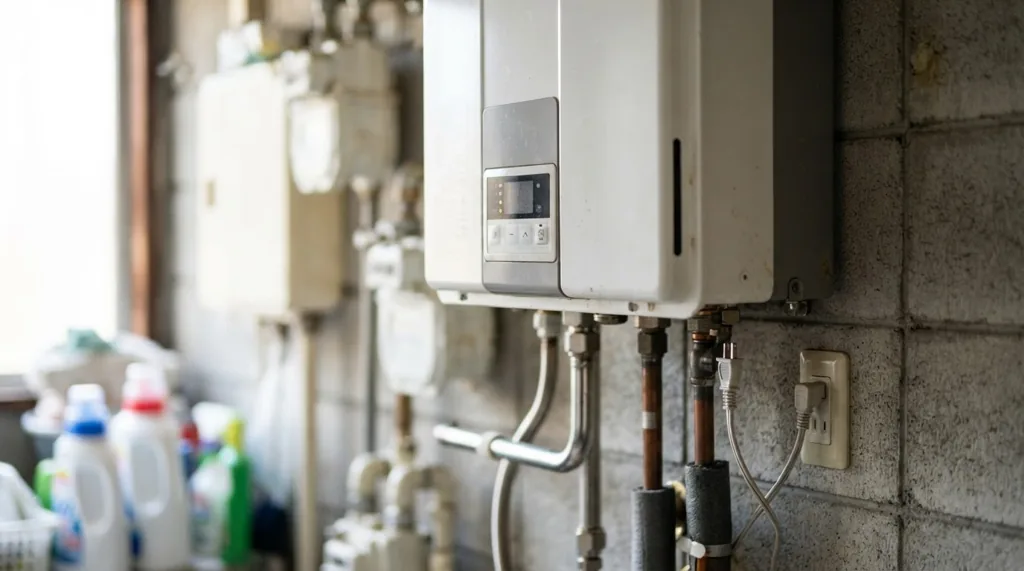
Japan has established decision-making criteria for manufacturers and revised energy efficiency notification requirements under the Rational Use of Energy Act to enhance the energy consumption performance of gas and electric water heaters.
Japan will require makers and importers of home gas and electric water heaters to set, publish and meet their own targets for cutting fossil energy use. The rules are planned to take effect on 1 April 2027, with targets due to be met from fiscal year 2034.
Japan has notified the World Trade Organization (WTO) of new "decision-making criteria" for water heater makers under its energy-saving law1. The criteria cover residential water heaters that run on gas or electricity, and companies must publish their shipment plans and targets by the end of fiscal 20271. The Agency for Natural Resources and Energy, part of the Ministry of Economy, Trade and Industry (METI), first set out the system in a report on 22 May 20262.
| At a glance | Details |
|---|---|
| What was published | New energy-saving criteria for home water heaters, notified to the WTO |
| Published on | WTO notice text gives no date; METI report on the system dated 22 May 2026 |
| Who must comply | Manufacturers and importers of residential gas and electric water heaters |
| Effective date | 1 April 2027 (planned) |
| Next milestone | Shipment policies and targets published by end of fiscal 2027; targets met from fiscal 2034 |
What are the new water heater rules?
The measure falls under the Act on Rationalization of Energy Use and Shifting to Non-fossil Energy (Act No. 49 of 1979)1. That law requires the Minister of Economy, Trade and Industry to set and publish criteria for makers and importers of listed equipment1. Water heaters are now covered by a new set of these criteria.
Water heating uses about 30% of household energy in Japan, making it the largest single use of energy in homes1. The government says cutting fossil energy use in this area is therefore important1.
Which water heaters are covered?
The rules apply to residential water heaters that use gas or electricity1. Several products are left out:
- oil-fired water heaters
- water heaters used for space heating
- commercial or industrial water heaters
The criteria look across energy sources. Companies set targets for total fossil energy use across all the gas and electric units they ship2.
What manufacturers and importers must do
Companies must take two steps, both by the end of fiscal 20271. First, they must write and publish a policy on which water heaters they will ship toward the 2034 target year1. Second, they must set and publish their own target value for fossil energy use1.
| Area | What the criteria require |
|---|---|
| Shipment policy | Write and publish a policy for shipments toward fiscal 2034 |
| Target value | Set and publish a fossil energy target per unit per person |
| Deadline for both | End of fiscal 2027 |
| Achievement | Meet the target in fiscal 2034 and every year after |
The METI report adds that companies should consider raising their targets if the market changes before 20342. They must keep meeting the target in each year after the target year2.
How the government benchmarks work
The government gives two kinds of guide. The first is a quantitative benchmark of 5,605 MJ of fossil energy per unit per person1. MJ, or megajoules, is a unit of energy.
The second is a set of qualitative benchmarks about where each type of heater should go1. In homes suited to high-efficiency heaters, companies must ship high-efficiency models1. Such homes have a suitable climate, enough installation space and enough hot-water demand to make the heaters economical1.
In other homes with no barriers to condensing gas heaters, companies must ship heaters at least that efficient1. A condensing gas heater recovers heat from exhaust gases to use less fuel. The METI report lists heat pump heaters, home fuel cells and hybrid heaters as high-efficiency types2.
How fossil energy use is calculated
Each heater’s yearly water heating energy is calculated from its efficiency and expected use1. Gas use in MJ is multiplied by a fossil energy factor of 0.991. Electricity use in kilowatt-hours is multiplied by 0.41, then by 9.40 MJ per kilowatt-hour1. The two results are added together.
| Energy source | Conversion to fossil energy |
|---|---|
| Gas (MJ) | Multiply by 0.99 |
| Electricity (kWh) | Multiply by 0.41, then by 9.40 MJ/kWh |
What the government expects by 2034
METI expects the share of high-efficiency heaters in shipments to rise from 22% in fiscal 2023 to 39.3% in fiscal 20342. Condensing heaters would rise from 29% to 42.5%2. Overall fossil energy use from water heaters would fall by about 11.8% against fiscal 20232.
| Share of shipments | Fiscal 2023 | Fiscal 2034 |
|---|---|---|
| High-efficiency heaters | 22% | 39.3% |
| Condensing heaters | 29% | 42.5% |
| Other heaters | 49% | 18.1% |
Enforcement and labelling
The government will check whether each company’s results in the target year meet its own target2. It may issue a recommendation to improve if a company’s policy and target ignore the criteria, or if the target is missed2. The METI report also says labelling rules for consumers will be reviewed, with that work to finish by the end of fiscal 20312.
Key terms in plain words
| Term | Meaning |
|---|---|
| Decision-making criteria | Official standards a company must use to judge its own energy-saving efforts |
| Target value | The fossil energy figure each company sets for the heaters it ships |
| Fossil energy consumption | The share of a heater’s gas and power use counted as fossil energy under set factors |
| Condensing gas heater | A gas heater that reuses heat from exhaust to save fuel |
| WTO | World Trade Organization, which members notify of new product rules |
The criteria are planned to enter into force on 1 April 20271.
Sources
- ↩ 26_05932_00_e.pdf https://members.wto.org/crnattachments/2026/TBT/JPN/26_05932_00_e.pdf
- ↩ 家庭用給湯器の省エネ・非化石エネルギー転換に向けた新しい制度に関する報告書を取りまとめました(METI/経済産業省) https://www.meti.go.jp/press/2026/05/20260522001/20260522001.html