

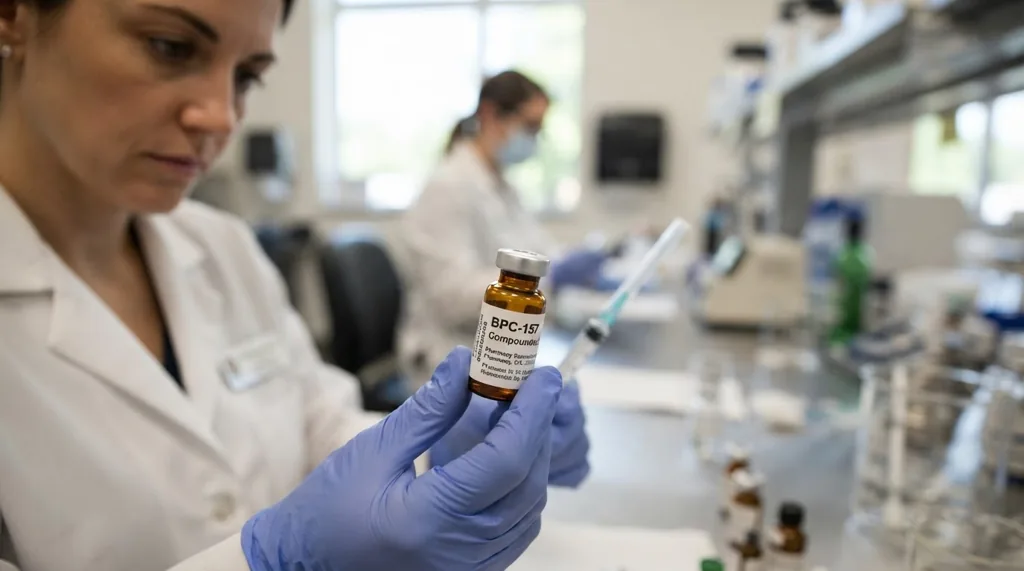
HHS will not act against pharmacies compounding six peptides that meet 10 conditions. Comments are due two weeks after Oct. 30, 2026.
The US Department of Health and Human Services (HHS) will not take action against pharmacies that compound six peptides under strict conditions. Comments on the policy are open for 2 weeks after its Oct. 30, 2026 publication.
HHS published a notice in the Federal Register announcing an interim enforcement policy for six peptide ingredients used in compounded drugs1. It covers state-licensed pharmacies, federal facilities and licensed physicians that mix these drugs for individual patients2. The policy applies while the Food and Drug Administration (FDA) builds the official list of allowed ingredients through formal rulemaking1.
| At a glance | Details |
|---|---|
| What was published | Interim enforcement policy, announced as a draft notice |
| Published on | 30 October 2026 |
| Who can comment / Who must comply | State-licensed pharmacies, federal facilities and licensed physicians that compound drugs |
| Feedback deadline / Effective date | Comments due 2 weeks after 30 October 2026 |
| Final rules / Next milestone | FDA rulemaking on the list of allowed ingredients |
What is the peptide policy, and why does it matter?
Compounding means a licensed pharmacist or physician mixes or alters ingredients to make a medicine for one patient2. Compounded drugs are not FDA-approved, so the FDA does not review their safety, effectiveness or quality before sale2. Under federal law, pharmacies may only use bulk ingredients that meet set standards, are part of approved drugs, or appear on an official list2.
The six peptides covered here meet none of those tests yet. HHS says the policy will discourage the widespread use of research-use-only peptides supplied by foreign manufacturers that pose a safety risk to US patients2. It calls the policy a more controlled alternative that advances patient choice while protecting safety2.
Which six peptides are covered?
The policy lists the peptides in its Appendix A2. Each one may be used only in certain forms, set out in Appendix B2.
| Peptide | Allowed forms |
|---|---|
| BPC-157 acetate | Injection under the skin or into muscle, oral and topical |
| TB-500 acetate | Injection under the skin or into muscle |
| Epitalon acetate | Injection under the skin or into muscle, in intermittent courses |
| Semax free base | Nasal use |
| KPV acetate | Topical and oral |
| MOTS-c acetate | Injection under the skin or into muscle |
All six were on the FDA’s "Category 2" list from September 2023 until April 22, 20262. FDA’s drug review center recommended against listing each of them. The Pharmacy Compounding Advisory Committee, an expert panel that advises FDA, voted in favor2.
What pharmacies must do to qualify
HHS will hold back enforcement only when all 10 conditions are met2. The main ones are:
- The ingredient must come from a facility registered with the FDA, with a valid certificate of analysis2.
- The original manufacturer must be FDA-registered and follow good manufacturing rules, with its location listed on the certificate2.
- Each compounded product may contain only one active ingredient from the list2.
- The only delivery device allowed is an FDA-cleared syringe2.
- Labels must state: "This is a compounded drug product. Not for resale."2
- Each drug still needs a valid prescription for a specific patient2.
For oral products, the pharmacy must keep records showing the patient’s body absorbs enough of the peptide2. HHS says oral absorption of peptides is inherently difficult2.
Testing and reporting duties
The certificate of analysis must show test results for identity, purity and strength2. It must also cover harmful contaminants such as endotoxins, heavy metals and microbes2. Appendix B sets out a testing standard listing methods for each quality check2.
Pharmacies must report serious adverse events to MedWatch, the FDA’s safety reporting program2. They must report these whether or not the drug seems to be the cause. Product quality problems, such as contamination, must also be reported, and the states involved must be informed2.
| Reporting item | What pharmacies must include |
|---|---|
| Active ingredient | Name and strength per unit |
| Original manufacturer | Name and unique facility identifier |
| Product form | Dosage form and route of use |
How long the policy lasts
The policy runs until each peptide is addressed in a final rule, either added to or left off the official list2. Future FDA rules may propose adding some or all six peptides, based on the evidence1. HHS may revisit the policy if a safety signal or quality issue arises1.
The notice says the policy creates no rights and does not bind HHS or the public1. Comments go to Docket No. HHS-OASH-2026-0496 on regulations.gov1.
Key terms in plain words
| Term | Meaning |
|---|---|
| Compounding | Mixing or altering drug ingredients to make a medicine for one patient |
| Enforcement discretion | A choice by the government not to take legal action in set cases |
| 503A | The section of US drug law covering pharmacy compounding |
| Bulk drug substance | The raw active ingredient used to make a medicine |
| Certificate of analysis | A lab report confirming an ingredient’s identity, purity and testing |
| MedWatch | The FDA’s program for reporting drug safety problems |
Public comments on the policy are due 2 weeks after its Oct. 30, 2026 publication in the Federal Register1.
Sources
- ↩ Federal Register :: Enforcement Discretion Policy Regarding 503A Compounding Using Certain Peptide Bulk Drug Substances https://www.federalregister.gov/documents/2026/10/30/2026-22192/enforcement-discretion-policy-regarding-503a-compounding-using-certain-peptide-bulk-drug-substances
- ↩ hhs-503a-peptide-enforcement-discretion-policy-appendix-b.pdf https://www.hhs.gov/sites/default/files/hhs-503a-peptide-enforcement-discretion-policy-appendix-b.pdf