

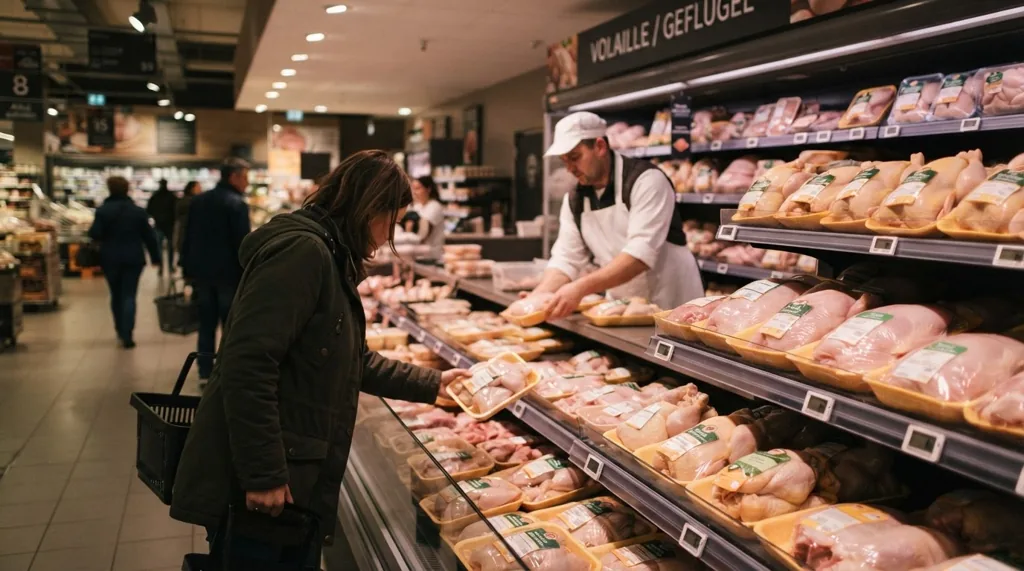
The EU has suspended poultry imports from 14 new bird flu zones in Canada, the UK and the US, from 30 October 2026.
The European Commission has stopped imports of poultry, hatching eggs and poultry meat from 14 new bird flu zones in Canada, the United Kingdom and the United States. At the same time, it has reopened five zones in South Dakota, with the change taking effect on 30 October 2026.
The Commission published Implementing Regulation (EU) 2026/2466 in the Official Journal of the European Union on 29 October 20261. It updates the EU lists of non-EU countries and zones that may send live poultry, poultry breeding material and fresh poultry and game bird meat into the EU1. The rules enter into force the day after publication, and the Commission says they take effect as a matter of urgency1.
| At a glance | Details |
|---|---|
| What was published | Final implementing regulation amending EU import lists |
| Published on | 29 October 2026 |
| Who must comply | EU importers and border controls handling poultry products from Canada, the UK and the US |
| Effective date | 30 October 2026 (day after publication) |
| Next milestone | Further list updates as outbreaks are reported or zones recover |
Why the EU acted on bird flu
The trigger is highly pathogenic avian influenza (HPAI), a severe and fast-spreading form of bird flu2. The Commission’s food safety service notes that HPAI can cause severe disease and death in flocks2. Wild birds carry the virus and play a major role in spreading it2.
EU animal health law only lets animals and animal products enter the EU from listed countries or zones1. When an exporting country reports outbreaks, the Commission can suspend entry from the affected area. It did so here to protect the health of animals in the EU1.
The new outbreaks behind the ban
Canada reported four new outbreaks in poultry in Alberta and Manitoba, confirmed between 8 and 18 October 20261. The United Kingdom reported one outbreak in Northumberland, England, confirmed on 19 October 20261. The United States reported nine new outbreaks across eight states, confirmed between 9 and 22 October 20261.
| Country | New suspended zones |
|---|---|
| Canada | 4 zones in Alberta and Manitoba |
| United Kingdom | 1 zone near Belford, Northumberland |
| United States | 9 zones in Illinois, Kansas, Minnesota, Nebraska, North Dakota, South Dakota, Washington and Wisconsin |
Veterinary authorities in all three countries set up restricted zones of at least 10 km around the affected farms1. They also applied a stamping-out policy, which means culling infected flocks to stop the disease1.
What changes for importers
Each new zone is added to two annexes of Implementing Regulation (EU) 2021/404, the EU’s master list of approved sources1. Annex V covers live poultry and poultry germinal products, such as hatching eggs1. Annex XIV covers fresh meat of poultry and game birds1.
Each zone entry carries the date the outbreak was confirmed1. Consignments from those zones are suspended in line with those dates1. The US zones cover single counties, including Kandiyohi and Roseau in Minnesota and Barron in Wisconsin1.
| Product group | Where the rule sits |
|---|---|
| Live poultry and hatching material | Annex V of Regulation 2021/404 |
| Fresh poultry and game bird meat | Annex XIV of Regulation 2021/404 |
South Dakota zones reopen
The regulation also lifts earlier bans on five South Dakota zones1. Those outbreaks were confirmed between 12 August and 9 September 20261. The United States sent updated information on them on 16 October 20261.
The United States told the Commission it had culled the infected flocks and completed cleaning and disinfection1. The Commission found the situation no longer a threat to animal or public health in the EU1. Imports from those zones are authorised again, to avoid unnecessary disruption to trade with the United States1.
| Reopened zone | Outbreak date | Closing date in the list |
|---|---|---|
| US-2.1402 | 12 August 2026 | 26 September 2026 |
| US-2.1403 | 20 August 2026 | 5 October 2026 |
| US-2.1405 | 27 August 2026 | 5 October 2026 |
| US-2.1408 | 9 September 2026 | 18 October 2026 |
| US-2.1409 | 9 September 2026 | 19 October 2026 |
How EU bird flu controls work
Inside the EU, a confirmed outbreak triggers culling on the infected farm2. Authorities must set a protection zone of at least 3 km and a surveillance zone of at least 10 km around it2. The Commission lists restricted zones inside the EU through separate emergency decisions2.
The Standing Committee on Plants, Animals, Food and Feed, a panel of national experts, backed this regulation1. The Commission says it can adopt further emergency measures through that committee if needed2.
Key terms in plain words
| Term | Meaning |
|---|---|
| HPAI | Highly pathogenic avian influenza, a severe and deadly type of bird flu |
| Implementing regulation | A binding EU rule adopted by the Commission to apply an existing law |
| Germinal products | Breeding material such as hatching eggs |
| Stamping-out | Culling infected animals to stop a disease spreading |
| Restricted zone | An area around an outbreak where movements are limited |
| Third country | Any country outside the EU |
The changes apply across all EU member states from 30 October 20261.
Sources
- ↩ L_202602466EN.000101.fmx.xml https://eur-lex.europa.eu/legal-content/EN/TXT/HTML/?uri=OJ:L_202602466
- ↩ Avian influenza – Food Safety – European Commission https://food.ec.europa.eu/animals/animal-diseases/diseases-and-control-measures/avian-influenza_en