

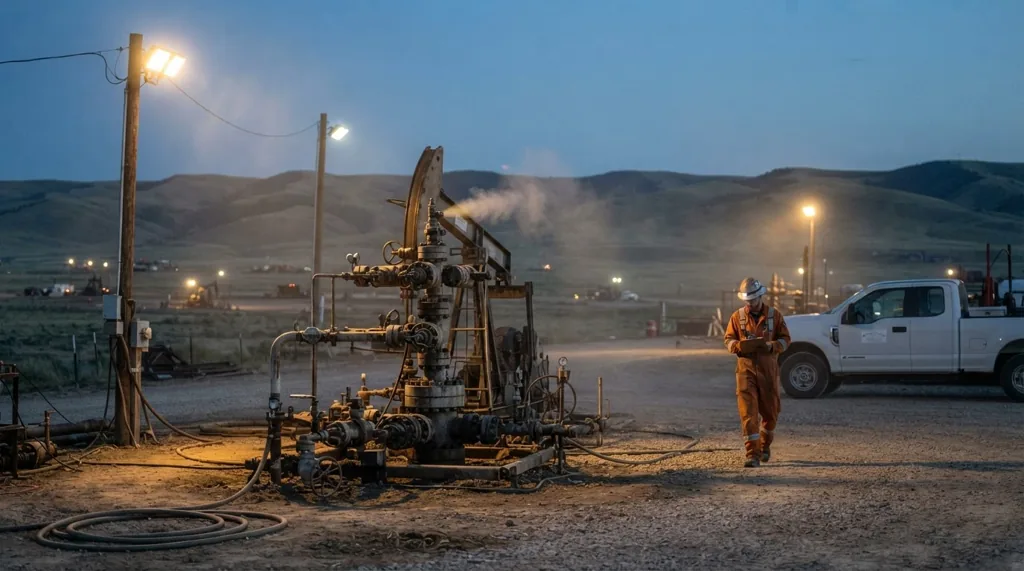
The EPA proposed scrapping the Super Emitter Program and easing 2024 oil and gas emission rules. Comments are due Dec. 16, 2026.
The US Environmental Protection Agency (EPA) has proposed new rollbacks to its 2024 methane and air pollution rules for oil and gas sites. The public can comment until Dec. 16, 2026.
The proposed rule appeared in the Federal Register on Oct. 29, 20261. It would scrap the Super Emitter Program, set separate rules for low-producing wells, and loosen several equipment requirements1. The EPA will hold a virtual public hearing 15 days after publication, before it writes final rules2.
| At a glance | Details |
|---|---|
| What was published | Proposed rule amending the 2024 oil and gas air standards |
| Published on | 29 October 2026 |
| Who can comment / Who must comply | Oil and natural gas well owners and operators, states and the public |
| Feedback deadline / Effective date | 16 December 2026 (comments) |
| Final rules / Next milestone | Virtual public hearing 15 days after publication |
What is the EPA changing, and why?
The proposal revises two sets of Clean Air Act rules for the crude oil and natural gas industry1. One covers new and modified sources, called NSPS OOOOb. The other guides states on existing sources, called EG OOOOc2.
The EPA says it is responding to petitions for reconsideration, which are formal requests to revisit a rule, filed against the March 2024 amendments1. It also cites policy decisions, legal interpretations and the need to correct the rule text1. The notice runs to 128 pages under docket EPA-HQ-OAR-2025-01631.
The agency estimates the proposal would save $45 billion in costs for consumers and businesses3. It also expects an extra 210 million barrels of oil and 1.41 trillion cubic feet of natural gas to be produced3. When the 2024 rules were finalized, their cost was estimated at $18 billion3.
Ending the Super Emitter Program
The Super Emitter Program certified outside monitors to report very large leak events, and required states to do the same3. The EPA now proposes to rescind the program1.
The agency says the program is not needed to meet Clean Air Act requirements and is not effective2. It also says the legal authority cited in the 2024 rule is inadequate to keep the program2. Other parts of the 2024 rule already give operators timely information to find and fix big leaks, the agency argues2.
Separate rules for low-producing wells
The EPA is putting forward two options for splitting well sites into groups with their own standards3. The aim is to make the rules workable for different types of wells3.
Marginal wells, also called stripper wells, are low-producing oil and gas wells2. The EPA says they make up roughly four in five producing wells in the country3.
What changes for gas flaring and equipment
Associated gas is the natural gas that comes up from wells drilled mainly for oil. The 2024 rules required all of it to reach a sales line3. The EPA now proposes to restore 95% efficient flaring or other control devices as the best emission control method instead3.
Other proposed changes cover several types of equipment:
| Area | What the proposal would do |
|---|---|
| Covers and closed vent systems | Split the "no identifiable emissions" standard into design and operating requirements, with room for repairs3 |
| Control devices | Allow flexibility for flame monitoring gaps, device alerts and visible emissions tests3 |
| Other equipment | Revise rules for liquids unloading, process controllers and pumps2 |
| Rule text | Make technical corrections2 |
The proposal also covers fugitive emissions, storage vessels and equipment leaks at gas processing plants1.
Further cuts the EPA may consider
Beyond the formal proposal, the EPA seeks comment on repealing other parts of the 2024 rule2. These include process controller standards and leak monitoring at gas processing plants2. Recordkeeping and reporting duties are also on the list2.
This is the latest in a series of steps since the EPA announced a full reconsideration on March 12, 20253. Earlier actions extended compliance deadlines and revised temporary flaring rules3.
| Key date | What happens |
|---|---|
| March 12, 2025 | EPA announces full reconsideration of the 2024 rule3 |
| July 31, 2025 | Interim rule extends several compliance deadlines3 |
| April 6, 2026 | EPA finalizes changes on temporary flaring of associated gas3 |
| Oct. 27, 2026 | EPA announces the new proposal3 |
| Oct. 29, 2026 | Proposal published in the Federal Register1 |
| Nov. 30, 2026 | Paperwork comments due to the Office of Management and Budget1 |
| Dec. 16, 2026 | Public comment deadline1 |
How to comment
Comments go to docket EPA-HQ-OAR-2025-0163 on Regulations.gov, or by mail or courier to the EPA Docket Center2. Comments must arrive by Dec. 16, 20261.
Comments on the record-keeping paperwork are best sent to the Office of Management and Budget (OMB) by Nov. 30, 20261. The EPA will post hearing details on its oil and gas web page2.
Key terms in plain words
| Term | Meaning |
|---|---|
| NSPS OOOOb | Federal emission limits for new or modified oil and gas sources |
| EG OOOOc | Federal guidelines states use to set limits for existing oil and gas sources |
| Super Emitter Program | A system for outside monitors to report very large methane leaks |
| Marginal well | A low-producing oil or gas well, also called a stripper well |
| Associated gas | Natural gas that comes up with oil from an oil well |
| Flaring | Burning off gas at the site instead of selling it |
Public comments on the proposal are due by Dec. 16, 20261.
Sources
- ↩ Federal Register :: Additional Reconsideration Standards of Performance for New, Reconstructed, and Modified Sources and Emissions Guidelines for Existing Sources: Oil and Natural Gas Sector Climate Review https://www.federalregister.gov/documents/2026/10/29/2026-22082/additional-reconsideration-standards-of-performance-for-new-reconstructed-and-modified-sources-and
- ↩ Technical Fact Sheet for October 2026 Oil and Natural Gas Proposed Reconsideration https://www.epa.gov/system/files/documents/2026-10/technical_factsheet_o-g_recon2_nprm_10.26.pdf
- ↩ EPA Proposes Major New Revisions to Burdensome, Unworkable Biden-era Oil and Natural Gas Regulations | US EPA https://www.epa.gov/newsreleases/epa-proposes-major-new-revisions-burdensome-unworkable-biden-era-oil-and-natural-gas