

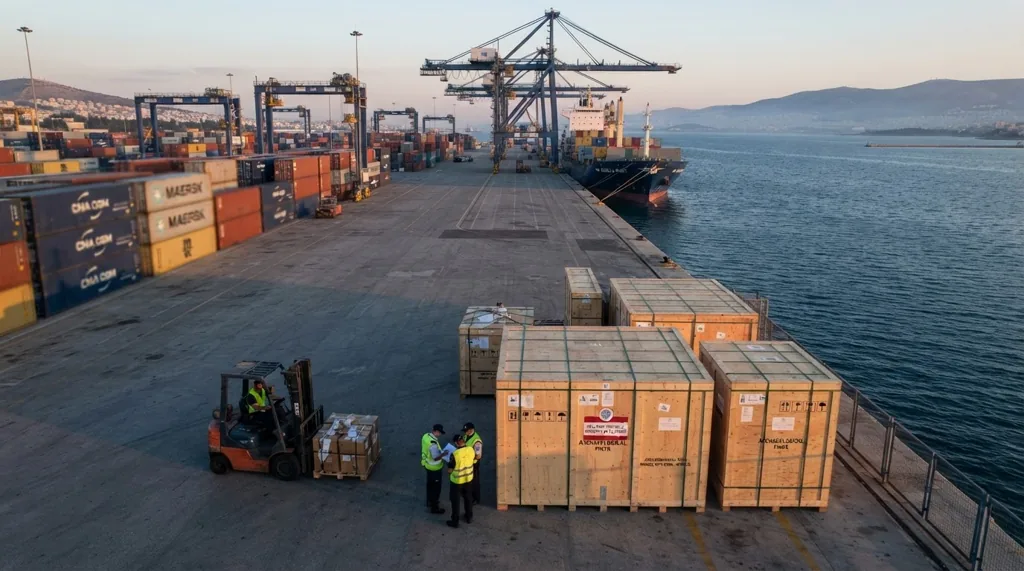
US Customs and Border Protection extended import limits on Greek antiquities and church objects for five years, effective Nov. 21, 2026.
US Customs and Border Protection (CBP) has extended its import limits on Greek antiquities and religious objects for five more years. The limits now run until Nov. 21, 2031, and the extension took effect on Nov. 21, 2026.
CBP, the US border and customs agency, published the final rule in the Federal Register on Nov. 20, 20261. It applies to anyone bringing covered archaeological or church objects from Greece into the United States. The rule took effect without a public comment period, because CBP treats it as a foreign affairs matter1.
| At a glance | Details |
|---|---|
| What was published | Final rule, CBP Decision 26-20 |
| Published on | 20 November 2026 |
| Who must comply | Importers of covered Greek archaeological and church objects |
| Effective date | 21 November 2026 |
| Next milestone | Restrictions expire 21 November 2031 unless extended again |
What is this rule, and why does it matter?
The rule keeps in place a ban on importing certain Greek cultural objects without proper paperwork. The goods include archaeological objects from about the 3rd millennium B.C. to the 15th century A.D.1. They also include church objects from the early Christian, Byzantine and post-Byzantine periods, made from A.D. 324 through 18301.
The two numbers that bind
The limits rest on the Convention on Cultural Property Implementation Act (CPIA), a US law1. That law carries out a 1970 treaty of the United Nations Educational, Scientific and Cultural Organization (UNESCO) against illegal trade in cultural property1. Under the law, each round of restrictions lasts no more than five years1.
How the US and Greece reached this point
The two countries first signed a memorandum of understanding (MOU), a formal bilateral agreement, on July 17, 20111. It entered into force on Nov. 21, 2011. CBP then extended the limits in 2016 and again in 20211.
The 2021 round replaced the first agreement with a new MOU. It also added certain Byzantine and Medieval coins and post-Byzantine church objects up to A.D. 18301.
| Key date | What happens |
|---|---|
| 17 July 2011 | US and Greece sign the first MOU |
| 21 November 2011 | First MOU enters into force |
| 23 November 2016 | CBP extends limits to 21 November 2021 |
| 22 November 2021 | CBP extends limits to 21 November 2026 |
| 21 November 2026 | New five-year extension takes effect |
The steps behind the 2026 extension
The US Department of State proposed the extension in the Federal Register on Jan. 26, 20261. Its Cultural Property Advisory Committee, an expert panel, then met on March 3-5, 2026 to review it2. The committee also reviewed proposed extensions for Bolivia and Egypt at that meeting2.
How the extension was made
On Aug. 10, 2026, a senior State Department official made the legal findings needed to extend the deal1. The two governments signed the extension agreement on Oct. 7, 20261. A joint statement from the US-Greece Strategic Dialogue that day confirmed the signing3.
What changes for importers and collectors
In practice, little changes on the ground. The same list of restricted objects stays in force, now through Nov. 21, 20311. That list, called the Designated List, was set out in CBP Decision 21-161.
The rule at a glance
| Dimension | Provision |
|---|---|
| Issuer | US Customs and Border Protection, CBP Decision 26-20 |
| Goods covered | Greek archaeological objects and church objects on the Designated List |
| Entry condition | Must meet CPIA section 2606 and CBP section 12.104c |
| In force | 21 November 2026 to 21 November 2031 |
Covered objects from Greece can enter the United States only if they meet the conditions in the CPIA and CBP rules1. Those conditions are in section 2606 of the law and section 12.104c of CBP’s regulations1. The State Department also publishes the Designated List on its website1.
The rule updates one entry in the CBP regulations, section 12.104g(a)1. That entry now reads "CBP Dec. 21-16, extended by CBP Dec. 26-20"1.
Why there was no public comment period
CBP issued the rule without advance notice or public comment1. It said the rule involves a foreign affairs function, so normal notice rules do not apply1. For the same reason, it did not delay the effective date1.
CBP also said the rule is exempt from cost-benefit review under Executive Order 128661. It did not prepare a small business impact analysis, because no proposed rule was required1.
Key terms in plain words
| Term | Meaning |
|---|---|
| CBP | US Customs and Border Protection, the agency that controls goods entering the country |
| MOU | Memorandum of understanding, a formal agreement between two governments |
| CPIA | The US law that lets the government limit imports of foreign cultural objects |
| Designated List | The official list of Greek objects covered by the import limits |
| Ecclesiastical ethnological material | Religious and church objects tied to a culture’s heritage |
| Final rule | A binding change to federal regulations |
The import limits on Greek cultural objects now stay in force until Nov. 21, 20311.
Sources
- ↩ Federal Register :: Extension of Import Restrictions Imposed on Archaeological and Ethnological Material of Greece https://www.federalregister.gov/documents/2026/11/20/2026-23724/extension-of-import-restrictions-imposed-on-archaeological-and-ethnological-material-of-greece
- ↩ Cultural Property Advisory Committee Meeting, March 3-5, 2026 – United States Department of State https://www.state.gov/cultural-property-advisory-committee-meeting-march-3-5-2026
- ↩ Joint Statement on the U.S.-Greece Strategic Dialogue – United States Department of State https://www.state.gov/releases/office-of-the-spokesman/2026/10/joint-statement-on-the-u-s-greece-strategic-dialogue