

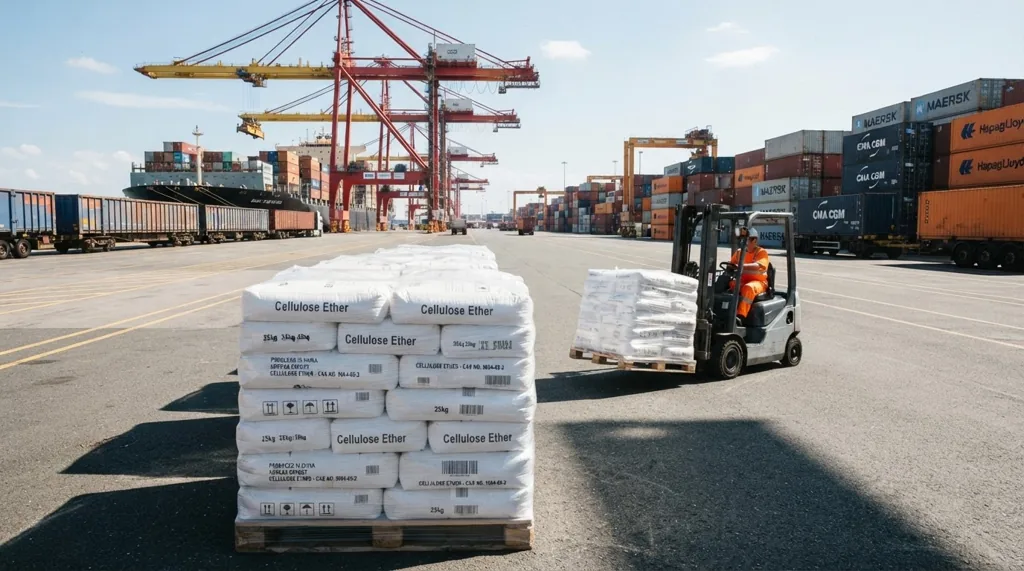
The EU now registers cellulose ether imports from China and South Korea, so anti-dumping duties could later be charged retroactively.
The European Commission has ordered customs authorities to register imports of certain cellulose ethers from China and South Korea. Registration lets the EU later charge anti-dumping duties on these goods back to their arrival date, if its investigation justifies it.
The measure is Commission Implementing Regulation (EU) 2026/2391, adopted on 29 October 2026 and published in the Official Journal on 30 October 20261. It enters into force the day after publication, and registration ends nine months after that1. It is part of an anti-dumping investigation the Commission opened on 24 September 20262.
| At a glance | Details |
|---|---|
| What was published | Implementing regulation ordering import registration |
| Published on | 30 October 2026 |
| Who must comply | Importers of six cellulose ethers from China and South Korea, and EU customs authorities |
| Effective date | Day after publication in the Official Journal |
| Next milestone | Commission decision on definitive duties, which will assess any backdated charge |
What are cellulose ethers, and why does this matter?
Cellulose ethers are chemicals made from wood pulp. The regulation covers six types: methyl cellulose, hydroxyethyl cellulose, hydroxyethyl methyl cellulose, hydroxypropyl methyl cellulose, ethyl hydroxyethyl cellulose and methyl ethyl hydroxyethyl cellulose1. It applies regardless of colour, physical form, or grade1.
The goods fall under customs code ex 3912 39 851. Dumping means selling exports below their fair price in the home market. Three EU producers complained that Chinese and Korean imports were dumped and were hurting EU industry2.
Why the Commission ordered registration
Registration is a record-keeping step at the border. Its purpose is to make sure duties, if any, can be levied retroactively on registered imports1. In plain terms, goods entering now could face a bill later.
What the registration rule does
| Provision | What it says |
|---|---|
| Products | Six cellulose ethers, code ex 3912 39 85 |
| Origin | China and South Korea |
| Who acts | EU customs authorities register imports |
| Purpose | Allow duties to be levied retroactively |
| Duration | Nine months from entry into force |
The Commission acted on its own initiative1. Whether backdated duties are actually charged will be decided in the regulation that sets definitive duties1. Any future liability will depend on the findings of the investigation1.
How big could the duties be?
The complaint gave early estimates. It put dumping margins at 120% to 130% for China and 45% to 55% for Korea1. It estimated the level needed to remove the harm at 120% to 140% for China and 40% to 60% for Korea1.
| Complaint estimates | China | Korea |
|---|---|---|
| Dumping margin | 120% to 130% | 45% to 55% |
| Level to remove harm | 120% to 140% | 40% to 60% |
A duty would normally be set at the lower of the two levels1. The Commission stresses that it cannot yet estimate any future liability. The complaint figures are for information only and create no expectations about the final duty1.
The raw material question for China
The complaint also alleged distorted raw material costs in China. Chemical wood pulp makes up more than 17% of production costs, according to the complaint2. It said the pulp is affected by a withdrawal of a value added tax (VAT) refund in China2.
If the Commission finds such distortions, the duty could be set at the full dumping margin1. That would apply only if a lower duty would not be enough to remove the harm to EU industry1.
Who brought the case and what is under review
The complaint was lodged on 10 August 20261. It came from Ashland Industries Nederland BV, Ashland Specialties Belgium BV and SE Tylose GmbH & Co. KG, on behalf of EU producers1.
The case so far
The investigation covers sales from 1 April 2025 to 31 March 20262. Trends in harm to EU industry are examined from 1 January 2022 to the end of that period2. The complainants say imports from both countries rose in volume and market share2.
| Key date | What happens |
|---|---|
| 10 August 2026 | Complaint lodged by three EU producers |
| 24 September 2026 | Commission opens the investigation |
| 29 October 2026 | Registration regulation adopted |
| 30 October 2026 | Regulation published in the Official Journal |
| Nine months after entry into force | Registration expires |
What changes for importers now
From entry into force, customs authorities must register each import of the listed products from China and South Korea1. No duty is charged at this stage. But importers now carry the risk of a later, backdated charge if definitive duties are imposed1.
Personal data collected during registration will be handled under the EU’s data protection rules for its own institutions, Regulation (EU) 2018/17251.
Key terms in plain words
| Term | Meaning |
|---|---|
| Anti-dumping duty | An extra import tax on goods sold abroad below their fair price |
| Registration | Customs keeps a record of imports so duties can be charged on them later |
| Retroactive levy | Charging a duty on goods that arrived before the duty was set |
| Dumping margin | How far the export price falls below the fair price |
| Definitive duties | The final duties set at the end of an investigation |
| CN code | The EU’s customs classification number for a product |
Registration runs for nine months from the regulation’s entry into force, while the Commission decides on duties1.
Sources
- ↩ Implementing regulation – EU – 2026/2391 – EN – EUR-Lex https://eur-lex.europa.eu/eli/reg_impl/2026/2391/oj/eng
- ↩ EUR-Lex – 52026XC04924 – EN – EUR-Lex https://eur-lex.europa.eu/legal-content/EN/TXT/?uri=OJ:C_202604924