

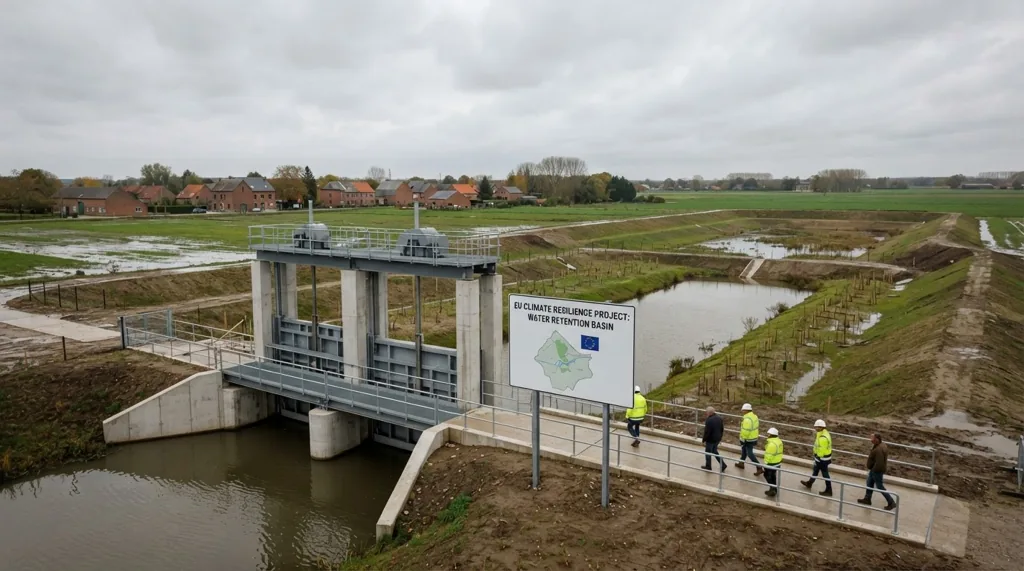
The European Commission proposed a Climate Resilience Law requiring EU governments to plan for 2 °C warming by 2050 using one strategic plan.
The European Commission has proposed a European Climate Resilience Law that gives all EU countries one shared warming outlook for planning against climate risks. Governments would plan for warming of 2 °C by 2050 and replace scattered national plans with one single strategic plan.
The Commission presented the law on 26 October 2026 as part of a wider EU Framework for Climate Resilience1. The proposal is a regulation, an EU law that applies directly in every member state without being copied into national law2. It is dated 27 October 2026 and now goes to the European Parliament and the Council of the EU, the body of national governments2.
| At a glance | Details |
|---|---|
| What was published | Proposed regulation, COM(2026) 730, the European Climate Resilience Law |
| Published on | 27 October 2026 (presented 26 October 2026) |
| Who must comply | EU member state governments and public authorities. Private firms are not directly covered |
| Feedback deadline / Effective date | Not set. The law must first be agreed by the Parliament and the Council |
| Final rules / Next milestone | Implementation Plan within six months of adoption. EU strategic plan in 2028 |
What is the Climate Resilience Law, and why now?
The law aims to make planning ahead for climate risks the norm at every level of government2. Today, member states use different warming assumptions, scenarios and assessment cycles2. The Commission says this makes risks hard to compare and leaves preparedness uneven across the EU2.
The cost of damage is rising. Estimated losses from climate damage in 2022 to 2025 were about €200 billion, or €50 billion per year1. Preliminary data show more than 35,000 heat-related deaths after Europe’s 2026 heatwaves3.
| Climate risk by the numbers | Details |
|---|---|
| Climate damage losses, 2022 to 2025 | About €200 billion, or €50 billion a year1 |
| Output losses from 2026 heatwaves | €113 billion3 |
| Yearly investment needed for resilience | Around €70 billion4 |
| Return on adaptation spending | More than 10 times its value in avoided damage1 |
| Global market for resilience solutions by 2050 | €3.5 trillion1 |
The common warming trajectory
At the core of the law is a common reference trajectory for global warming1. It assumes the world warms by 1.5 °C above pre-industrial levels by 2030, 2 °C by 2050 and 3 °C by 21001. Member states would use this shared baseline when they assess future climate risks and make decisions1.
A new online map, the European Climate Viewer, will show what this trajectory means for different parts of Europe2. The European Centre for Medium-Range Weather Forecasts (ECMWF), a weather research body, built the viewer1. Countries can still build their own national scenarios from the shared baseline2.
What changes for national governments
The proposal sets out five core elements for governments2:
- a shared warming trajectory for risk assessments and planning
- named "policy risk owners", the bodies responsible for each climate risk
- better and more regular climate risk assessments
- one single strategic plan on climate resilience, for the Commission and each member state
- simpler monitoring and progress tracking
The single plan would merge four separate planning elements into one document2. Countries could use it to meet their duties under this law, the European Climate Law and the Governance Regulation, the EU law on national energy and climate planning4. Article 14 of the proposal deletes overlapping adaptation duties from the Governance Regulation2.
The Commission says it is not adding new reporting duties2. Countries would keep reporting on adaptation under Article 19 of the Governance Regulation2. The Commission would then review each country’s progress through the European Semester, the EU’s yearly cycle of economic policy checks2.
What it means for businesses
Private firms are not directly subject to the proposal2. The Commission says it wants to raise company awareness of climate risks and help firms use resilience solutions2. Clearer public plans should help businesses understand their exposure and protect assets and operations4.
Member states could support company investment in resilience through tax or State aid measures, meaning government subsidies4. The Commission will also set up a Climate Insurance Alliance to narrow gaps in insurance cover for natural disasters4. The European Investment Bank Group has pledged at least €30 billion for climate resilience by 20304.
New tools for planners and companies
The framework adds three online tools for public authorities, businesses and communities1. They sit on a European online platform for climate resilience1.
| Tool | What it does |
|---|---|
| European Climate Viewer | Interactive map of projected climate hazards across Europe1 |
| Navigator of Climate Resilience Tools | Helps users find tools by location, sector and risk, run by the European Environment Agency (EEA)1 |
| Mission Solutions Explorer | Shows tested adaptation projects from the EU Mission on Adaptation to Climate Change1 |
Transition timeline and key deadlines
No date of entry into force is set yet, because lawmakers must first agree the text2. The Commission has set out later steps once the law is adopted4.
| Key date | What happens |
|---|---|
| 26 October 2026 | Commission presents the framework and the proposed law1 |
| Within six months of adoption | Commission puts forward an Implementation Plan4 |
| 2028, then every five years | Commission presents an EU strategic plan on climate resilience4 |
| From 2030 | Eurostat, the EU statistics office, is expected to collect data on economic losses caused by climate change2 |
The Commission will also present a European Heatwave Plan and a European Water initiative separately1.
Key terms in plain words
| Term | Meaning |
|---|---|
| Climate resilience | The ability to prepare for, cope with and recover from climate impacts |
| Reference warming trajectory | One shared forecast of how much the planet will warm, used by all planners |
| Policy risk owner | The public body responsible for managing a given climate risk |
| Single strategic plan | One national plan replacing several separate climate adaptation plans |
| Governance Regulation | The EU law that sets how countries plan and report on energy and climate |
| European Semester | The EU’s yearly review of national economic and budget policies |
The next official milestone is the Commission’s first EU strategic plan on climate resilience, due in 20284.
Sources
- ↩ Commission presents Climate Resilience Framework for a better prepared and protected Europe https://ec.europa.eu/commission/presscorner/detail/en/ip_26_2244
- ↩ dc70f56e-0b44-4a7a-b3ba-5cda2d378016_en https://climate.ec.europa.eu/document/download/dc70f56e-0b44-4a7a-b3ba-5cda2d378016_en?filename=com_2026_730_en.pdf
- ↩ EU Framework for Climate Resilience – Climate Action – European Commission https://climate.ec.europa.eu/areas-action/adaptation-and-resilience-climate-change/eu-framework-climate-resilience_en
- ↩ Questions and answers on the EU Climate Resilience Framework https://ec.europa.eu/commission/presscorner/detail/en/qanda_26_2245