

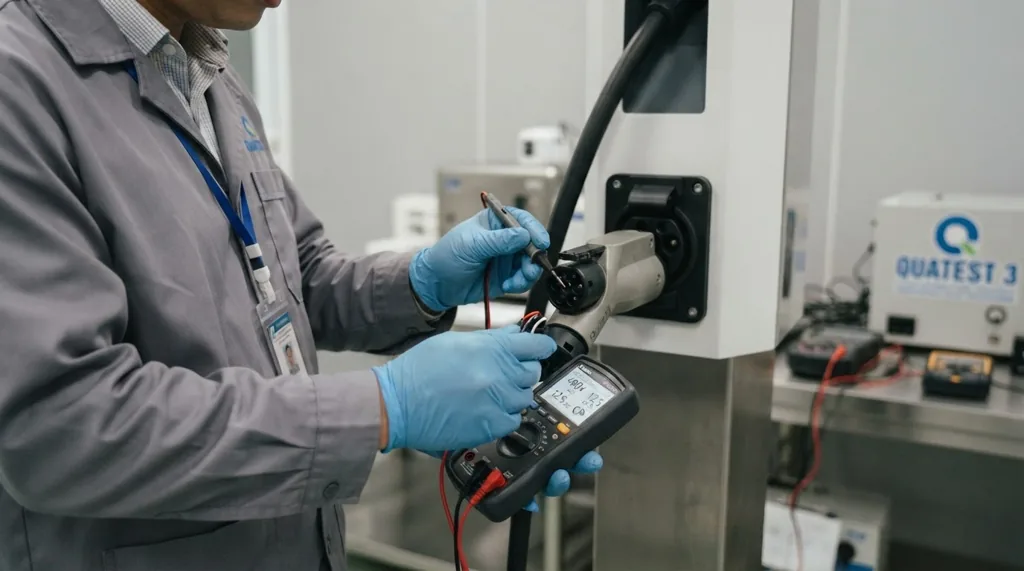
Viet Nam will require public EV charging stations to meet national safety, power and data rules and serve all compatible vehicles from July 1, 2027.
Viet Nam’s Ministry of Industry and Trade has issued national technical rules for electric vehicle charging equipment and charging stations, covering makers, importers, investors and operators, from July 1, 20271.
The rules come in Circular 61/2026/TT-BCT, signed on Sept. 29, 2026, together with a national technical regulation coded QCVN 32:2026/BCT1. A national technical regulation is a set of mandatory minimum standards that products and facilities must meet.
In short, public charging stations in Viet Nam must meet one set of safety, power and data rules and be able to charge any vehicle with a compatible plug. Existing stations can keep running but must check and fix safety gaps on a fixed timetable.
Who must follow the charging rules?
The regulation applies to firms and individuals that make, assemble, import, distribute or sell charging posts2. It also covers station investors, designers, builders, installers, managers and operators. Power suppliers, grid dispatchers, testing and certification bodies and state agencies are named as well1.
Highest rated voltage covered, volts
It covers stations in public places, central parking areas, highway rest stops and similar sites3. The equipment in scope charges road electric vehicles, including fully electric cars and plug-in hybrids. It is limited to equipment rated up to 1,000 V for alternating current (AC) or 1,500 V for direct current (DC)1.
Several kinds of equipment are left out:
- stations located inside buildings, such as basements, half-basements and indoor car parks
- wireless chargers and chargers built into vehicles
- equipment for railways, off-road special vehicles and industrial vehicles
- posts used only for testing, research, display or training
- stations serving only an owner’s own needs, without a commercial charging service
Stations outdoors or under a standalone roof that only shields against rain and sun are not treated as indoor stations, so they stay covered1. The power grid on the supply side of a station’s connection point is also outside the rules.
Must stations serve all compatible vehicles?
Yes. The regulation says a station must be technically able to serve any road electric vehicle whose charging port matches the station’s plug types, charging modes and technical setup1. This is the shared-use principle at the core of the rules3.
Compatibility is judged by plug type, charging mode, voltage and current range, communication functions and safety interlocks1. Each post’s technical file must name the plug standard and version, electrical specifications and any software version that affects compatibility.
For each configuration it declares, a post must be able to start, maintain and end a charging session. Test results must be kept. Control functions must not restrict declared compatibility when technical, authentication and safety conditions stay the same1.
What safety and data rules apply to stations?
The posts themselves fall into three types: AC, DC and combined AC-DC2. They must protect against electric shock, overload and short circuits, and meet rules on electromagnetic interference, communication, labelling and user instructions.
Each post’s label must show the maker, model, input and output voltage and current, output power, protection rating, operating temperature and year of manufacture1. The user screen must be in Vietnamese, and makers and importers must supply installation and user guides in Vietnamese.
At the station level, the regulation sets rules for electrical safety, fire prevention, site layout, safety distances, power supply, electricity metering, load management, monitoring and data management2. A station’s total power use must not exceed its connection point or the capacity of its internal distribution system.
Stations must not block entrances, escape routes or fire engine access1. Charging areas need signs, electrical safety warnings and operating instructions. Every station must have an emergency power cut-off, and power may only be restored once the cause has been checked1.
Monitoring systems must collect and display operating status, fault alerts and electrical readings2. Data on operations, incidents, metering, payments and user complaints must be stored, retrievable and protected. The ministry’s research institute notes that stations must also ensure cybersecurity and protect users’ personal data3.
Do chargers need certification before sale?
Charging posts made or assembled in Viet Nam, and those imported, must go through conformity certification before they go on sale3. This means testing and approval against the regulation, a public declaration of conformity and the CR conformity mark on the product.
Testing and certification for this purpose must be done by bodies designated or recognised under the law3. Before charging starts, a post must also show users at least its power, voltage and current range, plug type, instructions and safety warnings1.
How long do existing stations have to comply?
Charging posts installed legally before July 1, 2027 may stay in use1. Owners and operators must keep them safe, inspect and maintain them, and fix defects.
Stations built before July 1, 2027
| Question | Already operating | Started, not yet signed off |
|---|---|---|
| Can it run now? | Yes, during the transition | Opens only once compliant |
| What must be done? | Safety review in 6 months, fixes in 24 | Update designs for unfinished work |
Stations already operating before that date face two deadlines, counted from July 1, 20272:
- a safety review within 6 months
- all safety gaps fixed within 24 months
Any part of a station repaired, renovated, expanded or reconfigured after the rules take effect must meet the new regulation1. Stations whose construction started before July 1, 2027 but that have not yet been signed off must update designs for unfinished work. They may only open once they meet the regulation1.
What happens when a Viet Nam station poses a direct risk?
The circular defines a direct risk as one that could cause electric shock, fire, explosion, structural instability, or damage to vehicles or the electrical system if operation continues1. Such risks must be dealt with immediately, without waiting for the transition deadlines.
Handling a direct risk
The operator must warn users, stop operation or isolate the affected part, and carry out repairs1. If the part cannot be isolated safely, the whole station must shut down. The affected part may only restart after it has been fixed and checked.
The ministry’s Industry Department proposed the rules, and the Ministry of Science and Technology gave its opinion in a letter dated Sept. 23, 20261. Provincial people’s committees and ministry units are responsible for carrying out the circular. The first compliance milestone for existing stations, the 6-month safety review, falls due 6 months after the rules take effect on July 1, 2027.
Sources
- ↩ TT_61_tru___sa__c_die____n_b5124.pdf https://moit.gov.vn/upload/2005517/20261005/TT_61_tru___sa__c_die____n_b5124.pdf
- ↩ Ban hành quy chuẩn kỹ thuật quốc gia về trụ sạc, trạm sạc xe điện https://baochinhphu.vn/ban-hanh-quy-chuan-ky-thuat-quoc-gia-ve-tru-sac-tram-sac-xe-dien-102261005155514536.htm
- ↩ Bộ Công Thương chính thức ban hành Quy chuẩn kỹ thuật quốc gia về trụ sạc, trạm sạc xe điện (QCVN 32:2026/BCT) https://vioit.moit.gov.vn/vn/tin-hoat-dong-nganh/bo-cong-thuong-chinh-thuc-ban-hanh-quy-chuan-ky-thuat-quoc-gia-ve-tru-sac–tram-sac-xe-dien–qcvn-32-2026-bct–7161.4056.html