

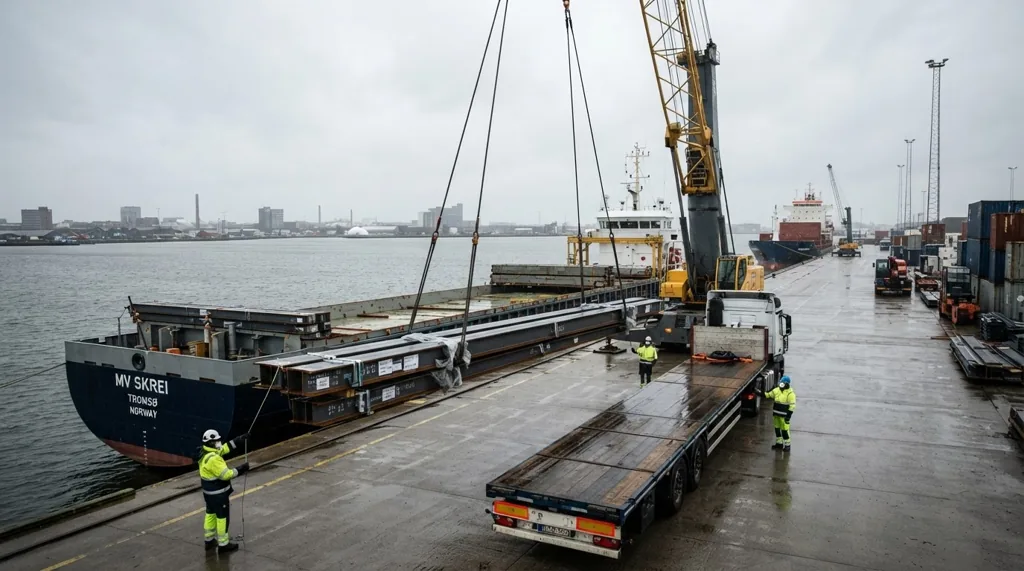
European Union Council Decision (EU) 2026/2240, in force since its adoption on 24 September 2026, sets the EU position for applying CBAM in Iceland, Liechtenstein and Norway, with EFTA importers given until 31 March 2027 to apply for authorisation under grace terms.
The Council of the European Union has set the EU’s position for extending its carbon border levy on imported steel, aluminium, fertilisers, cement, electricity and hydrogen to Iceland, Liechtenstein and Norway, in a decision dated 24 September 2026 and published on 6 Oct. 20261.
The measure is Council Decision (EU) 2026/2240. It tells EU negotiators how to vote in the EEA Joint Committee, the body that adds EU laws to the European Economic Area (EEA) Agreement1. The decision took effect on the day it was adopted1.
In short, the EU wants the Carbon Border Adjustment Mechanism, known as CBAM, to work the same way in the three EEA countries outside the EU. Importers there would face the same carbon charge, paperwork and checks as importers in the EU, under their own national customs laws.
What is the CBAM carbon border levy?
CBAM was created by Regulation (EU) 2023/956 of 10 May 20231. It puts a carbon price on certain goods brought into the EU. Importers must file a CBAM declaration and buy and hand over CBAM certificates for the emissions in those goods2.
How CBAM reached the EEA
A transitional period, with reporting only, began on 1 Oct. 2023 and ended on 1 Jan. 20262. The rules were then changed by Regulation (EU) 2025/2083 of 8 Oct. 2025, which aimed to simplify and strengthen the scheme2.
The Council decision says both regulations should become part of the EEA Agreement1. A draft Joint Committee decision attached to it sets out how1.
Which importers in Norway, Iceland and Liechtenstein are covered?
The draft extends CBAM’s reach to "the customs territories of the EFTA States", meaning the EEA members of the European Free Trade Association1. Goods entering those countries from outside the EEA would fall under the same rules as goods entering the EU.
The 2025 amendment added an exemption for small importers. Importers whose yearly imports stay under a 50 tonnes combined weight are freed from CBAM duties for that year2. The limit covers iron and steel, aluminium, fertilisers and cement together. It does not apply to electricity or hydrogen2.
An importer that goes over the limit must meet the rules for all its imports that year2. That includes getting approval as an authorised CBAM declarant before passing the threshold2. The EU set the limit so that at least 99% of embedded emissions stay covered2.
Goods already cleared for free circulation in the EU or an EFTA state would not be charged again when moved on1. The customs declarant, the party filing the customs form, must be able to show proof of that earlier clearance on request1.
What paperwork changes for EFTA-based importers?
EFTA importers declaring goods into the EU would need an EORI number, the EU’s customs identification code, in two cases1:
- when the customs declaration is lodged in the importer’s own name;
- when an indirect customs agent lodges it using the importer’s CBAM authorisation number.
What EFTA importers and customs must do
Firms that hold a company identifier from another EEA country must tell the relevant authority1. National identifiers used in EFTA states would count alongside the EORI number in CBAM records1.
EFTA customs authorities must send customs data to the CBAM Registry, the central CBAM database1. They must use the same format as EU member states1.
Who enforces CBAM in the EFTA states?
The EFTA Surveillance Authority, the watchdog that checks EEA rules in Iceland, Liechtenstein and Norway, gains a direct role1. It may review CBAM declarations from importers based in EFTA states1.
Any audits at the premises of EFTA-based declarants would be carried out by that authority1. The European Commission must keep it informed of any irregularities it finds1.
Information sharing with the European Public Prosecutor’s Office would not apply to EFTA states1. Money from selling CBAM certificates to EFTA-based declarants would go to the EFTA states, not to the EU1.
How will customs codes stay aligned across the EEA?
CBAM depends on knowing where goods come from and how they are classified. The draft says EFTA states must adopt rules that are substantively identical to the EU’s on origin and product codes1.
Code and origin rule changes, days
The EU must warn the EFTA states at least 45 days before changes to origin rules or covered product codes take effect1. The EFTA states then have 45 days to update their own laws1. The same timing applies to the EU’s more detailed Taric product codes1.
Once the EU signs a carbon pricing deal with a non-EU country under CBAM, importers in the EU and in EFTA states must be treated alike1.
When must EFTA importers apply for CBAM authorisation?
In the EU, importers that applied for authorisation by 31 March 2026 could keep importing during 2026 while their request was pending2. The draft gives importers based in EFTA states, and imports into those countries, a later date of 31 March 20271.
Authorisation grace terms, EU and EFTA
| Question | EU importers | EFTA importers |
|---|---|---|
| Apply for authorisation by | 31 March 2026 | 31 March 2027 |
| Company ID in CBAM records | EORI number | EORI or national identifier |
The next step is a vote in the EEA Joint Committee on the draft. The Council decision leaves the date and number of that Joint Committee decision blank1. Once adopted, EFTA importers have until 31 March 2027 to apply for authorisation under the same grace terms1.
Sources
- ↩ L_202602240EN.000101.fmx.xml https://eur-lex.europa.eu/legal-content/EN/TXT/HTML/?uri=CELEX:32026D2240
- ↩ Regulation – EU – 2025/2083 – EN – EUR-Lex http://data.europa.eu/eli/reg/2025/2083/oj