

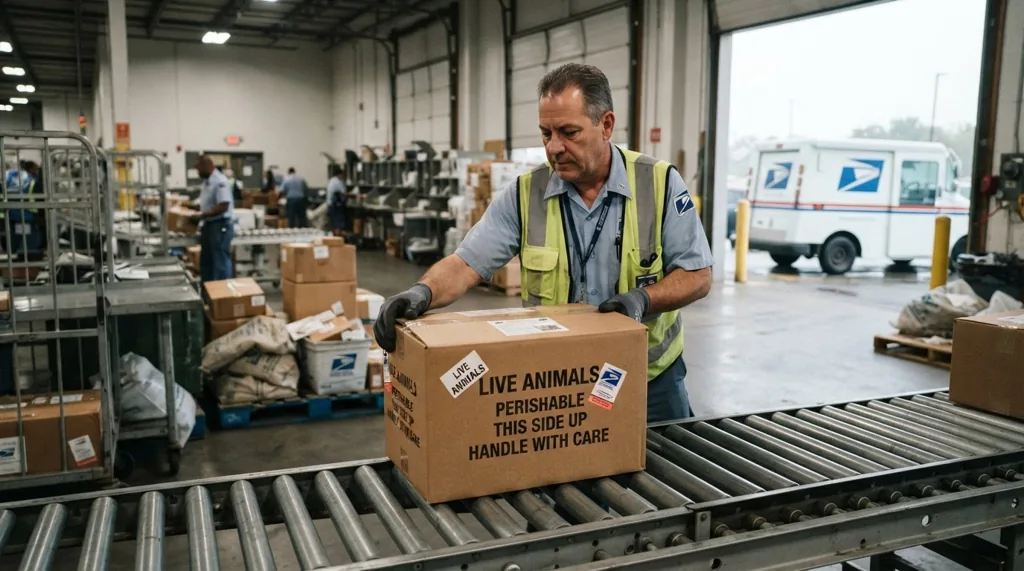
The US Postal Service banned reused fiberboard boxes for live animals and requires labeled, numbered bundles from Oct. 19, 2026.
The US Postal Service has tightened its packaging and labeling rules for mailing live animals, including a ban on reusing fiberboard boxes. The changes take effect on Oct. 19, 2026, the same day the final rule appears in the Federal Register.
The final rule updates Publication 52, the Postal Service rulebook for hazardous, restricted and perishable mail1. It covers everyone who mails live animals, and it aims to keep packages intact and easy to identify during sorting1. The Postal Service says it may extend some of the ideas raised by the public in a future update1.
| At a glance | Details |
|---|---|
| What was published | Final rule revising Publication 52 |
| Published on | 19 October 2026 |
| Who must comply | Anyone mailing live animals through the Postal Service |
| Effective date | 19 October 2026 |
| Next milestone | Possible future rule on addressing for all live animal shipments |
What does the new rule change?
The rule makes three main changes. Mailers can no longer reuse fiberboard containers for any live animal shipment1. The Postal Service gives the reason plainly: these boxes have a high chance of breaking down during transport1.
Shipments made of several boxes strapped together also get new rules. One shipping label may cover the bundle, but each box must carry its own address label1. Each box must also be numbered in order, such as "1 of 5" and "2 of 5," so staff can handle it properly if the bundle comes apart1.
Packaging standards for live animals
The basic box standard stays in place. Containers must be made of at least 275-pound test, double-wall corrugated, weather-resistant fiberboard, graded W5c, or an equivalent1. Packaging made by the Postal Service, including Flat Rate boxes, cannot be used1.
Live animal box rules
| Requirement | Standard / Details |
|---|---|
| Box material | 275-pound test, double-wall fiberboard (W5c) or equivalent |
| Reused boxes | Fiberboard containers must not be reused |
| Bundled boxes | Each box needs its own address label |
| Box numbering | Numbered in sequence, such as “1 of 5” |
| Postal Service boxes | Not allowed, including Flat Rate containers |
| Area | What the rule requires |
|---|---|
| Box material | 275-pound test, double-wall, weather-resistant fiberboard (W5c) or equivalent |
| Reused boxes | Fiberboard containers must not be reused |
| Bundled boxes | Each box needs its own address label |
| Box numbering | Boxes numbered in sequence, such as "1 of 5" |
| Postal Service boxes | Not allowed, including Flat Rate containers |
What changes for adult bird shipments?
Adult bird boxes must carry the marking "Live Birds—USPS Approved Container #" once a number is issued1. They must show the full addresses and phone numbers of sender and recipient on the outer packaging1. Arrows showing the "up" position must appear on at least two sides1.
Recipient address on bird boxes
| Question | August proposal | Final rule |
|---|---|---|
| Write address on box? | Required | Recommended |
| Address and phone on outer packaging | Required | Required |
| “Up” arrows | At least two sides | At least two sides |
The final rule softens one part of the August proposal. The draft would have required mailers to write the recipient’s name and address directly on adult bird boxes2. The final text only recommends this step, in case the shipping label falls off1.
How the rule evolved from the draft
The Postal Service published its proposal on Aug. 6, 2026, and took comments until Sept. 8, 20262. It received 32 formal responses1.
From proposal to final rule
| Key date | What happens |
|---|---|
| 6 August 2026 | Proposed rule published |
| 8 September 2026 | Comment period closed |
| 19 October 2026 | Final rule published and in effect |
Several commenters asked for the name and address requirement to cover all live animal shipments, not just adult birds1. The Postal Service replied that it may consider this in a future update1. Another commenter suggested a barcode as an alternative to the address and phone number requirement, which the agency said it may consider later1.
What the Postal Service declined to change
Some commenters wanted a 48-hour delivery window for day-old poultry1. The Postal Service said this was not needed. Day-old poultry must be no more than 24 hours old when mailed and can be delivered within 72 hours of hatching1.
Requests for climate-controlled transport were also turned down. The agency said this is not currently feasible for all modes, though it limits exposure to extreme heat and cold where possible1. It added that mailers must protect animals against extreme temperatures through proper packaging1.
The Postal Service also pointed to embargoes, temporary halts on live animal shipments, which it issues during weather disruptions or reduced holiday schedules1. It said it is in contact with major animal shippers and gets advance notice of large shipments1.
Concerns about roosters and animal fighting
Two commenters raised the mailing of roosters for illegal cockfighting1. One asked for a full ban on mailing adult roosters1. The Postal Service said it allows domestic mailing of disease-free adult birds when shippers follow all laws, including the Lacey Act and the Animal Welfare Act1.
Another commenter proposed health records, written non-fighting statements and daily limits for rooster shipments1. The Postal Service said it will research these suggestions for a possible future rulemaking1.
Key terms in plain words
| Term | Meaning |
|---|---|
| Publication 52 | The Postal Service rulebook for hazardous, restricted and perishable mail |
| Final rule | The finished version of a regulation, after public comments |
| Fiberboard | Thick corrugated cardboard used to make shipping boxes |
| 275-pound test | A minimum strength rating for the box material |
| Embargo | A temporary halt on accepting certain shipments |
| Federal Register | The US government’s daily journal of rules and notices |
The new live animal mailing standards take effect on Oct. 19, 20261.
Sources
- ↩ Federal Register :: New Mailing Standards for Live Animals — 2026 21317 / new mailing standards for live animals https://www.federalregister.gov/documents/2026/10/19/2026-21317/new-mailing-standards-for-live-animals
- ↩ Federal Register :: New Mailing Standards for Live Animals — 2026 16016 / new mailing standards for live animals https://www.federalregister.gov/documents/2026/08/06/2026-16016/new-mailing-standards-for-live-animals