

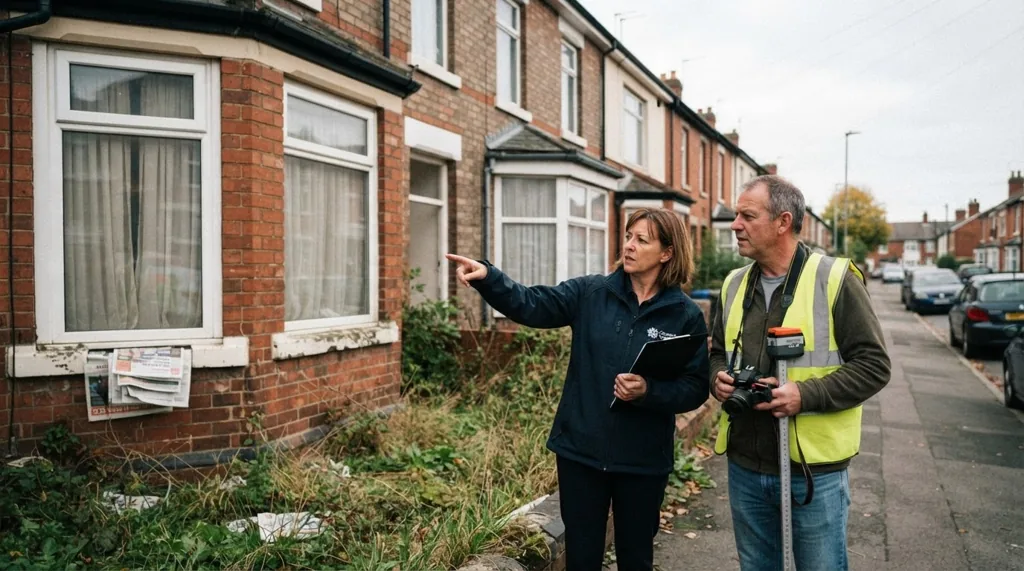
England will let councils seek control of homes empty for six months, down from two years, from 5 November 2026.
England has cut how long a home must sit empty before councils can ask to take over its management, from two years to six months. The new rule takes effect on 5 November 2026 and covers tribunal applications made from that day.
The Ministry of Housing, Communities and Local Government made the order on 14 October 2026 and laid it before Parliament the same day1. It applies to local housing authorities in England and to owners of homes left wholly empty1. Parliament’s objection period ends on 22 November 20262.
| At a glance | Details |
|---|---|
| What was published | Statutory instrument 2026 No. 1085, an amendment order |
| Published on | 14 October 2026 |
| Who must comply | Councils in England and owners of long-term empty homes |
| Effective date | 5 November 2026 |
| Next milestone | Objection period in Parliament ends 22 November 2026 |
What is an Empty Dwelling Management Order?
An Empty Dwelling Management Order (EDMO) lets a council take over the management of a long-term empty home3. The council can return the home to occupation for up to seven years3. Ownership stays with the property owner throughout3.
There are two stages. An interim EDMO lets the council take steps to get the home occupied1. A final EDMO follows it, to keep the home occupied1.
A council cannot make an interim order on its own. It must first get approval from the residential property tribunal, a court-like body that hears housing disputes1.
What the new order changes
The order is made under the Housing Act 20041. That Act set a minimum empty period of 6 months, but a 2012 order raised it to at least 2 years1. The new order removes the 2012 rule and restores the 6-month period1.
The order also removes two extra conditions that councils had to meet before the tribunal could approve an interim order1. The government said these related to issues such as anti-social behaviour or community support for intervention3.
Why the government acted
The ministry announced the reforms on 27 September 20263. It said the changes will help bring more long-term empty homes back into use3.
It also said earlier action would stop homes from falling into serious disrepair3. A simpler process should make it easier for councils to seek an order through the tribunal3.
What changes for property owners and councils
Owners of homes left wholly empty face council action much sooner. After six months without occupants, a home can become eligible for an order3.
Councils face a lighter evidence burden when they apply. The other conditions in the 2006 order still apply1.
The order states that no full impact assessment was produced. It says no significant impact on the private, voluntary or public sectors is expected1.
Transition timeline and key deadlines
The new rules do not apply to applications already lodged. Applications submitted to the tribunal before 5 November 2026 stay under the old rules1.
The order follows Parliament’s "made negative" procedure, with scrutiny by both Houses2.
The ministry said it is also exploring further changes to strengthen the EDMO rules3. It has not published details of those changes.
Key terms in plain words
| Term | Meaning |
|---|---|
| EDMO | Empty Dwelling Management Order, letting a council manage an empty home |
| Interim EDMO | The first-stage order, used to get the home occupied |
| Final EDMO | The follow-on order that keeps the home occupied |
| Residential property tribunal | A court-like body that must approve interim orders |
| Statutory instrument | A law made by a minister under powers in an Act |
| Objection period | The window in which Parliament can object to the order |
The six-month rule applies to tribunal applications made from 5 November 20261.
Sources
- ↩ The Housing (Empty Dwelling Management Orders) (Prescribed Period of Time and Prescribed Requirements) (England) (Amendment) Order 2026 https://www.legislation.gov.uk/uksi/2026/1085/made
- ↩ Work package for Housing (Empty Dwelling Management Orders) (Prescribed Period of Time and Prescribed Requirements) (England) (Amendment) Order 2026 https://api.parliament.uk/procedure-browser/work-packages/UxBoo7JS
- ↩ New reforms to bring more long-term empty homes back into use – GOV.UK https://www.gov.uk/government/news/new-reforms-to-bring-more-long-term-empty-homes-back-into-use–2