

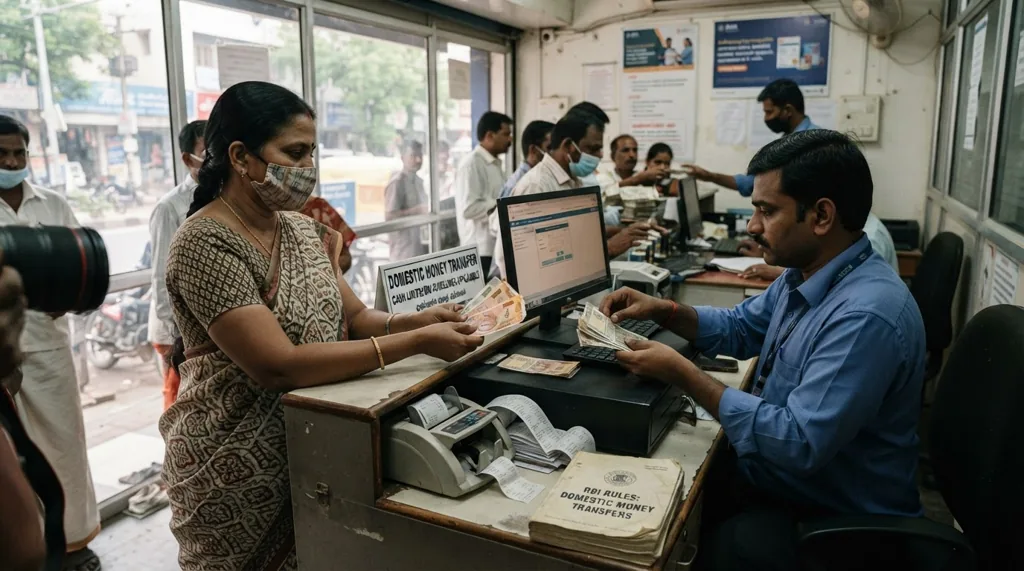
India’s central bank merged its cash money transfer rules into one rulebook, effective immediately on 11 November 2026, with firm per-transaction and monthly limits.
India’s central bank has merged its rules for small cash-based money transfers into one rulebook for banks and payment firms. The new rules took effect immediately on 11 November 2026 and set firm limits on cash sent and received.
The Reserve Bank of India (RBI) issued the Reserve Bank of India (Domestic Money Transfer) Directions, 2026 on 11 November 20261. They apply to commercial, rural and co-operative banks and to authorised payment system operators and participants1. The directions replace two earlier circulars from 2011 and 2024, so firms now follow one document1.
| At a glance | Details |
|---|---|
| What was published | Final directions on Domestic Money Transfer (DMT) |
| Published on | 11 November 2026 |
| Who must comply | Commercial banks, Regional Rural Banks, co-operative banks, and authorised payment operators |
| Effective date | 11 November 2026 (effective immediately) |
| Next milestone | No further step announced. Earlier 2011 and 2024 circulars are repealed |
What is domestic money transfer, and why does it matter?
Domestic money transfer is a service for sending small sums through formal banking channels. The RBI says it serves people, including migrant workers, who lack proof of identity or address to use banks normally1. Such transfers come with transaction limits, monthly ceilings, monitoring and safeguards1.
The service is not new. The RBI’s 2015 Master Circular on Customer Service in Banks already included a section on Domestic Money Transfer relaxations2. The 2026 directions now gather all such instructions in one place1.
The RBI issued the rules under Section 18 read with Section 10(2) of the Payment and Settlement Systems Act, 20071. Card-to-card transfers are outside these rules and stay under their own guidelines1.
The new limits on cash transfers
The directions cover two services. Cash pay-out lets a bank customer send money from an account to someone without a bank account1. The recipient collects cash at an ATM, through a bank agent, or another authorised channel1.
Cash pay-in works the other way. A walk-in customer with cash pays it into a recipient’s bank account1.
| Service | Limit set by the directions |
|---|---|
| Cash pay-out, per transaction | ₹10,000 |
| Cash pay-out, monthly ceiling | ₹25,000 per beneficiary |
| Walk-in cash at a branch via NEFT | Up to ₹50,000 |
| Cash via bank agents or ATMs, per transaction | ₹5,000 |
| Cash via bank agents or ATMs, monthly cap | ₹25,000 per remitter |
For cash pay-out, the sending bank must record the name and address of the recipient1. A walk-in branch customer can send up to ₹50,000 through NEFT, India’s National Electronic Funds Transfer system1.
How banks must check the sender
Banks and their agents must register each cash sender before transfers begin. Registration uses a verified mobile phone number and a self-certified identity document listed in the RBI’s Know Your Customer Directions, 20251.
Every transaction must pass an extra security check, called an Additional Factor of Authentication1. Banks and agents must also follow the cash deposit provisions of the Income-Tax Act, 20251.
The payment message itself must carry details of the sender1. It must also include a tag marking the transfer as a cash-based remittance1.
Fraud checks and settlement
Banks and payment firms must run strong safeguards, including velocity checks that flag unusually fast or frequent transfers1. They must also alert customers when money arrives in their accounts through these services1.
Any sudden spike in credits to one account, or a group of accounts, must be investigated immediately1. Firms must alert the proper authorities about suspicious transactions1.
Transfers are expected to happen in real time or close to it1. Banks must settle money between themselves only through payment systems approved by the RBI1.
What changes for customers and complaints
Banks and payment firms may set reasonable charges for the service, with the aim of making it more widely used1. They may also set up systems to handle customer complaints1.
Complaints about these transfers fall under the Reserve Bank Integrated Ombudsman Scheme, 20261.
| Repealed circular | Date |
|---|---|
| Domestic Money Transfer – Relaxations | 5 October 2011 |
| Domestic Money Transfer – Review of Framework | 24 July 2024 |
Both circulars are now folded into the 2026 directions and repealed1.
Key terms in plain words
| Term | Meaning |
|---|---|
| Domestic Money Transfer (DMT) | Sending small sums inside India, often in cash, through banks or their agents |
| Business Correspondent (BC) | A local agent appointed by a bank to offer basic banking services |
| NEFT | National Electronic Funds Transfer, India’s system for bank-to-bank payments |
| Additional Factor of Authentication (AFA) | An extra security check required for each transaction |
| Velocity check | A check that flags many transfers made in a short time |
| Officially Valid Document (OVD) | An identity or address document accepted under the RBI’s customer checks |
The directions have applied since 11 November 2026, and the 2011 and 2024 circulars no longer stand on their own1.
Sources
- ↩ Notifications | Official Website of Reserve Bank of India https://www.rbi.org.in/scripts/NotificationUser.aspx?Id=13752&Mode=0
- ↩ Reserve Bank of India https://m.rbi.org.in/commonman/English/Scripts/Notification.aspx?Id=1587