

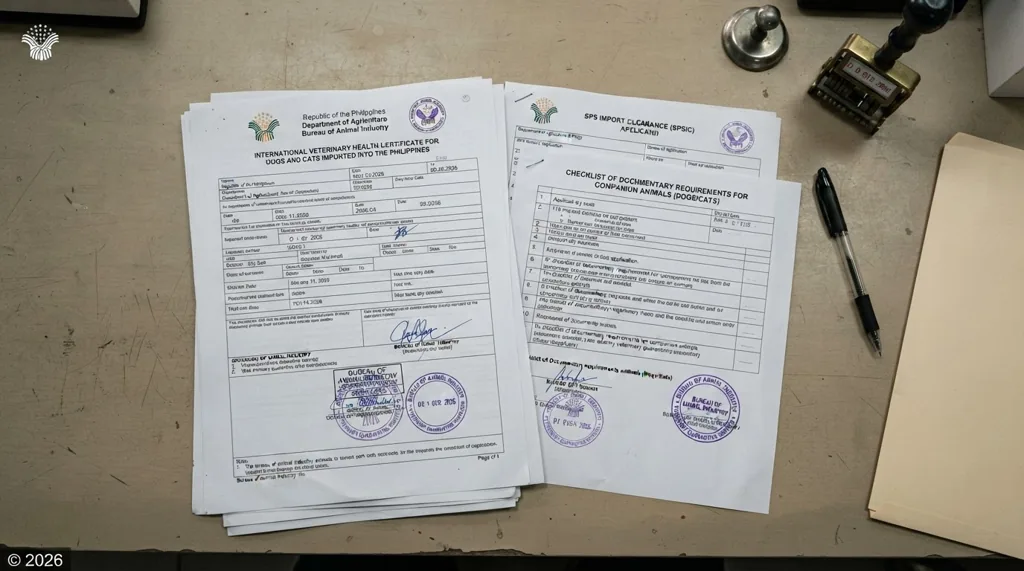
Philippines has established sanitary and phytosanitary measures alongside international veterinary health certification requirements for dogs and cats entering the country.
The Philippines will require a rabies blood test for every dog and cat entering the country. The new import rules apply to all permit applications from 1 January 2027.
The Bureau of Animal Industry (BAI), the Philippine agency that controls animal imports and animal disease, has published updated guidelines for bringing in dogs and cats1. They cover pet owners, pet relocation firms and anyone importing a dog or cat. The current rules stay in place until the new set takes effect on 1 January 20272.
| At a glance | Details |
|---|---|
| What was published | Updated import guidelines for dogs and cats |
| Published on | Publication date not stated on the agency’s pages |
| Who must comply | Anyone bringing a dog or cat into the Philippines |
| Effective date | 1 January 2027 |
| Next milestone | Permits approved by 31 December 2026 can still be used within their 60-day validity |
What changes for pet importers?
The biggest change is a rabies antibody blood test for every animal. It checks that the rabies vaccine has worked. Under the current rules, this test is not required2.
Dog and cat imports, before and after
| Requirement | Current rules | From 1 January 2027 |
|---|---|---|
| Rabies blood test | Not required | At least 0.5 IU/ml |
| Number of animals | Up to 3 per year | No limit |
| Minimum age at application | 4 months | 18 weeks |
| Other vaccines | Several required | Rabies only |
From 1 January 2027, each animal must also have its own Form 11. This form records the vaccination, the blood test result, parasite treatment and the microchip number. An owner bringing two cats needs two completed forms1.
The current cap on numbers also goes. Today, an importer may bring in at most 3 animals per year2. The updated guidelines set no limit on how many dogs or cats may enter, as long as all documents are provided1.
| Area | Change from current rules to 1 January 2027 |
|---|---|
| Rabies blood test | Not required, then required at 0.5 IU/ml or more |
| Number of animals | Up to 3 per year, then no limit |
| Minimum age at application | 4 months, then 18 weeks (4.5 months) |
| Other vaccines | Several required, then rabies only |
How the rabies blood test works
Every dog or cat must show a result equal to or above 0.5 IU/ml1. That figure measures the level of rabies antibodies in the blood. Only two lab methods are accepted, known as FAVN and RFFIT, and the ELISA method is rejected1.
The blood must be drawn at least 30 days after the first rabies shot1. A pet with a result below the threshold must be vaccinated again and can be retested after 14 days1. Microchips must be implanted before the blood test is done1.
The test can be done at labs on lists kept by the European Commission and by the body the agency names as the Centers of Disease Prevention and Control1. Government-recognised labs in the source country may also run it1. A valid result counts for the life of the pet, provided booster shots are given on time1.
Even countries that report no rabies are covered. The agency says this reflects the high number of rabies cases in the Philippines1.
The import permit and health certificate
Every dog or cat needs an approved Sanitary and Phytosanitary Import Clearance (SPSIC), the BAI’s import permit, before travel1. Each permit covers one shipment only and cannot be transferred. It is valid for 60 days, and extensions are not allowed1.
The import permit in numbers
Processing takes up to 11 days once an application is complete and under review1. Owners also need an International Veterinary Health Certificate (IVHC) from the government vets of the source country1. It must be issued within 10 days before arrival and be written in English or translated1.
A digital certificate is accepted if it can be checked on a platform endorsed by the source country’s veterinary authority1.
Animal health conditions
Pets must be at least 18 weeks old when the permit is requested1. Pregnant animals are not allowed. Animals that have given birth may travel only after 18 weeks1.
The rabies shot must be given by a licensed vet when the animal is at least 12 weeks old1. Every pet must also be treated for internal and external parasites1. Under the current rules, dogs also need shots against distemper, parvovirus and other diseases2. The updated guidelines require only a valid rabies vaccination1.
Fees and checks on arrival
At the port, owners must show the printed permit, the original health certificate, Form 1 and the blood test result1. Pets collected from an airport cargo terminal also need the airline’s stamped air waybill1. All fees are paid in cash, in Philippine pesos1.
Documents shown on arrival
| Document | Issuing authority or requirement |
|---|---|
| Import permit (SPSIC) | Printed copy of the BAI approval |
| Health certificate (IVHC) | Original, from source-country government vets |
| Form 1 | Completed and signed, one per pet |
| Rabies blood test result | Copy of the lab result |
| Air waybill | Airline-stamped, for cargo terminal pickups |
| Fee | Amount |
|---|---|
| Import clearance | Php 100.00 |
| Lodgement fee | Php 55.00 |
| Inspection, first 2 pets | Php 250.00 each |
| Inspection, each further pet | Php 300.00 each |
Transition timeline and key deadlines
A permit approved on or before 31 December 2026 can still be used without the blood test or Form 11. The pet must travel within that permit’s 60-day validity period1.
| Key date | What happens |
|---|---|
| Until 31 December 2026 | Permits issued under current rules, no blood test needed |
| 1 January 2027 | Blood test and Form 1 required for all permit applications |
Key terms in plain words
| Term | Meaning |
|---|---|
| BAI | Bureau of Animal Industry, the Philippine agency for animal imports and animal health |
| SPSIC | The import permit every dog or cat needs before travelling to the Philippines |
| IVHC | A health certificate issued by government vets in the country the pet leaves |
| RNATT | A blood test showing the rabies vaccine has produced enough antibodies |
| IU/ml | The unit used to measure rabies antibody levels in blood |
| Form 1 | A BAI form recording each pet’s vaccines, blood test, parasite treatment and microchip |
The new requirements apply to all import permit applications for dogs and cats from 1 January 20271.
Sources
- ↩ Bureau of Animal Industry — Stakeholders / NewPetImport https://www.bai.gov.ph/Stakeholders/NewPetImport
- ↩ Bureau of Animal Industry — Stakeholders / PetImport https://www.bai.gov.ph/Stakeholders/PetImport