

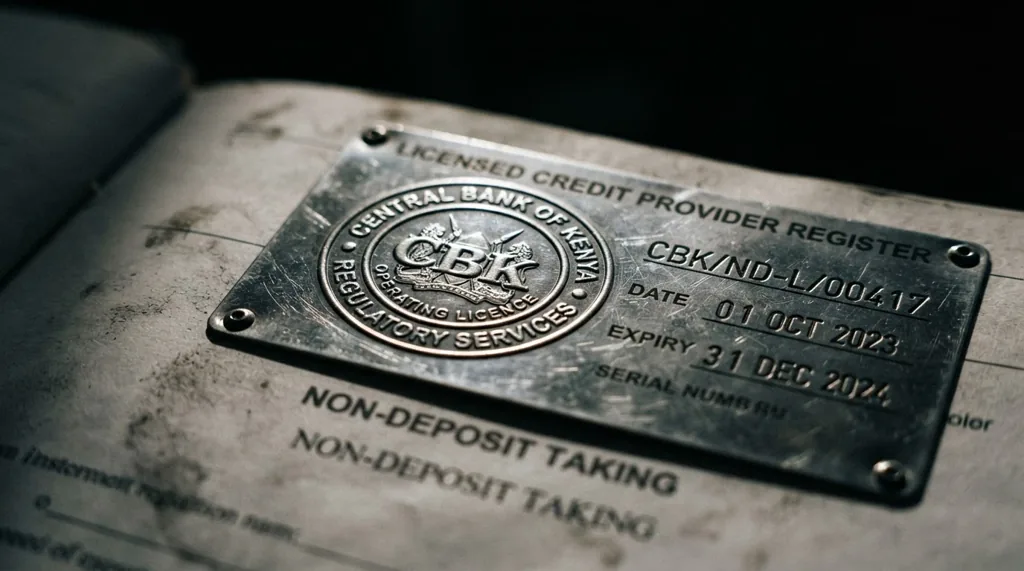
Kenya has gazetted the Central Bank of Kenya (Non-Deposit Taking Credit Providers) Regulations, 2026, published on 29 September 2026, requiring every lender outside other financial laws to hold a CBK licence or registration.
The Central Bank of Kenya (CBK) has issued new licensing rules for lenders that do not take deposits, covering digital lenders, buy now pay later and peer to peer lending, published in the Kenya Gazette on Sept. 29, 2026.
The Central Bank of Kenya (Non-Deposit Taking Credit Providers) Regulations, 2026 appear as Legal Notice No. 191 in Kenya Gazette Supplement No. 2341. Kenya Law, the official law reporting body, records them as published and commenced on Sept. 29, 2026, and as repealing the Central Bank of Kenya (Digital Credit Providers) Regulations2.
In short, any business that lends its own money in Kenya without taking deposits now needs a CBK licence or a CBK registration. The rules reach well beyond app-based lenders, and they set out what an applicant must file, how fast CBK decides and what yearly fees cost if paid late.
Why did CBK replace the digital lender rules?
CBK published a draft of these rules in August 2025 for public comment3. The draft followed changes to the Central Bank of Kenya Act made by the Business Laws (Amendment) Act, 20243. CBK said those changes aimed to clarify and widen the scope of non-deposit taking credit providers, which were formerly called digital credit providers3.
The sector was already sizeable before the new rules. In February 2026, National Treasury Cabinet Secretary John Mbadi told the Senate that CBK licensed 195 non-deposit taking credit providers4. He said credit from digital credit providers stood at Ksh 110.5 billion as of December 2025, or 2.4% of credit from the lenders CBK oversees4.
Which lenders fall under the CBK regulations?
The regulations apply to non-deposit taking credit business not regulated under any other written law1. A non-deposit taking credit provider is a person licensed or registered by CBK to lend using its own funds and assets1. The national and county governments are excluded from that definition1.
Lenders outside the new rules
The definition of a loan is broad. It covers any credit facility, advance or loan product, including buy now pay later, stock now pay later and peer to peer lending1. The rules also define "pay as you go" deals, where a customer pays in instalments to own an asset and the provider can deactivate or repossess it after missed payments1.
The regulations do not apply to these businesses, among others:
- banks licensed under the Banking Act
- microfinance institutions, co-operative societies and Sacco societies
- credit guarantee companies regulated under the CBK Act
- lease finance and hire-purchase arrangements under other laws
- sellers whose credit is merely incidental to selling goods or services
CBK may also exempt a person whose business falls outside the definition of a "financial institution" in the Proceeds of Crime and Anti-Money Laundering Act1.
Licence or registration under the KSh20 million threshold?
No one may set up a non-deposit taking credit business in Kenya, or present themselves as running one, without a CBK licence or registration1. A new business with initial capital of at least 20 million shillings must apply for a licence using Form 11. The regulations set out a separate registration route, and a later regulation deals with converting a registration into a licence1.
From name approval to application
Before applying, promoters must clear a company name. They must propose at least three names to CBK, in order of preference, with details of shareholders, capital and the planned business model1. CBK will reject names that copy an existing lender, mislead customers or suggest CBK endorsement1.
Once CBK approves a name, promoters have three months to incorporate the company1. They then have six months from incorporation to apply for a licence or registration1. A promoter holding only a name approval may not lend or claim authority to do so1.
What must a licence application to CBK include?
The application list is long. It reaches into data protection, competition, consumer protection and money laundering controls. Key items include:
- a certificate under section 19 of the Data Protection Act
- statements on compliance with the Consumer Protection Act and the Competition Act
- evidence of capital and a sworn declaration that funds are not proceeds of crime
- credit, consumer protection, anti-money laundering and data protection policies
- pricing parameters, including how loans are classed as non-performing
- business continuity plans and descriptions of IT systems and delivery channels
Applicants must also describe their planned range of loan sizes and interest rates1. Directors, the chief executive and senior officers must file fit and proper forms, a check of their honesty and competence1. Each must supply a certificate of good conduct, a tax compliance certificate and a credit reference bureau report1.
Shareholders and directors face one more limit. Applicants must swear that no proposed director or significant shareholder holds a similar position in another such lender in Kenya1. A significant shareholder is one holding 10% or more of the share capital1. The board must approve the policies, manuals and codes submitted1.
How quickly will CBK decide, and what can stall it?
CBK will judge the documents, the suitability of the people in charge, the source of funds and the public interest1. If satisfied, it may grant a licence, with or without conditions, within 60 days of submission1. A licence stays valid unless CBK suspends or revokes it1.
CBK decision and notice periods, days
Silence can end an application. If an applicant ignores a CBK request for more information for three months, CBK may stop processing the file1. It may first issue a 14-day notice asking the applicant to show why processing should continue1. CBK will then give its decision within seven days of receiving any reply, or longer if needed1.
When are annual CBK fees due?
Every licensed lender must pay its annual fees, set out in the Third Schedule, on or before Dec. 31 each year1. The fees may be paid as a lump sum or in another way CBK specifies1.
Late payment costs twice as much. A lender that misses the deadline must pay double the annual fee if it pays within three months of Dec. 311. If the fee is still unpaid after that, CBK may revoke the licence1. The next Dec. 31 deadline under the regulations is Dec. 31, 2026, with the double-fee window running to the end of March 2027.
Sources
- ↩ Microsoft Word – L.N. -191 Central Bank Act.doc https://kenyalaw.org/akn/ke/act/ln/2026/191/eng@2026-09-29/source
- ↩ The Central Bank of Kenya (Non-Deposit Taking Credit Providers) Regulations, 2026 – Kenya Law https://new.kenyalaw.org/akn/ke/act/ln/2026/191/eng@2026-09-29
- ↩ Draft Non-Deposit Taking Credit Providers (NDTCPs) Regulations, 2025 | CBK https://www.centralbank.go.ke/2025/08/07/draft-non-deposit-taking-credit-providers-ndtcps-regulations-2025/
- ↩ 𝐍𝐀𝐓𝐈𝐎𝐍𝐀𝐋 𝐓𝐑𝐄𝐀𝐒𝐔𝐑𝐘 𝐓𝐎 𝐃𝐄𝐀𝐋 𝐖𝐈𝐓𝐇 𝐑𝐎𝐆𝐔𝐄 𝐃𝐈𝐆𝐈𝐓𝐀𝐋 𝐋𝐄𝐍𝐃𝐄𝐑𝐒 | The Kenyan Parliament Website https://parliament.go.ke/node/25264