

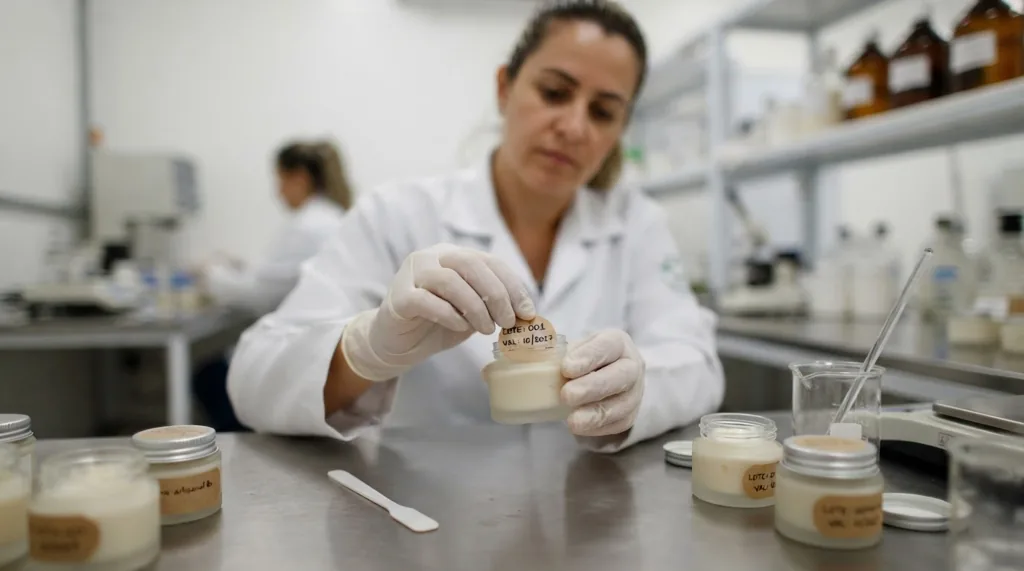
Brazil exempts small artisanal makers of soaps, perfumes, body oils and similar cosmetics from Anvisa product registration, under rules published Oct. 5, 2026, that take effect 60 days later.
Anvisa, Brazil’s national health regulator, published rules on Oct. 5, 2026, that let small artisanal makers of soaps, body oils, perfumes and similar cosmetics sell without product registration, taking effect 60 days after publication1.
The two instruments are Resolution RDC 1,045/2026 and Normative Instruction IN 474/2026, both approved by Anvisa’s collegiate board and printed in the Diário Oficial da União, Brazil’s official gazette1. They are the first rules written specifically for artisanal producers1.
In short, home-based and small-scale cosmetics makers no longer need Anvisa product registration, a factory operating permit or a hired technical expert. In exchange, they must follow basic hygiene rules, strict labelling and a 12-month shelf-life cap, and they carry full legal responsibility for product safety.
What does Anvisa’s artisanal cosmetics rule change?
Until now, artisanal producers had no rules of their own and faced legal uncertainty when trying to formalize a business1. The new rules apply simpler requirements, scaled to the size and risk of the activity1.
The main simplifications are:
- No registration or notification of products with Anvisa1.
- No company operating permit (AFE), the document required of traditional factories1.
- Automatic local health licensing, without prior review, visit or inspection1.
- No obligation to hire a technical manager, a qualified professional normally responsible for product safety1.
- A maximum shelf life of 12 months from manufacture2.
Local licensing remains subject to later checks by health inspectors1. The rules implement Law 15,154 of 2025, which ordered Anvisa to create simplified rules for artisanal cosmetics1. The law was signed in July 20252.
Which cosmetics producers qualify as artisanal?
The rules cover people who produce mainly by hand, at small scale, and who control every step from choosing ingredients to packaging1. No part of the process may be outsourced1.
Products must have simple formulas using ingredients with a recognized safety record1. They cannot contain a high water content, which limits the risk of microbial contamination1.
The draft resolution put before the board also excluded products made by simply refilling, diluting or relabelling industrial goods, or by assembling kits3. It defined small scale as production without automated machines and without industrial-style division of labour3. Producers that do not meet these conditions must follow the rules for industrial manufacturing3.
Which product groups does IN 474/2026 allow?
The normative instruction sets the official list of product groups that may be made in this simpler regime1. They are:
- Alcohol-based perfumes.
- Room fragrances.
- Solid bath and soaking products.
- Solid body soaps.
- Solid shampoos and conditioners.
- Body oils and butters.
- Solid underarm deodorants.
The list comes from Anvisa’s announcement of the board decision2. Product claims must stay simple: sensory or basic functional effects such as cleaning, moisturizing and scenting2. Therapeutic claims, and claims that would require complex efficacy tests, are not allowed2.
What hygiene and labelling duties apply?
Simplification does not remove controls, and producers stay responsible for the safety and quality of their goods1. The resolution sets simplified good manufacturing practices, basic hygiene and control rules adapted to artisanal scale2.
Duties for artisanal cosmetics producers
| Requirement | Standard / Details |
|---|---|
| Hygiene | Strictly clean production area and utensils |
| Utensils | No wooden or other porous utensils |
| Quality check | Check finished product before sale |
| Complaints | Customer channel plus a record of complaints and action taken |
| Label | Ingredients, dates, address, weight or volume, warnings |
| Label marking | “PRODUTO ARTESANAL” on every product |
Producers must:
- Keep the production area and utensils strictly clean1.
- Avoid wooden or other porous utensils, which are hard to clean1.
- Respect the expiry dates of raw materials1.
- Check the quality of the finished product before sale1.
- Run a channel for customer questions and complaints1.
- Keep a record of complaints received and the action taken1.
Labels are mandatory and must show the product name, ingredient list, manufacturing date, expiry date, production address, weight or volume and warning phrases1. Every label must also carry the words "PRODUTO ARTESANAL" (artisanal product)1. The draft resolution also listed the producer’s contact details and, where held, the health licence among the label items3.
Where can artisanal cosmetics be sold?
Producers may sell through their own shops, craft fairs, social media, websites and their own online marketplaces1. Family members or helpers may also sell on the producer’s behalf1.
The draft resolution framed these as direct-sale channels that keep the producer in contact with the final consumer3. It also covered shops and online stores run by producer associations or cooperatives, plus door-to-door sales3. Selling through general retail chains is not among the listed channels.
Who enforces the rules and what are the penalties?
Inspection stays with state and municipal health surveillance agencies, which may check compliance after a business starts operating1. Under the draft resolution, states and municipalities may also issue supplementary local rules3.
The draft resolution treats any breach as a health infraction, punishable under Law 6,437 of 1977, without prejudice to criminal and civil liability3. It did not set specific fine amounts.
How was the artisanal cosmetics rule developed?
Anvisa’s board approved the two instruments on Sept. 30, 2026, at its 18th public ordinary meeting of the year2. The rapporteur was director Marcelo Moreira2. Work began in August 2025, after the law was signed2.
Maximum shelf life for artisanal cosmetics, months
The process ran for more than a year and included a regulatory impact analysis and two public consultations1. The consultations drew more than 700 contributions from producers, associations, professionals and citizens1.
More than half of the valid contributions were accepted in full or in part1. Changes made as a result include allowing products used on the face, extending shelf life from 6 to 12 months, opening online sales and allowing sales by family and helpers1.
Summary of Brazil’s artisanal cosmetics rules
The table sets out the main points of RDC 1,045/2026 and IN 474/2026.
| Key Dimension | Details |
|---|---|
| Regulating Authority & Jurisdiction | Anvisa, Brazil’s national health regulator; enforcement by state and municipal health agencies1 |
| Legal Basis | Law 15,154 of 20251 |
| Scope & Who Must Comply | Small-scale, mainly manual producers who control every production step without outsourcing1 |
| Eligible Products | Seven groups, including solid soaps, alcohol-based perfumes, body oils and solid deodorants2 |
| Core Mandate / Key Change | No product registration, no AFE permit, automatic local licensing, no required technical manager1 |
| Compliance Thresholds | Maximum shelf life of 12 months; low water content; simple, non-therapeutic claims2 |
| Labelling | Ingredients, dates, address, weight or volume, warnings and "PRODUTO ARTESANAL"1 |
| Key Dates | Approved Sept. 30, 2026; published Oct. 5, 2026; in force 60 days after publication1 |
| Penalties / Enforcement Action | Breaches are health infractions under Law 6,437 of 1977, per the draft resolution3 |
Both instruments take effect together 60 days after publication, giving producers and local health agencies time to prepare1. From that date, artisanal makers in the seven product groups can operate under the simplified regime.
Sources
- ↩ Conheça as regras para produção artesanal de cosméticos https://www.gov.br/anvisa/pt-br/assuntos/noticias-anvisa/2026/conheca-as-regras-para-producao-artesanal-de-cosmeticos
- ↩ Anvisa aprova regularização de cosméticos artesanais https://www.gov.br/anvisa/pt-br/assuntos/noticias-anvisa/anvisa-aprova-regularizacao-de-cosmeticos-artesanais
- ↩ PDF 25351.930822/2025-24 https://www.gov.br/anvisa/pt-br/assuntos/regulamentacao/agenda-regulatoria/minutas-previas/rop-2026/rop-18/sei_4505578_minuta_de_rdc_item-2-7a.pdf/@@display-file/file