

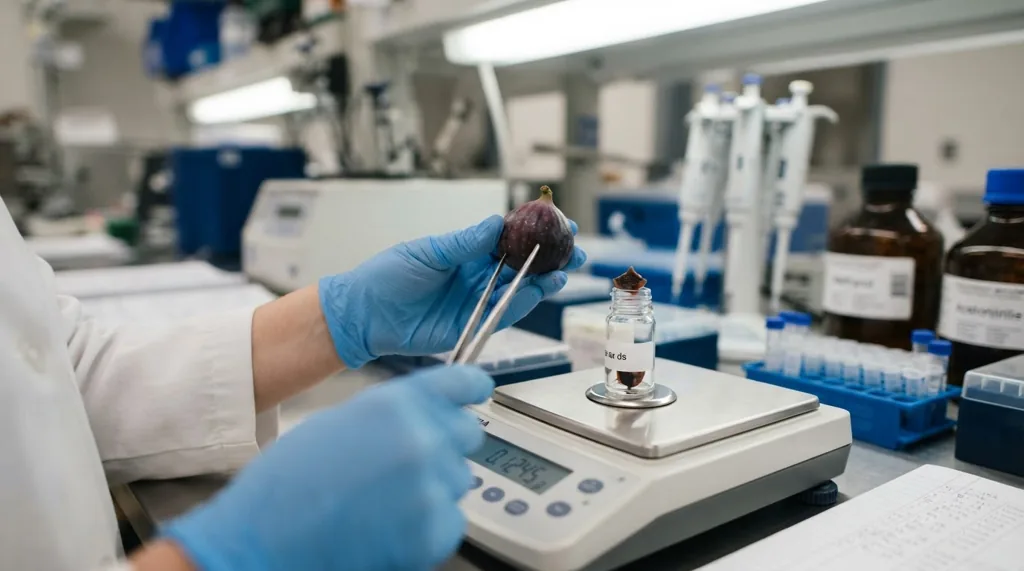
The EPA set legal residue limits for the growth regulator ethephon on figs, effective Nov. 13, 2026, with objections due Jan. 12, 2027.
The US Environmental Protection Agency (EPA) has set legal residue limits for the growth regulator ethephon on figs. The rule took effect on Nov. 13, 2026, and objections are due by Jan. 12, 2027.
The final rule, published in the Federal Register, sets a tolerance for ethephon in or on fig1. A tolerance is the legal limit for pesticide residue in or on a food. Fig growers, food manufacturers and pesticide makers are the groups most likely to be affected1.
| At a glance | Details |
|---|---|
| What was published | Final rule setting ethephon residue limits on fig |
| Published on | 13 November 2026 |
| Who must comply | Crop producers, food manufacturers and pesticide manufacturers |
| Effective date | 13 November 2026 |
| Next milestone | Objections and hearing requests due 12 January 2027 |
What is ethephon, and why does it matter?
Ethephon is a plant growth regulator, a chemical that changes how a plant grows or ripens2. The rule describes it as an "ethylene releaser" that differs in structure from organophosphate pesticides3. EPA found that ethephon does not share a toxic mechanism with organophosphates3.
The US Department of Agriculture (USDA) submitted a comment supporting ethephon use on figs1. Ethephon is already registered for use on other crops, including apples, grapes, cotton and wheat3.
Who asked for the new limit?
The request came from Interregional Research Project Number 4 (IR-4), based at North Carolina State University1. EPA announced the petition in the Federal Register on Dec. 16, 20251. That notice opened a public comment period that closed on Jan. 15, 20262.
The petition asked for a limit of 0.02 parts per million of ethephon in or on fig2. It also stated that a suitable laboratory test is available to enforce the limit2. The final rule amends section 180.300 of Title 40 of the Code of Federal Regulations, which lists ethephon limits1.
How EPA judged the residue safe
Under the Federal Food, Drug, and Cosmetic Act, EPA may set a limit only if it is "safe"1. The law defines safe as a reasonable certainty that no harm will result from total exposure. That includes food, drinking water and home settings, but not exposure at work1.
EPA reused earlier ethephon reviews where the science had not changed1. It concluded that ethephon is "Not Likely to be Carcinogenic to Humans"1. Because of that finding, it did not run a separate cancer exposure assessment1.
For short, single-day exposure, risk reached 26% of the safe level for the general population4. The figure was 73% for children 1 to 2 years old, the most exposed group4. EPA found no long-term dietary risks of concern for any group4.
What changes for growers and food firms
The fig use does not add new animal feed items, so earlier livestock exposure estimates still apply1. The new use also does not raise estimated ethephon levels in drinking water3. EPA therefore kept the drinking water estimates from its 2015 review3.
The rule lists the industries it may touch1:
- crop production
- animal production
- food manufacturing
- pesticide manufacturing
Some ethephon products are used on ornamentals, home gardens and golf courses3. Their labels require protective clothing, so EPA treated them as not for homeowner use3. Residential turf has been removed from all ethephon labels3.
How to object, and the deadline
Any person may object to any part of the rule and ask for a hearing1. Objections must be in writing and reach EPA’s Hearing Clerk by Jan. 12, 20271. Anyone who misses that deadline gives up the right to raise issues the rule settled1.
Filings must name docket EPA-HQ-OPP-2025-0148 on the first page1. EPA’s judges division prefers electronic filing, under an order dated Dec. 3, 20251.
Key terms in plain words
| Term | Meaning |
|---|---|
| Tolerance | The legal maximum amount of a pesticide residue allowed in or on a food |
| Plant growth regulator | A chemical that changes how a plant grows, flowers or ripens |
| Parts per million (ppm) | A measure of tiny amounts, such as 1 gram in 1,000 kilograms |
| IR-4 | Interregional Research Project Number 4, the petitioner, based at North Carolina State University |
| Docket | The public online file holding the rule and its supporting papers |
| Objection | A formal written challenge to a final rule, which can lead to a hearing |
Objections and hearing requests on the ethephon fig limit are due by Jan. 12, 20271.
Sources
- ↩ Federal Register :: Ethephon; Pesticide Tolerances https://www.federalregister.gov/documents/2026/11/13/2026-23120/ethephon-pesticide-tolerances
- ↩ 2025-22937.pdf https://www.govinfo.gov/content/pkg/FR-2025-12-16/pdf/2025-22937.pdf
- ↩ Federal Register, Volume 91 Issue 218 (Friday, November 13, 2026) https://www.govinfo.gov/content/pkg/FR-2026-11-13/html/2026-23120.htm
- ↩ 2026-23120.pdf https://www.govinfo.gov/content/pkg/FR-2026-11-13/pdf/2026-23120.pdf