

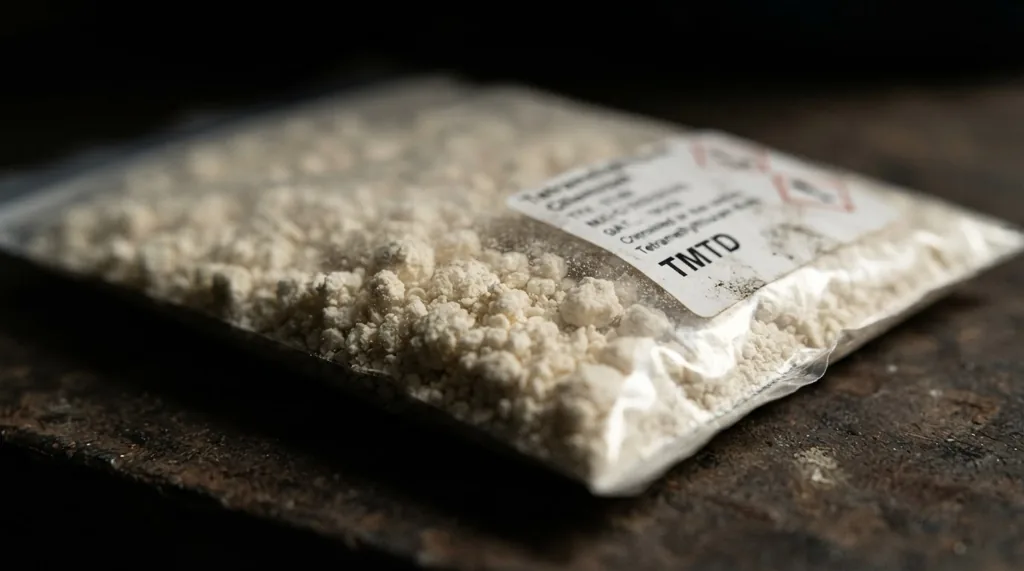
Canada now requires 180 days’ notice before anyone makes over 100 kg of TMTD yearly or uses that much in latex products.
New TMTD uses need advance notice
Existing uses of the rubber chemical are not affected.
Canada has placed the rubber chemical TMTD under new notification rules for larger-scale manufacture and latex use. Firms planning such activity must notify the environment minister at least 180 days before they start.
The Order 2026-87-22-01 Amending the Domestic Substances List, registered as SOR/2026-208, appeared in the Canada Gazette, Part II, on Oct. 21, 20261. It moves TMTD, a chemical mainly used to control the process of making solid rubber products, into a stricter part of the Domestic Substances List2. The order takes effect on the 180th day after its registration on Oct. 9, 20262.
| At a glance | Details |
|---|---|
| What was published | Final order amending the Domestic Substances List (SOR/2026-208) |
| Published on | 21 October 2026 |
| Who must comply | Anyone planning to make more than 100 kg of TMTD a year, or use over 100 kg a year in latex products |
| Effective date | 180th day after registration on 9 October 2026 |
| Next milestone | Ministry review of any notice within 180 days of receipt |
What is TMTD, and why does it matter?
TMTD is the short name for the chemical listed as thioperoxydicarbonic diamide, tetramethyl-, with Chemical Abstracts Service Registry Number (CAS RN) 137-26-82. It does not occur naturally and is mainly used as a process regulator in solid rubber manufacturing in Canada2. It also appears in automotive parts, sealants, adhesives and a limited number of food packaging materials2.
The main releases come from wastewater linked to solid rubber plants2. TMTD breaks down quickly in the environment but is highly toxic to aquatic organisms2. A January 2021 government assessment found it meets the environmental criteria for a toxic substance under the Canadian Environmental Protection Act, 19992.
What the order changes
The order deletes TMTD from Part 1 of the list and adds it to Part 2 with conditions2. Part 2 covers substances that carry "significant new activity" rules, meaning certain new uses need government review first2.
Two activities now count as significant new activities2:
| Activity | Trigger |
|---|---|
| Making TMTD | More than 100 kg in a calendar year |
| Using TMTD to make liquid rubber (latex) products | More than 100 kg in total in a calendar year |
Research and development uses are exempt, as defined in the New Substances Notification Regulations (Chemicals and Polymers)2.
What changes for rubber makers and importers
The order does not impose requirements on existing activities with TMTD in Canada2. The government judged those uses to present no or limited risk, or to be adequately managed2. Firms using or importing at or below the thresholds will not incur any cost2.
The two numbers that bind
A company planning a covered activity must file a Significant New Activity Notification with the minister2. It must arrive at least 180 days before the activity begins2. The notice must include specified data from Schedule 1 of the New Substances Notification Regulations2. There is no notification fee, though firms may face costs for generating data and for waiting during the review2.
How the review and supply chain rules work
The minister must assess the information within 180 days after receiving it2. If risks are found, the minister may bring in measures to reduce them2.
Anyone who passes TMTD to another person must tell that person about the notification duties2. A buyer may not need its own notice if a supplier’s original filing covered its activities, under certain conditions2. Firms that learn TMTD is or could become toxic must report that information to the minister without delay2.
Transition timeline and key deadlines
The rule has been years in the making. The government published a notice of intent on July 23, 2022, with a 60-day comment period, and received no comments2.
| Key date | What happens |
|---|---|
| January 2021 | Assessment of the Thiocarbamates Group, including TMTD |
| 23 July 2022 | Notice of intent opens 60-day comment period |
| 4 April 2026 | Rubber sector release guidelines take effect |
| 5 October 2026 | Environment minister signs the order |
| 9 October 2026 | Order registered as SOR/2026-208 |
| 21 October 2026 | Order published in the Canada Gazette, Part II |
The order complements the Release Guidelines for Chemicals Used in the Rubber Product Manufacturing Sector, which took effect on April 4, 20262. Minister of the Environment Julie Dabrusin signed the order in Ottawa on Oct. 5, 20262.
Enforcement and penalties
The order is enforced under the Compliance and Enforcement Policy for the Canadian Environmental Protection Act2. Officials weigh the nature of the violation, effectiveness in achieving compliance and consistency when choosing a response2. The order sets no specific fine amounts.
Importers and users are expected to check import records, usage data and Safety Data Sheets to see whether an activity is covered2. Manufacturers are expected to know their own formulations2.
Key terms in plain words
| Term | Meaning |
|---|---|
| Domestic Substances List (DSL) | The federal chemicals list that this order amends |
| Significant new activity (SNAc) | A new use that could release more of a chemical into the environment |
| Significant New Activity Notification (SNAN) | The advance notice a firm files before starting a covered activity |
| TMTD | A chemical used in making rubber products, toxic to water life |
| CEPA | The Canadian Environmental Protection Act, 1999, Canada’s main chemicals law |
| SOR | The Canada Gazette code for statutory instruments that are regulations |
The order takes effect on the 180th day after its Oct. 9, 2026 registration2.
Sources
- ↩ Canada Gazette, Part 2, Volume 160, Number 21: Index https://gazette.gc.ca/rp-pr/p2/2026/2026-10-21/html/index-eng.html
- ↩ Canada Gazette, Part 2, Volume 160, Number 21: Order 2026-87-22-01 Amending the Domestic Substances List https://gazette.gc.ca/rp-pr/p2/2026/2026-10-21/html/sor-dors208-eng.html