

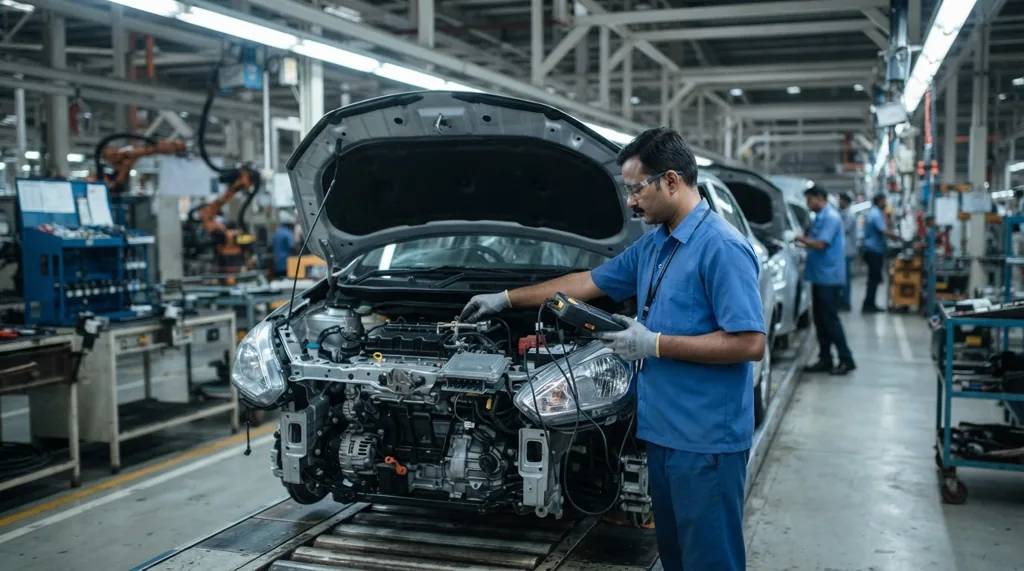
India’s road transport ministry added E100 ethanol fuel to vehicle emission rules for certified flex-fuel vehicles, effective on gazette publication.
India’s road transport ministry has changed its vehicle rules so that certified flex-fuel vehicles can run on E100, fuel made almost entirely of ethanol. The change took effect on publication in the official gazette, and it does not touch ordinary cars already on the road.
The Ministry of Road Transport and Highways (MoRTH) announced the amendments to the Central Motor Vehicles Rules, 1989 on 26 October 20261. The rules now name E100 alongside E85 in the emission certification provisions, the part of the rules that sets pollution limits for vehicle approval. Vehicles certified for these fuels must meet the emission and safety requirements for their category1.
| At a glance | Details |
|---|---|
| What was published | Final amendment to the Central Motor Vehicles Rules, 1989 |
| Published on | 26 October 2026 (ministry announcement) |
| Who must comply | Makers of flex-fuel vehicles certified for E85 or E100 |
| Effective date | Date of publication in the official gazette |
| Next milestone | No further step announced by the ministry |
What changed in the vehicle rules?
The ministry said the amendments support the adoption of flex-fuel vehicles that can use E85 and other high-ethanol fuels1. The emission certification provisions now expressly include E100 alongside E851.
The notification also updates rules on biodiesel and makes technical corrections1. The ministry’s announcement did not give details of those smaller changes.
What are E85, E100 and flex-fuel vehicles?
The letter E stands for ethanol, and the number shows its share of the fuel1. E85 is a petrol and ethanol blend with up to 85% ethanol by volume1. E100 is a fuel made mostly of ethanol1.
Flex-fuel vehicles are built to run on a range of ethanol and petrol blends from a single fuel tank1. Their fuel system parts and materials are chosen for the approved blends. Engine controls adjust automatically to the fuel mix1.
Depending on design and certification, a vehicle’s range may stretch to E85 or E1001. Drivers can then choose any fuel within the range the manufacturer has certified and declared. The ministry noted that Brazil and the United States already use this technology1.
Who the change does not affect
The ministry stressed that E85 and E100 are only for specially designed and certified vehicles1. The fuels do not apply to other vehicles sold in the market or used so far.
A car that works with E10 or E20 is not, for that reason alone, suitable for E851. The notification does not require owners of existing vehicles to switch fuels or modify their cars, now or later1.
The ministry asked motorists to check the fuel compatibility sticker on their vehicle1. It also pointed them to the manufacturer’s guidance in the owner’s manual when choosing fuel at the pump.
Why India is pushing ethanol
The ministry said more use of ethanol made in India can reduce dependence on imported crude oil1. In suitably designed vehicles, ethanol can cut certain exhaust pollutants. It can also lower greenhouse gas emissions over the fuel’s production and use, depending on the crop and process used1.
The vehicle rule change builds on a wider national ethanol programme. The Ministry of Petroleum and Natural Gas reported a 20% blending rate for the ethanol supply year 2025-26, covering November to June 20262. That ministry said several departments, including road transport, worked together to expand feedstock, infrastructure and investment2.
What changes for carmakers and fuel buyers
For vehicle makers, the amended rules give a clear legal basis to certify models for E100 as well as E85. Each certified model must still pass the emission and safety rules for its vehicle category1.
For drivers, the change widens fuel choice only for owners of certified flex-fuel models. Everyone else can keep using the fuel their vehicle maker approves, with no new obligation1.
Key terms in plain words
| Term | Meaning |
|---|---|
| MoRTH | Ministry of Road Transport and Highways, India’s ministry for vehicle and road rules |
| Central Motor Vehicles Rules, 1989 | India’s national rulebook for vehicle approval, safety and emissions |
| Flex-fuel vehicle | A vehicle built to run on different mixes of petrol and ethanol from one tank |
| E85 | Fuel with up to 85% ethanol mixed with petrol |
| E100 | Fuel made almost entirely of ethanol |
| Emission certification | Official testing that a vehicle model stays within pollution limits |
The amended rules are already in force, as they took effect on the date of their publication in the official gazette1.
Sources
- ↩ Press Release Page | Press Information Bureau https://www.pib.gov.in/PressReleasePage.aspx?PRID=2328642®=48&lang=1
- ↩ Press Release:Press Information Bureau https://www.pib.gov.in/PressReleaseIframePage.aspx?PRID=2283118®=48&lang=2