

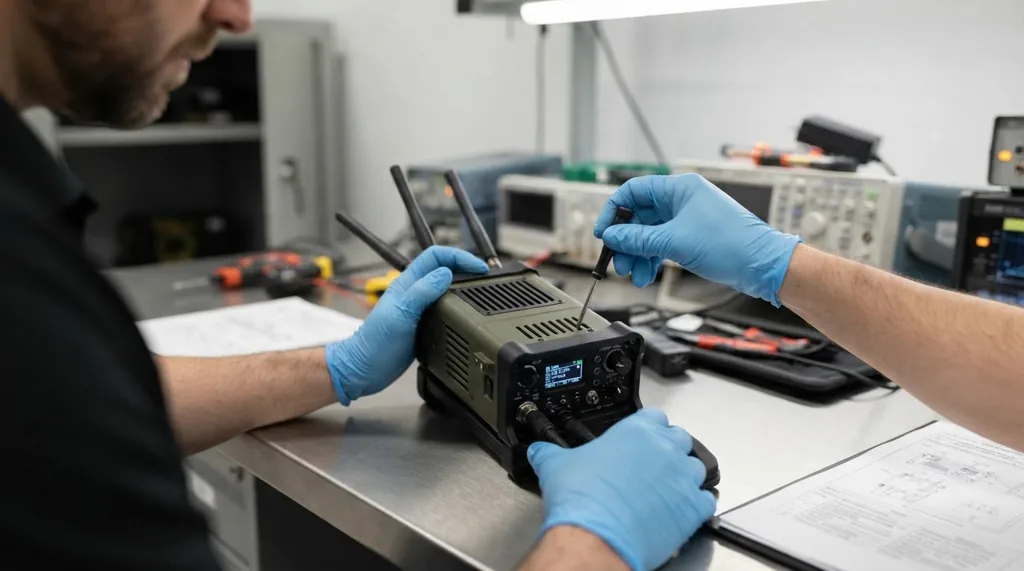
Canada proposed on Oct. 10, 2026, to let selected police forces and their suppliers legally use radio jammers.
Canada’s Department of Industry proposed on Oct. 10, 2026, to let certain police forces and their suppliers legally use and handle radio jammers.
Jammers are devices that block or disrupt radio signals. Canadian law bans them, and until now only federal bodies have held exemptions1.
In short, selected police services would no longer need to call on the Royal Canadian Mounted Police (RCMP) to jam signals. Suppliers that sell to those police services could also demonstrate, sell and service jammers, as long as they follow strict conditions.
What does the jammer exemption order change?
The proposal is the Radiocommunication Act Exemption Order (Jammers — Certain Law Enforcement Agencies), published in Part I of the Canada Gazette, the government’s official journal for draft rules2. The sponsoring department is the Department of Industry1.
The Radiocommunication Act, Canada’s law on radio use, bans installing, using, possessing, making, importing, selling or leasing jammers1. It also bans interfering with any radio communication without lawful excuse. The Minister of Industry can exempt people or organizations from these bans for limited purposes1.
The order would exempt employees of police agencies listed in a schedule. The exemption covers jammer work they must do as part of their duties or training1.
Why are police agencies being added now?
Three exemption orders exist today. The RCMP has held them since 2015, with the current one issued in 20241. The Department of National Defence and the Canadian Armed Forces received one in 2024. Federal and Quebec prison services received a pilot exemption in 20251.
Jammer exemptions so far
The RCMP is the only police agency with an exemption. Other police services therefore depend on it whenever they need jamming1. The RCMP told Innovation, Science and Economic Development Canada (ISED), the federal department that manages radio spectrum, that sustaining this support has become challenging1.
The government says the change would let other agencies act more independently and quickly1. ISED’s regulatory plan says the goal is to help police counter threats from illicit communications, drones and other radio-enabled devices3.
Which police services and suppliers are covered?
The first group would be police agencies that have an explosive disposal unit or that support the prisons already exempted1. Agencies were chosen for their operational capacity and experience with specialized equipment1.
Who the exemption reaches
The exemption would also reach:
- provincial and municipal employees who buy jammers for exempted police agencies
- firms answering a call for bids, who could offer a jammer for sale
- firms answering a letter of interest, request for information or call for bids, who could demonstrate or test equipment
- suppliers and subcontractors delivering jammers or related services under a contract
The order would not broadly let suppliers manufacture jammers in Canada1. Only firms bidding for, or holding a contract with, an exempted police agency could do so. ISED says it will work with stakeholders on a framework for manufacturing outside these cases1.
For what purposes could police use jammers?
Use would be limited to purposes set out in subsection 14(1) of the act1. These are:
- national security
- public safety, including prisons and penitentiaries
- international relations
- investigating or prosecuting offences, including preserving evidence
- protecting property or preventing serious harm to a person
The government gives examples such as protecting critical infrastructure, major public events and crime scenes1. Exempted agencies could also help the RCMP secure the Canadian border, including against organized crime1.
What conditions must police and suppliers meet?
Exempted people must meet conditions to keep the exemption1. They must make every reasonable effort to limit interference with other radio users. They must also keep emissions and exposure to a minimum and store jammers securely1.
Conditions attached to the exemption
| Requirement | Standard / Details |
|---|---|
| Interference | Every reasonable effort to limit interference |
| Emissions | Keep emissions and exposure to a minimum |
| Storage | Store jammers securely |
| Training | Specialized training; RCMP-validated training when available |
| Contacts | Give ISED contact details of responsible people |
Police employees must have received, or be receiving, specialized jammer training1. They must also take RCMP-developed or RCMP-validated training as soon as feasible, where it exists1.
Each police agency must give ISED contact details for the people responsible for its jammers1. This applies to the agency itself and to its suppliers or bidders. ISED inspectors would use the details for interference investigations and compliance checks1.
What does it cost suppliers, and how is it enforced?
The government expects suppliers to benefit, since they cannot sell jammers at all today1. It says compliance costs, such as secure storage, should be minor compared with those benefits. It could not estimate how many businesses would be affected1.
Small businesses may face low costs. The government says it kept the conditions simple and avoided complex record-keeping or reporting duties1. The one-for-one rule, which requires offsetting new administrative costs for business, does not apply1.
Anyone outside the order who handles jammers still breaks the law and faces the act’s enforcement provisions1. ISED will fold compliance checks into its existing enforcement work. The order would have no expiry date, but the minister may amend or repeal it at any time1.
Before drafting, ISED surveyed police services and received questionnaires from 26 agencies1. Police asked that suppliers be able to demonstrate equipment before a contract. They also stressed training to prevent unintended interference1.
Summary of the police jammer exemption order
The table below sets out the core facts of the proposed order.
| Key Dimension | Details |
|---|---|
| Regulating Authority & Jurisdiction | Minister of Industry, under the Radiocommunication Act; applies across Canada1 |
| Instrument | Proposed Radiocommunication Act Exemption Order (Jammers — Certain Law Enforcement Agencies)2 |
| Scope & Who Must Comply | Employees of listed police agencies, procurement staff, bidders, suppliers and subcontractors1 |
| Core Mandate / Key Change | Lifts the jammer ban for these groups for limited purposes1 |
| Permitted Purposes | National security, public safety, international relations, investigations, preventing serious harm1 |
| Compliance Conditions | Limit interference, secure storage, specialized training, contact details to ISED1 |
| Key Dates & Implementation Milestones | Proposed Oct. 10, 2026; 30-day public comment period planned; no expiry3 |
| Penalties / Enforcement Action | Jammer use outside the order stays illegal under the act’s enforcement provisions1 |
ISED planned a 30-day comment period after publication in the Canada Gazette3. Until the order is made final, police agencies other than the RCMP remain bound by the jammer ban.
Sources
- ↩ Canada Gazette, Part 1, Volume 160, Number 41: Radiocommunication Act Exemption Order (Jammers {|mdash|} Certain Law Enforcement Agencies) https://gazette.gc.ca/rp-pr/p1/2026/2026-10-10/html/reg2-eng.html
- ↩ Canada Gazette, Part 1, Volume 160, Number 41: Index https://gazette.gc.ca/rp-pr/p1/2026/2026-10-10/html/index-eng.html
- ↩ Spectrum and Telecommunications Sector – Acts and regulations https://ised-isde.canada.ca/site/acts-regulations/en/forward-regulatory-plan/spectrum-and-telecommunications-sector