

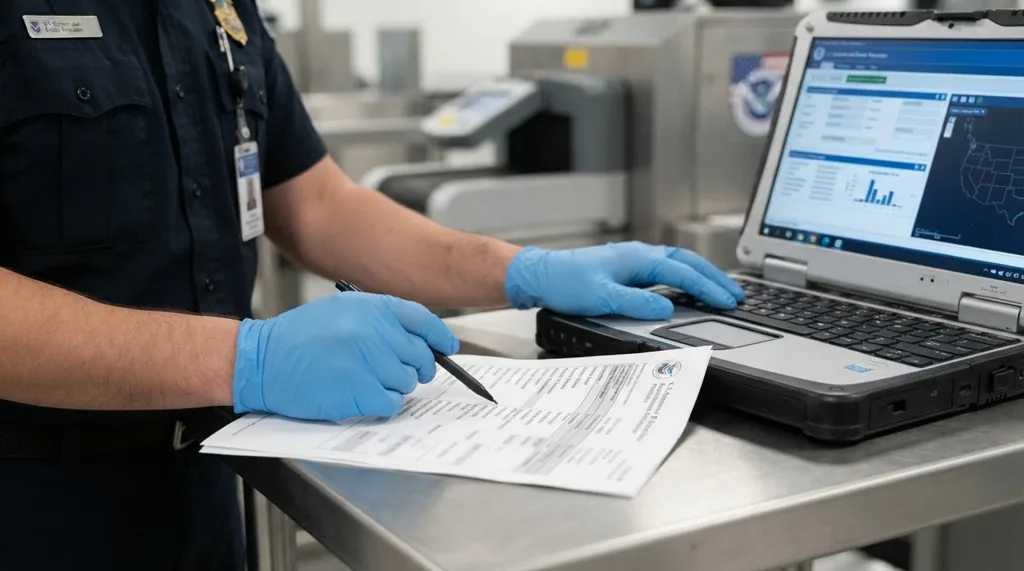
United States border agency CBP proposed on Oct. 13, 2026 that rail carriers send passenger and crew data before trains cross the border, with comments due Dec. 14, 2026.
U.S. Customs and Border Protection (CBP) has proposed a rule requiring rail carriers to send advance electronic data on every passenger and crew member aboard trains crossing the U.S. border, in a notice set for publication on Oct. 13, 20261.
The proposal would turn a voluntary data-sharing program into a legal duty for passenger and cargo railroads running trains to and from Canada and Mexico2.
In short, railroads would have to tell CBP about a cross-border train and the people on it before the train reaches the border. CBP would screen those travelers in advance and could recommend that a carrier not board a person it flags2.
What would the CBP rail rule require?
The notice of proposed rulemaking, a draft rule published for public comment, is titled "Advance Traveler Information for Rail"1. It carries docket number USCBP-2026-0992 and regulatory identifier RIN 1651-AB60, and would amend 19 CFR Part 123, the rules on CBP’s dealings with Canada and Mexico1.
The draft sets two core duties for rail carriers:
- An advance notice of arrival or departure for any train entering or leaving the United States with a traveler on board.
- Advance electronic traveler information for every crew member and passenger aboard.
Both duties also cover trains that cross the U.S. border while in transit1. The notice would be due no later than 24 hours before the train reaches the U.S. border crossing, on both inbound and outbound trips1.
Which traveler data must railroads send?
The required data largely matches what appears on a passport or other travel document approved by the Department of Homeland Security (DHS). It includes name, date of birth, sex, country of citizenship, country of residence, and the document’s type, number, issuing country and expiry date1.
Data railroads would send for each traveler
| Requirement | Standard / Details |
|---|---|
| Identity | Name, date of birth, sex, citizenship, residence |
| Travel document | Type, number, issuing country, expiry date |
| Trip details | Role on board and complete itinerary |
| U.S. address | All travelers except those in transit |
| If available | Booking locator, baggage tag, seat, phone, email |
Carriers would also send each traveler’s role on board, such as conductor, engineer, passenger or crew, and their complete itinerary1. Other items include a U.S. address for all travelers except those in transit, an alien registration number where one applies, and a known traveler number where one applies1.
Several items are required only when available or applicable. These include the booking record locator, redress number, baggage tag information, seat and car number, a phone number with country code, and an email address1.
How would CBP screening of rail travelers work?
After a carrier sends the data, CBP would run an initial check and send back a response message2. The message would either confirm that CBP accepted the data or tell the carrier to contact CBP before departure2.
From data to boarding
If the check finds no traveler of concern, the carrier needs to take no further advance action2. If CBP flags a traveler, the carrier would call a CBP phone number to resolve the issue, for example by fixing errors in the data2. Where a traveler raises potential security, immigration, customs or other law enforcement issues, CBP may recommend that the carrier not board that person2.
How would carriers transmit data to CBP?
The draft offers carriers two ways to send the data2. Under the first, a carrier would use its own system, which CBP must test and certify as able to exchange data and messages with CBP’s system2.
Under the second, a carrier could use any electronic system CBP approves. Examples include the Electronic Advance Passenger Information System (eAPIS), an online CBP portal for passenger data, or any CBP-approved application with manifest functions2.
Why is CBP ending the voluntary rail program?
Current rules require a rail carrier to report a train’s arrival only when it reaches the U.S. port of entry2. Travelers on board also report to CBP only once they arrive2.
In 2005, CBP set up a program that lets rail carriers send traveler data voluntarily2. Only one rail carrier currently takes part2. CBP says the lack of advance data has left a security gap that terrorists or other criminals could exploit, and that the risk has grown as air and sea travel security has tightened1.
CBP also expects faster processing at the border when data arrives early and complete, and wants consistent procedures across all modes of transport1. The agency bases its legal power on sections 431 and 433 of the Tariff Act of 1930, which allow DHS to demand electronic manifests, or lists of people and goods, from the person in charge of a vehicle, including a train1.
What would the rail rule cost carriers?
CBP’s cost analysis covers 2026 to 20302. It finds net gains for most groups but a net cost for cargo railroads2:
- Rail passengers: annual net benefit of $8,170,861.
- Passenger rail carriers: annual net benefit of $346,911.
- CBP: annual net benefit of $62,567.
- Cargo rail carriers: annual net cost of $380,495.
Annual net benefit by group, USD
Over the full period, passenger rail carriers would gain $1,542,478 at a 3% discount rate, while cargo carriers would bear a net cost of $1,691,8022. CBP says security benefits for all groups were not counted in these figures2.
Summary of the Advance Traveler Information for Rail proposal
The table below sets out the core facts of the draft rule.
| Key Dimension | Details |
|---|---|
| Regulating Authority & Jurisdiction | U.S. Customs and Border Protection, Department of Homeland Security; 19 CFR Part 1231 |
| Scope & Who Must Comply | Rail carriers running trains with travelers into, out of or through the United States1 |
| Core Mandate / Key Change | Advance notice of arrival or departure plus electronic data on all passengers and crew1 |
| Compliance Thresholds | Notice due no later than 24 hours before reaching the U.S. border crossing1 |
| Transmission Options | CBP-certified carrier system, or CBP-approved system such as eAPIS2 |
| Screening Outcome | CBP accepts the data or asks the carrier to call; it may recommend not boarding a traveler2 |
| Cost Estimate | Cargo carriers face a $380,495 annual net cost; passenger carriers gain $346,911 a year2 |
| Key Dates & Milestones | Publication Oct. 13, 2026; comments due Dec. 14, 20261 |
| Legal Basis | Sections 431 and 433 of the Tariff Act of 19301 |
Comments on the draft must reach CBP by Dec. 14, 2026, through the federal eRulemaking portal under docket USCBP-2026-09921. The proposal does not yet set a date when the requirements would take effect; CBP must first issue a final rule.
Sources
- ↩ Federal Register :: Advance Traveler Information for Rail https://www.federalregister.gov/documents/2026/10/13/2026-20884/advance-traveler-information-for-rail
- ↩ 2026-20884.pdf https://www.govinfo.gov/content/pkg/FR-2026-10-13/pdf/2026-20884.pdf