

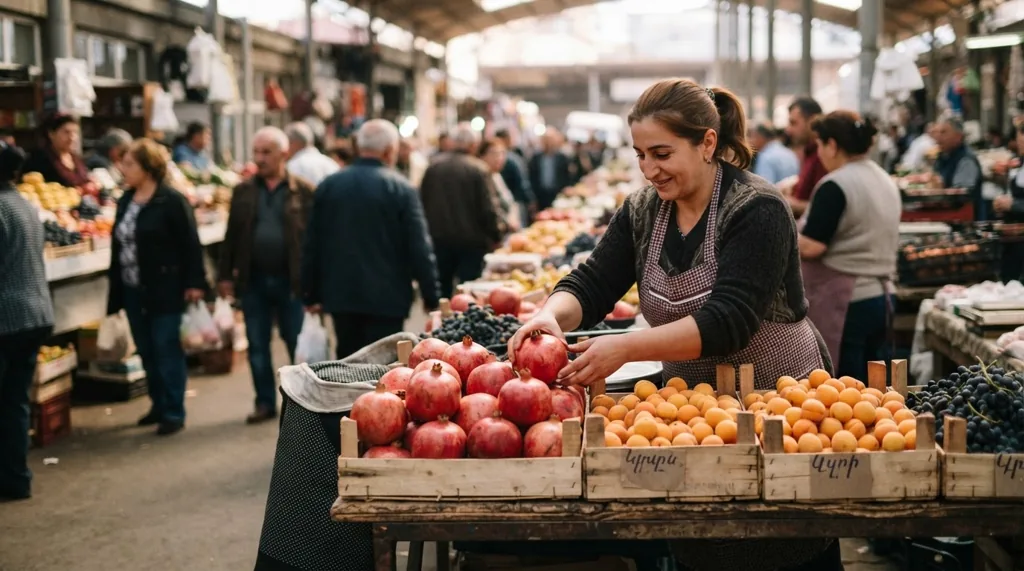
European Union importers can bring in listed Armenian goods free of ad valorem duties from Oct. 10, 2026, for two years.
The European Union has removed or cut import duties on a wide range of Armenian goods, including farm produce such as fruit, vegetables and honey, for two years from Oct. 10, 20261.
The measure is Regulation (EU) 2026/2269 of the European Parliament and of the Council of Oct. 7, 2026, published in the EU’s Official Journal on Oct. 91. According to the Council, it frees around 80% of Armenia’s exports to the EU from duties1.
In short, EU importers can bring in many Armenian products without paying the usual percentage-based customs duty, as long as the goods truly come from Armenia and carry valid proof of that. The European Commission can switch the benefit off if Armenia breaks the conditions, or impose protective measures if imports hurt EU producers.
Why did the EU open its market to Armenia?
The regulation responds to trade measures that Russia has imposed since May 20262. Those measures hit imports and transit of key Armenian exports, including alcoholic beverages, mineral water, fruits and vegetables2. The legal text says this has cut Armenia’s access to its traditional markets and disrupted supply chains, hurting small firms and farmers most2.
The EU’s stated aim is to help Armenia diversify its exports and strengthen its economic resilience1. The measure sits within the EU-Armenia Comprehensive and Enhanced Partnership Agreement, the treaty that governs relations between the two sides1. That agreement entered into force on March 1, 20212.
The Armenian government notes that Armenia is the only country without EU candidate status or a Deep and Comprehensive Free Trade Agreement with the EU to receive such preferences3.
Which Armenian goods enter the EU duty-free?
The regulation splits the products into two lists, called annexes1:
- Annex I goods: exempt from percentage-based duties with no volume limit.
- Annex II goods: exempt from those duties only within yearly tariff quotas, measured in tonnes.
Annex I follows the duty suspensions of the EU’s Generalised Scheme of Preferences Plus, an existing EU tariff-preference schedule, with some changes2. Certain sensitive products were removed, and some farm goods banned by Russia were added2. Annex II covers eight agricultural products2.
Annex I includes, among many others, fish and seafood, live plants and cut flowers, natural honey, potatoes, tomatoes, onions, mushrooms and other fresh vegetables2. Duty relief is determined by the product’s Combined Nomenclature (CN) code, the EU’s customs classification number2.
Do any duties still apply to Armenian imports?
Yes. The regulation removes only "ad valorem" duties, meaning duties charged as a percentage of the goods’ value1. It does not cover specific duties, which are charged per unit such as per kilogram, so those still apply1.
The Commission’s trade portal says importers should check each CN code against the relevant annex and the EU’s TARIC tariff database1. For Annex I products, the duty suspension applies directly1.
For Annex II products, the first quota period runs from entry into force until Dec. 31, 20261. Once a quota is used up, the normal tariff applies1. The Commission manages the quotas under Articles 49 to 54 of Implementing Regulation (EU) 2015/24471.
How do importers prove Armenian origin?
Only goods with Armenian preferential origin, under the rules of origin between the EU and Armenia, qualify1. The importer must hold a valid proof of origin when goods are declared for release into free circulation, the customs step that clears goods for sale in the EU1.
Proof of Armenian origin at EU customs
| Document / Filing | Requirement |
|---|---|
| EUR.1 movement certificate | Declared in H1 with code N954 |
| Invoice origin declaration | Code N864; approved exporter above EUR 6,000 |
| REX exporter declaration | Allowed by the regulation; customs acceptance not yet confirmed |
| Preference code | Enter 300 in H1 |
The regulation accepts three types of proof1:
- a EUR.1 movement certificate;
- an origin declaration on an invoice or other commercial document by the exporter, or by an approved exporter where the value exceeds EUR 6,000;
- an origin declaration by an exporter registered in the EU’s REX system, an online register of exporters.
So far, the EU has confirmed acceptance of only the first two in customs declarations1. Importers declare them in the H1 customs declaration with code N954 for the EUR.1 certificate and code N864 for the invoice declaration1. The preference code to enter is 3001.
When can the EU suspend the Armenia preferences?
The benefits depend on four conditions set out in Article 22. Armenia must follow the rules of origin and cooperate closely with the EU to verify origin and prevent fraud2. It must not raise duties or add new trade barriers on EU goods unless justified and notified to the Commission2. It must also respect democracy, the rule of law and human rights, and counter the spread of weapons of mass destruction2.
Conditions Armenia must meet
| Requirement | Standard / Details |
|---|---|
| Rules of origin | Follow EU-Armenia rules of origin |
| Customs cooperation | Help the EU verify origin and prevent fraud |
| No new trade barriers | No new or higher duties on EU goods |
| Essential elements | Democracy, rule of law, human rights, non-proliferation |
If the Commission finds sufficient evidence that Armenia has broken a condition, it may suspend the preferences in whole or in part2. When an EU country asks for suspension over new Armenian trade barriers, the Commission must give a reasoned opinion within four months2.
How does the safeguard protect EU producers?
The Commission may impose any necessary measure if Armenian imports under the regulation harm EU producers of similar or competing products2. It can start an assessment at an EU country’s request or on its own initiative, and must finish within four months2. The assessment looks at how fast imports rise and their effect on EU production and prices2.
Safeguard time limits, days
In urgent cases, the Commission can impose provisional measures within 21 days of a country’s request2. Those measures can last no more than 120 days2. Before a final measure, the Commission must publish a notice, giving interested parties no more than 10 days to comment2.
The Commission will report on how the measures work to the EU-Armenia Partnership Committee in its trade configuration2.
Summary of the EU-Armenia trade-liberalisation regulation
The table below sets out the main points of Regulation (EU) 2026/2269.
| Key Dimension | Details |
|---|---|
| Regulating Authority & Jurisdiction | European Parliament and Council; European Commission manages quotas and suspensions; applies in all EU countries1 |
| Scope & Who Must Comply | EU importers of goods of Armenian preferential origin listed in Annex I or Annex II1 |
| Core Mandate / Key Change | Ad valorem import duties removed; specific duties still apply1 |
| Coverage | Around 80% of Armenia’s exports to the EU, according to the Council1 |
| Quotas | Annex II: eight farm products duty-free within yearly tonnage quotas2 |
| Proof of Origin | EUR.1 certificate (code N954) or invoice declaration (code N864); preference code 3001 |
| Key Dates | Adopted Oct. 7, 2026; published Oct. 9; applies from Oct. 10 for two years1 |
| Enforcement & Safeguards | Commission may suspend preferences or impose safeguard measures; provisional measures up to 120 days2 |
The next milestone is Dec. 31, 2026, when the first Annex II quota period ends1. The preferences then run until two years after entry into force3.
Sources
- ↩ The EU temporarily liberalises trade in certain products originating in Armenia | Access2Markets https://trade.ec.europa.eu/access-to-markets/en/news/eu-temporarily-liberalises-trade-certain-products-originating-armenia
- ↩ pdf https://data.consilium.europa.eu/doc/document/PE-61-2026-INIT/en/pdf
- ↩ With EU regulations, approximately 80 percent of Armenia’s exports to the EU will be liberalized • Government of the Republic of Armenia https://www.gov.am/en/articles/%D5%AC%D6%80%D5%A1%D5%B0%D5%B8%D5%BD/with-eu-regulations-approximately-80-percent-of-armenias-exports-to-the-eu-will-be-liberalized