

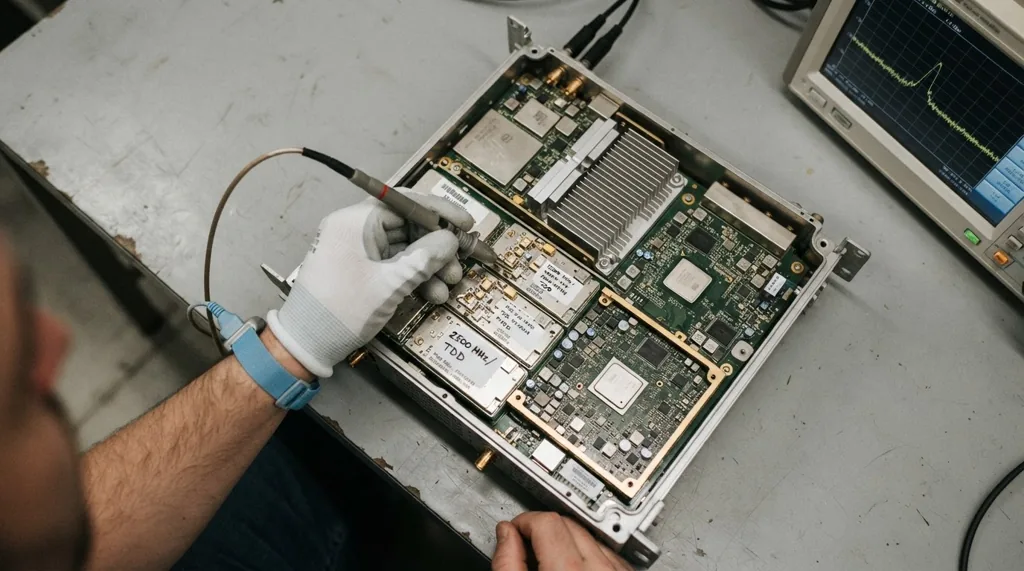
Canada has revised the 2500-2690 MHz band into 38 unpaired 5 MHz TDD blocks and lifted current deployment requirements, with the decision published in the Canada Gazette on Oct. 10, 2026.
Innovation, Science and Economic Development Canada (ISED) has decided to convert the 2500-2690 MHz mobile band to a single unpaired layout for Time Division Duplexing, a change published in the Canada Gazette on Oct. 10, 2026, that will reshape how Bell, Rogers, TELUS, Videotron, Cogeco and other licensees run 5G networks in the band.
The decision, numbered SPB-006-26, replaces a mix of paired and unpaired frequency blocks with 38 unpaired blocks of 5 MHz each1. ISED, the federal department that manages radio spectrum, also lifted the current deployment requirements attached to licences in the band2.
In short, Canada is moving its 2500 MHz band to the same technology used across the border in the United States. Operators keep their licences, but they will eventually need to swap equipment and, for now, no longer face the old build-out tests.
What does the 2500 MHz decision change?
Until now, the band followed an international plan that mixed two technologies. Frequency Division Duplexing (FDD) uses one pair of frequencies, one to send and one to receive. Time Division Duplexing (TDD) uses a single block and takes turns sending and receiving1.
The 2500 MHz band plan, old and new
| Question | Old plan | New plan |
|---|---|---|
| Technology | Paired FDD plus unpaired TDD | Unpaired TDD only |
| Unpaired range | 2570-2620 MHz | All 2500-2690 MHz |
| Block layout | Paired blocks plus middle unpaired range | 38 blocks of 5 MHz |
Under the old plan, blocks in 2500-2570 MHz were paired with blocks in 2620-2690 MHz. Only the middle range, 2570-2620 MHz, was unpaired1. Within that middle range, 2570-2575 MHz and 2615-2620 MHz were restricted bands, usable only without protection from interference1.
The new plan makes the entire 190 MHz range unpaired spectrum for TDD use1. The decision states the core ruling plainly: ISED is revising the band "to a new unpaired band plan consisting of 38 unpaired 5 MHz blocks in 2500-2690 MHz"1. The blocks run from A1 at 2500-2505 MHz to U2 at 2685-2690 MHz1.
Why did ISED move to the U.S. TDD layout?
In 2011, ISED chose the international plan over the U.S. plan, which allows only TDD1. That choice has caused growing trouble along the border as both countries rolled out 5G1.
Canadian licensees reported rising interference, most of all in the FDD uplink range of 2500-2570 MHz1. The decision says this interference has made it harder for operators to meet their deployment obligations1. Rogers told ISED that operators and regulators on both sides of the border had studied the problem since 20141.
ISED expects the change to cut cross-border interference, widen access to equipment and lead to more efficient use of the band1. It also pointed to the large TDD equipment market built by U.S. operators using the band1.
How were the 5 MHz block sizes chosen?
The January 2026 consultation, SPB-002-26, proposed the TDD switch but left block sizes for later3. Respondents instead pressed ISED to move quickly on updating its equipment standard, RSS-199, for the band1.
Stakeholders split on size. TELUS wanted to keep 10 MHz blocks, while Cogeco argued that 5 MHz blocks would work1. ISED settled on a minimum block size of 5 MHz1.
The decision says smaller blocks give room for licensees that now hold 25 MHz blocks, while still fitting 10 MHz holdings1. Operators may combine the 5 MHz blocks into wider channels1.
Several parties, including Nokia and TELUS, asked ISED to extend the band down to 2496 MHz to match a common global equipment band1. ISED said this falls outside the decision’s scope and needs more study, but it may consult on it later1.
Which 2500 MHz licensees are affected?
The change reaches every licence in the band. ISED awarded 304 licences at a 2015 auction on 20-year terms ending in 20351. Residual auctions in 2018 and 2023 added 66 licences with terms ending in 20381. Another 204 licences held before the 2015 auction remain in force, also expiring in 20351.
Licences in the 2500 MHz band, by origin
Twelve parties commented on the consultation, among them Bell, Rogers, TELUS, Québecor, Cogeco, SaskTel, Xplore and Eastlink1. Almost all supported the switch1.
Eastlink stood apart and strongly opposed the change. It warned of stranded investment in equipment that would soon be replaced, extra costs and risks to consumers1. Globalstar did not object, provided services in the adjacent 2483.5-2500 MHz range stay fully protected1.
What happens to deployment requirements?
Licences in the band carried rules requiring holders to prove they were putting the spectrum to use. The 2015 auction framework gave licensees 10 years from first issue to show this3.
ISED has now lifted current deployment requirements for licences in the 2500 MHz band2. New requirements to show the spectrum is in use will be set in a future decision, following consultation2. ISED posted the same notice on the licence conditions for non-auctioned licences renewed in 20204.
For operators, this removes the risk of failing build-out tests while equipment plans are redrawn. It does not end the obligation for good: a new test is coming.
How does this fit with the border workaround?
In January 2026, ISED issued spectrum advisory bulletin SAB-01-26 as a stopgap2. It let five groups swap access to frequency blocks along the border to avoid U.S. interference: Bell, Cogeco, Videotron, Rogers and TELUS2.
From stopgap to new band plan
That authorization took effect on Feb. 2, 20262. ISED described it as a provisional solution, and the decision calls it only an interim measure1. The new band plan is the long-term answer.
When will operators have to switch to TDD?
The consultation floated starting the transition around 2028, with four to six years to finish it3. Existing licensees generally said a 2028 start would not be appropriate1.
Operators told ISED they still use and deploy older equipment for the current plan1. They said manufacturers also need time to build and certify new equipment for Canada1. TELUS argued against any mandatory start date1.
The decision says giving licensees ample time should ease costs by letting them replace equipment near the end of its normal life1.
Summary of Canada’s 2500 MHz TDD band plan decision
The table below sets out the main points of decision SPB-006-26.
| Key Dimension | Details |
|---|---|
| Regulating Authority & Jurisdiction | Innovation, Science and Economic Development Canada, for the Minister of Industry, under the Radiocommunication Act1 |
| Scope & Who Must Comply | All licensees in the 2500-2690 MHz band, including 304 licences from 2015, 66 residual and 204 older licences1 |
| Core Mandate / Key Change | Whole band becomes unpaired spectrum for TDD use1 |
| Technical Thresholds | 38 unpaired blocks of 5 MHz, which can be combined1 |
| Deployment Rules | Current deployment requirements lifted; new ones to follow consultation2 |
| Key Dates & Implementation Milestones | Decision dated September 20261; Canada Gazette notice Oct. 10, 20265 |
| Licence Expiry | 2035 for auction and older licences; 2038 for residual licences1 |
| Related Interim Measure | SAB-01-26 border block swaps, in effect Feb. 2, 20262 |
The next concrete step is a consultation on new rules for showing the spectrum is in use, which ISED says will lead to a future decision2. Licence terms for most of the band run to 20351.
Sources
- ↩ Decision on Revisions to the Band Plan for 2500-2690 MHz https://ised-isde.canada.ca/site/spectrum-management-telecommunications/en/learn-more/key-documents/consultations/decision-revisions-band-plan-2500-2690-mhz
- ↩ SAB-01-26 — Authorization for the Use of Certain Frequency Blocks in the 2500 MHz Band along the Canada/U.S. Border https://ised-isde.canada.ca/site/spectrum-management-telecommunications/en/learn-more/key-documents/spectrum-advisory-bulletins-sab/sab-01-26-authorization-use-certain-frequency-blocks-2500-mhz-band-along-canadaus-border
- ↩ Consultation on the Revisions to the 2500-2690 MHz Band Plan https://ised-isde.canada.ca/site/spectrum-management-telecommunications/en/learn-more/key-documents/consultations/consultation-revisions-2500-2690-mhz-band-plan
- ↩ Q9 — 2.5 GHz BRS Non-Auctioned Spectrum Licences issued via the 2020 Renewal Process https://ised-isde.canada.ca/site/spectrum-management-telecommunications/en/licences-and-certificates/conditions-licence-appendices/q9-25-ghz-brs-non-auctioned-spectrum-licences-issued-2020-renewal-process
- ↩ Canada Gazette, Part 1, Volume 160, Number 41: Index https://gazette.gc.ca/rp-pr/p1/2026/2026-10-10/html/index-eng.html