

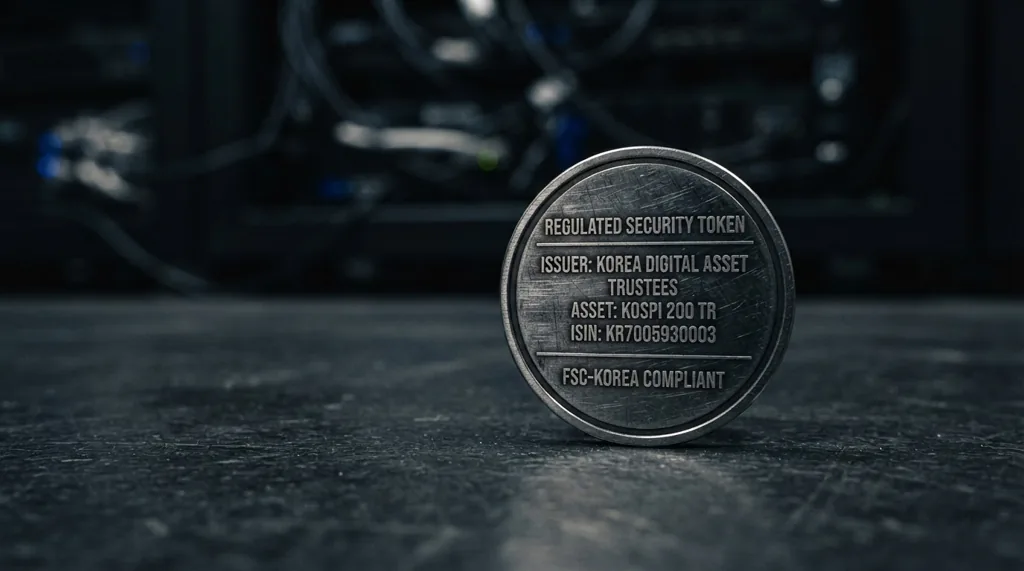
South Korea’s Financial Services Commission proposed detailed rules on Oct. 1, 2026 allowing stocks, bonds, funds and fractional investments to be issued and traded as tokens from Feb. 4, 2027.
South Korea’s Financial Services Commission (FSC), the country’s financial regulator, on Oct. 1, 2026 proposed detailed rules that let stocks, bonds, funds and fractional investments be issued and traded as digital tokens from Feb. 4, 20271.
The proposal revises the subordinate regulations, the detailed rules beneath two laws: the Financial Investment Services and Capital Markets Act (FSCMA) and the Act on Electronic Registration of Stocks and Bonds (the Electronic Registration Act)1. Both laws were already amended to allow tokenized securities from February 20271.
In short, Korea is writing the practical rulebook for security tokens, which are securities recorded on a shared digital ledger. Issuers, securities firms and trading venues now know the capital, staffing, ledger and investor-limit rules they must meet before the market opens.
Which securities can be tokenized in Korea?
The proposal covers traditional securities and newer fractional products1. These are the types allowed:
- stocks
- bonds
- funds
- non-monetary trust beneficiary certificates, which are fractional shares in assets held in trust
- investment contract securities, which give investors a share in a joint business project
This list follows a policy roadmap the FSC published on Sept. 4, 20262. That roadmap said tokenization would include conventional securities, not just fractional ones2.
The roadmap also set out three phases. The first phase, from February 2027, targets private money market funds and bonds reserved for institutional investors, unlisted stocks held through a trust, and publicly offered fractional investments2. A second phase would open tokenization to all publicly offered securities, and a third would seek on-chain payments linked to stablecoins2. The FSC said the timing of the later phases will stay flexible and depends on the first phase, technology and pending stablecoin legislation2.
How must the distributed ledgers work?
A distributed ledger is a shared database copied across several participants. Under the proposal, each ledger must be shared by at least two account management entities together with the Korea Securities Depository (KSD), the national electronic registration body1. The FSC said this ensures credibility and continuity1.
Ledger rules in the FSC proposal
| Dimension | Requirement / Provision |
|---|---|
| Who shares each ledger | At least two account management entities plus the KSD |
| Fees | No direct fee for use of the ledger |
| Connection check | KSD tests a firm’s system when it applies to connect |
| What is tested | Plans for system errors and business continuity |
Ledger operators will not be allowed to charge a fee directly for use of the ledger1. The regulator cited the public nature of the ledgers and the need to avoid disruption in confirming who owns which securities1.
The KSD has also prepared screening criteria for ledgers2. It will test a securities firm’s system when the firm applies to connect, including plans for system errors and business continuity2.
What must issuer account managers meet?
The amended Electronic Registration Act creates a new role, the "issuer account management entity"2. This is a token issuer that may manage securities accounts for its own customers, a task previously reserved for financial companies2.
Entry rules for issuer account management entities
| Requirement | Standard / Details |
|---|---|
| Equity capital | KRW4 billion minimum |
| Account management staff | At least one professional |
| Internal control staff | At least one professional |
| IT staff | At least two professionals |
| IT and cybersecurity | Strict compliance with standards |
The proposal sets firm entry requirements for these issuers1. They must have:
- KRW4 billion in equity capital at minimum
- at least one account management professional
- at least one internal control professional
- at least two information technology professionals
The roadmap added that these entities must also comply strictly with information technology and cybersecurity standards2. Start-ups that want to issue and service their own tokens will need to meet these thresholds before they can manage customer accounts.
How will over-the-counter token trading change?
Over-the-counter (OTC) exchanges are trading venues outside the main stock market. The proposal adds a new OTC licensing unit for debt securities1. It sits alongside existing units for unlisted stocks and non-monetary trust beneficiary certificates1.
The FSC said it expects trading of debt securities between retail investors to grow once bonds can circulate as tokens1. Investment contract securities do not yet get an OTC licensing unit; the roadmap said this will be considered after further study2.
No separate licence will be created only for tokenized securities2. Firms already authorized for a financial investment business can handle tokens within their licensed areas, but must consult the Financial Supervisory Service (FSS), the FSC’s supervisory arm, before intermediating token trades2.
What limits protect retail investors?
Retail investors will face a cap of KRW100 million in annual net purchases on each OTC exchange1. Net purchases are purchases minus sales over the year.
OTC exchanges must already follow standards to prevent, monitor and respond to unfair trading2. Rule-breaking on these venues can bring sanctions under the FSCMA, including criminal punishment, penalty surcharges, account freezes and bans on serving as an executive2.
For fractional investments through trusts, the roadmap’s model standards suggest a cap on each person’s subscription2. The cap is the smaller of KRW30 million or 5% of the total issue2. Those model standards apply immediately to fractional investments already issued as electronic securities2.
When does the FSC comment period close?
The proposals are open for public comment from Oct. 2 to Nov. 11, 20261. After that they go through an approval process before taking effect on Feb. 4, 20271.
Key dates for Korea’s token securities rules
Before the first phase starts, the KSD and securities companies are to build the needed infrastructure together2. The next fixed date is the Nov. 11, 2026 close of comments, after which the final rules must be approved in time for the Feb. 4, 2027 launch1.
Sources
- ↩ Press Releases – Financial Services Commission — pr010101 / 87834 https://www.fsc.go.kr/eng/pr010101/87834
- ↩ Press Releases – Financial Services Commission — pr010101 / 87653 https://www.fsc.go.kr/eng/pr010101/87653