

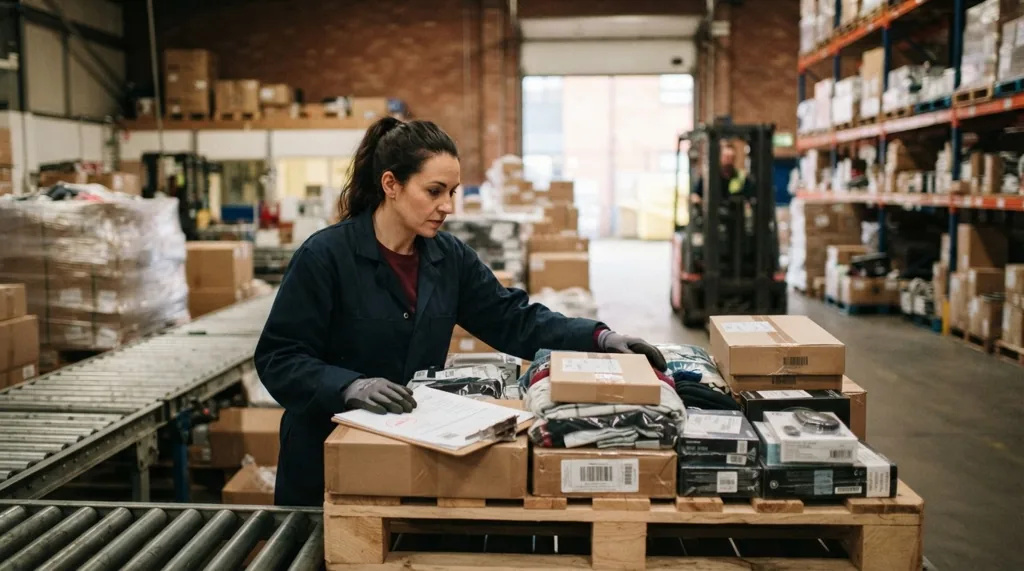
The UK will add the EU ban on forced-labour goods to the Windsor Framework on 10 November 2026, applying in Northern Ireland from 14 December 2027.
The UK government plans to apply the EU ban on products made with forced labour in Northern Ireland. It will agree the move on 10 November 2026, and the rules would apply there from 14 December 2027.
The Department for Business, Innovation, Science and Trade sent Parliament an explanatory memorandum on 4 November 2026, a paper explaining an EU law the UK is asked to adopt1. It covers Regulation (EU) 2024/3015, the EU Forced Labour Regulation, which bans firms from selling or exporting goods made with forced labour1. The UK will agree to add it to the Windsor Framework, the UK-EU deal on trade rules for Northern Ireland, at a meeting on 10 November2.
| At a glance | Details |
|---|---|
| What was published | Explanatory memorandum on adding an EU forced labour ban to the Windsor Framework |
| Published on | 4 November 2026 |
| Who must comply | Firms selling, supplying or exporting products in Northern Ireland |
| Effective date | 14 December 2027 |
| Next milestone | UK-EU Withdrawal Agreement Joint Committee meeting, 10 November 2026 |
What is the forced labour ban, and why does it matter?
The EU adopted the regulation on 27 November 2024 and published it on 12 December 20241. It stops firms from placing or making available products made with forced labour on the EU market1. It also stops them exporting such products.
Forced labour means forced or compulsory work as defined in Article 2 of ILO Convention No 291. That definition includes forced child labour. The ban also covers forced labour imposed by state authorities1.
The ban reaches any product of any sector. It applies whether goods are imported, made locally, sold online or exported1. Online offers count as on the market when they target buyers in the EU.
Why Northern Ireland is affected
The EU asked the UK to add the regulation through Article 13(4) of the Windsor Framework1. This is the procedure for adding new EU laws to the Northern Ireland trade arrangements. The rules would apply there from 14 December 2027, the same date as in the EU1.
From EU law to Northern Ireland
One part will not apply. Article 36, which changes an EU whistleblowing law, is left out for Northern Ireland1. The UK will implement the rest as EU member states do, to avoid gaps between the two systems1.
The move is still subject to the safeguards in Schedule 6B of the Northern Ireland Act 19981. These safeguards give Northern Ireland a democratic check on new EU rules.
How investigations and bans work in practice
Firms do not have to prove their supply chains are free of forced labour before selling goods1. Instead, authorities must prove a breach, using evidence gathered in each case. The European Commission leads cases where the forced labour is suspected outside the EU1.
Decisions must give firms reasonable time to comply. That is normally at least 30 working days, or 10 working days for perishable goods, animals and plants1. Firms may ask for a review at any time with substantial new evidence1.
Banned goods must be recycled or made unusable. Perishable goods should be donated to charity where possible1.
The role of customs at the border
Customs officers do not decide on their own whether forced labour was used1. They enforce decisions sent by the lead authority. When they spot a covered product, they suspend its release and notify that authority1.
How customs handles a covered product
If the authority confirms the product is covered, customs must refuse release or export1. Border checks follow investigations, not routine paperwork checks on all goods1. The Cabinet Office statement says any practical effect is expected to be minimal2.
What changes in Great Britain
The government will introduce a separate UK regime alongside the EU rules2. It will make human rights due diligence, checks a firm runs on its supply chain, mandatory. That duty covers services across the UK and goods in Great Britain only1.
A designated regulator will be able to withdraw, confiscate or dispose of goods made with forced labour1. This applies where a firm failed to meet the required standard of checks.
| Rule | EU ban in Northern Ireland | New UK regime |
|---|---|---|
| Where for goods | Northern Ireland | Great Britain |
| Who is covered | Any firm | Turnover over £350 million |
| Start | 14 December 2027 | No earlier than December 2027 |
The UK regime applies to firms with global turnover over £350 million1. It also covers non-UK firms with UK turnover above that level, with a review every five years1. The government aims for it to start alongside the EU rules in December 20272.
Trade between Great Britain and Northern Ireland
The minister concluded the move will not create a new regulatory border between Great Britain and Northern Ireland1. Goods in free circulation in Northern Ireland will keep unfettered access to Great Britain1.
Trade data shows Northern Ireland imports with possible forced labour risks are a minimal share of trade2. The government will give Northern Ireland firms targeted guidance1. Costs for hauling, storing and disposing of seized goods will add funding pressure1.
Key terms in plain words
| Term | Meaning |
|---|---|
| Windsor Framework | The UK-EU deal setting trade rules for Northern Ireland |
| Forced Labour Regulation | The EU law banning goods made with forced labour |
| Explanatory memorandum | A government paper telling Parliament about an EU law |
| Due diligence | Checks a firm runs on its suppliers for abuses |
| Joint Committee | The UK-EU body that runs the Withdrawal Agreement |
| Competent authority | The public body that investigates and enforces the ban |
The UK and EU will take the decision at the Joint Committee on 10 November 20262.
Sources
- ↩ 2026-11-04_-_EU_EM_Regulation__EU__2024.3015.pdf https://assets.publishing.service.gov.uk/media/6aec60d7d548048bba0e7db3/2026-11-04_-_EU_EM_Regulation__EU__2024.3015.pdf
- ↩ Pdf https://commonsbusiness.parliament.uk/Document/108784/Pdf?subType=Standard