

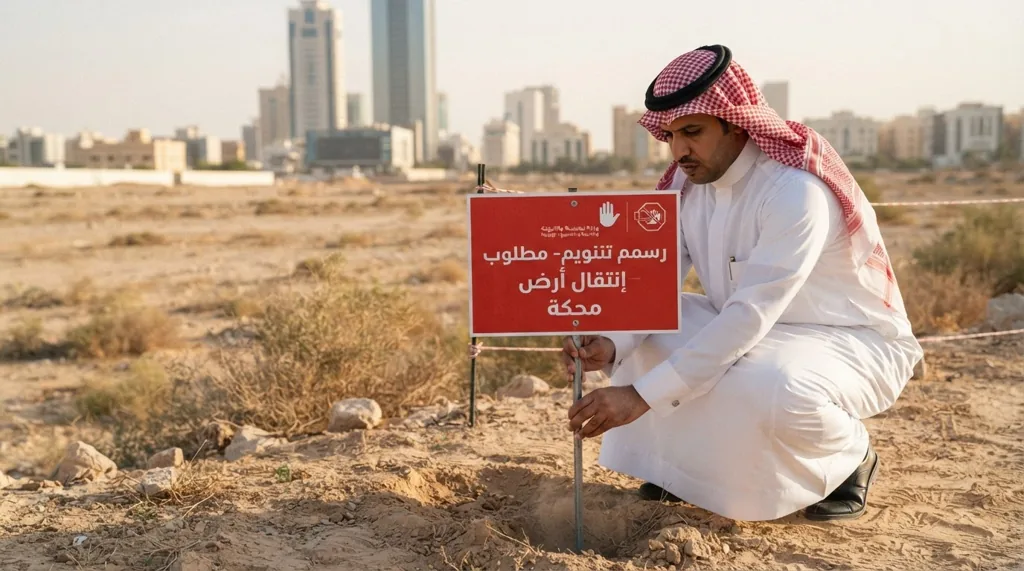
Saudi Arabia’s housing ministry approved rules barring recorded sales of fee-liable white land until fees are paid, with set cases still allowed.
Saudi Arabia’s housing ministry has approved rules that stop most sales of land subject to white land fees until the fees are paid. A set list of deals can still be recorded, but owners must still pay what they owe.
The Ministry of Municipalities and Housing announced the rules on 4 November 2026, according to the Saudi Press Agency (SPA), the state news agency1. They apply to owners, developers and buyers of land that carries the annual fee on undeveloped plots. The ministry says the rules carry out Cabinet Decision No. 263, which bars recording ownership transfers of such land before the due fees are verified as paid1.
| At a glance | Details |
|---|---|
| What was published | Approved rules and procedures for property deals on land subject to white land fees |
| Published on | 4 November 2026 |
| Who must comply | Owners, heirs, developers, buyers and real estate funds dealing in fee-liable land |
| Feedback deadline / Effective date | Not stated in the announcement |
| Final rules / Next milestone | Approved deals must complete the required procedures and keep paying due fees |
What are white land fees, and why do they matter?
White land fees are annual charges on undeveloped land inside Saudi cities. The law behind them is the White Land and Vacant Property Fees Law, which the ministry says has fifteen articles2. It gives the ministry power to decide where the fees apply and which plot sizes are covered2.
Covered land, or the total covered area, must be at least 5,000 m²2. The ministry says the law aims to raise the supply of property, balance the market and curb land hoarding2. Fee and fine revenue goes to housing projects2.
The ministry’s new rules on land deals
The core rule is simple. A deal that moves ownership of fee-liable land cannot be recorded until the fees are paid1. The ministry says this strengthens payment and brings order to property dealings1.
The ministry also said some deals need special handling1. The new rules set out those cases and the conditions each one must meet. The goal, it says, is to meet the needs of owners and developers and keep building and investment projects moving1.
Which deals can still go ahead?
The rules list specific cases in which ownership can still change hands under set conditions1. They are:
- Putting the entire plot into a real estate investment fund as an in-kind share of its capital.
- Dividing an estate among heirs.
- Selling to a buyer who will develop or build on the land during the owner’s extra grace period.
- Splitting or merging fee-liable plots among the same owners so they can develop them.
- Transfers based on court rulings.
Deals that can still be recorded
| Case | What it covers |
|---|---|
| Investment fund | Whole plot given as an in-kind share of fund capital |
| Inheritance | Estate divided among heirs |
| Sale for building | Buyer develops within the owner’s extra grace period |
| Court rulings | Transfers based on court rulings |
| Government deals | State is a party, or compulsory purchase for public use |
The list also covers deals inside approved off-plan sale and lease projects1. Deals with the government as a party are covered too1. So are transfers that arise from compulsory purchase for public use or temporary seizure of property1.
No exemption from paying the fees
The ministry stressed that these cases are not an exemption from the fees1. They are paths that let certain deals be recorded while the legal requirements still apply1.
Recording a deal in any of these cases means completing the required procedures first1. Owners must also keep paying the fees due under the set rules1.
Enforcement and appeals under the fees law
The fees law makes the owner responsible for paying fees or fines, unless another liable party pays2. Violators can be fined up to the amount of the fee due2. A fine does not cancel the duty to pay the fee2.
Owners can appeal decisions on whether land is covered or how it is valued2. They have 60 days from notification to do so, through official channels2.
How the rules fit the wider timeline
The Council of Ministers approved amendments to the fees law on 29 April 20252. The amended law appeared in the Umm Al-Qura Gazette, the official gazette, on 12 May 20252. The new deal rules followed on 4 November 20261.
The ministry says the rules are part of wider work to develop the property market1. It aims to use land better, boost investment and widen housing choices1.
Key terms in plain words
| Term | Meaning |
|---|---|
| White land | Undeveloped land inside city areas that can be charged an annual fee |
| Recording a deal | Officially registering a change of land ownership |
| In-kind share | Giving land, not cash, as an investor’s stake in a fund |
| Off-plan project | A property project sold or leased before it is built |
| Grace period | Extra time given to an owner to develop the land |
| Compulsory purchase | The state taking private property for public use |
The announcement does not give a start date, so the next step is for owners in the listed cases to complete the required procedures before their deals can be recorded1.
Sources
- ↩ اقتصادي / وزارة البلديات والإسكان تعلن عن اعتماد ضوابط لتنظيم التصرفات العقارية على الأراضي الخاضعة لرسوم الأراضي البيضاء https://www.spa.gov.sa/N2717990
- ↩ MOMAH: White Land and Vacant Property Fe | Ministry of Municipalities https://momah.gov.sa/en/node/14971