

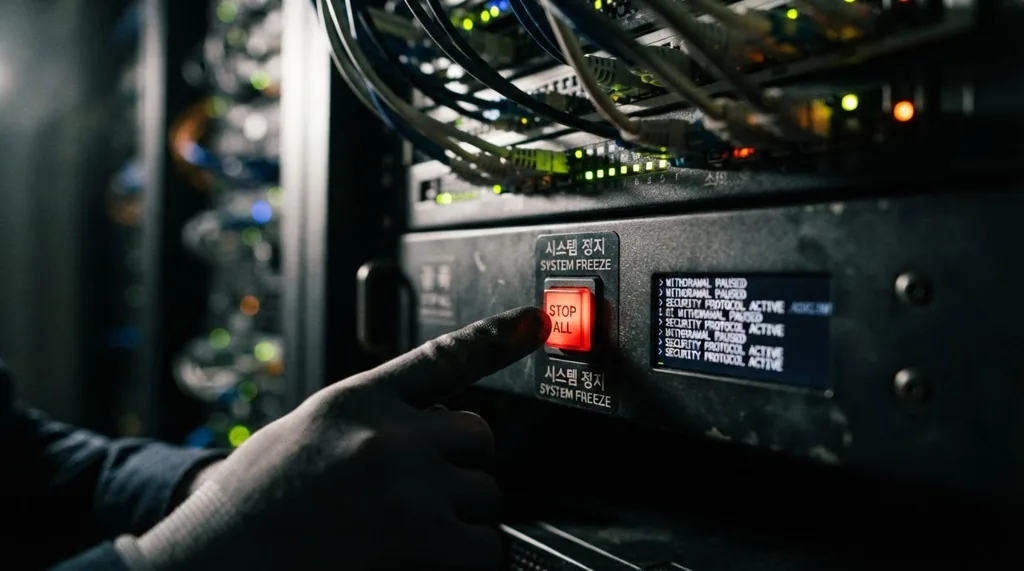
South Korea’s FSC will let crypto exchanges freeze deposits and withdrawals once a hack is suspected, and demands round-the-clock security monitoring.
South Korea’s Financial Services Commission (FSC) will let crypto exchanges freeze deposits and withdrawals as soon as a hack is suspected. Exchanges must also staff round-the-clock monitoring, or limit transfers to staffed hours and tell users in advance.
The FSC, South Korea’s financial regulator, announced the plan on 12 November 2026 after a security meeting with crypto firms1. It will issue a no-action letter, a written promise not to punish firms for a specific practice, covering early freezes during suspected attacks1. The same meeting set out emergency security guidelines and a push for exchanges to join the Financial Security Institute (FSI), the finance sector’s security agency2.
| At a glance | Details |
|---|---|
| What was published | Plan for a no-action letter on hack-related freezes, plus emergency security guidelines |
| Published on | 12 November 2026 |
| Who must comply | Virtual asset service providers: crypto exchanges and custody firms |
| Feedback deadline / Effective date | No date given for the letter |
| Final rules / Next milestone | Revised security inspection standards within 2026 |
Why exchanges needed permission to freeze
South Korea’s crypto user protection law bars exchanges from blocking deposits or withdrawals without a legitimate reason1. Article 11 of the Act on the Protection of Virtual Asset Users deals with this ban on discretionary blocking3. The law allows a block only when a hacking incident is clearly established1.
Exchanges told the regulator it was unclear whether they could act earlier. That gap mattered at the stage of abnormal trades, before a breach is confirmed1. The FSC said fast blocking is decisive for limiting user losses, citing cases such as the Binance hack1.
What the no-action letter allows
The letter will let exchanges block deposits and withdrawals pre-emptively when hacking is suspected1. The FSC discussed allowing this under certain conditions1. The press release does not list those conditions or give an issue date for the letter.
This moves the trigger point from a proven breach to a suspected one. In practice, an exchange that spots unusual large transfers could halt them before losses spread.
The emergency security guidelines
The guidelines respond to new threats, including cyberattacks that use artificial intelligence (AI)1. They cover three main areas:
- Monitoring: exchanges must keep staff on duty around the clock and act at once on suspicious large trades1.
- Storage and cover: exchanges must keep the most user assets possible offline and hold enough insurance and reserves1.
- IT safety: exchanges must meet safety standards similar to those for banks and other financial firms2.
Exchanges that cannot run monitoring at all hours must process deposits and withdrawals only during staffed hours1. They must tell users about this in advance and respond to transfer requests on time1.
Cold wallets, insurance and reserves
Current supervisory rules require exchanges to keep 80% of user assets in cold wallets, which are stored offline2. The FSC said the industry already holds more than 95% in cold wallets2.
Exchanges should still keep hot wallet holdings to the minimum needed for trading, the regulator said1. They may also spread those holdings across several hot wallets1. The FSC wants insurance limits and reserves large enough to compensate users after a hack1.
| Area | What the FSC expects |
|---|---|
| Cold wallet share | At least 80% by rule, with industry above 95% |
| Hot wallets | Minimum needed for trading, possibly spread across several |
| Insurance and reserves | Enough to compensate users after a hack |
| Incident reports | Quick notice to authorities of breaches or suspicious access |
How the rules change for exchanges
Exchanges must set safety standards for staff, facilities and technical controls1. They must test their systems and networks for weak points and fix what they find1. They must also report breaches, or signs of outside intrusion attempts, to the authorities quickly1.
These duties copy the Electronic Financial Transactions Act, which governs IT safety at financial firms1. A planned Digital Asset Act would later make them binding, along with liability for user damages1. The guidelines apply the standards before that law is passed1.
Security checks and FSI membership
Only 5 of 28 crypto firms have joined the FSI, all of them won-market exchanges1. The FSC will push the rest to join, citing breaches at smaller exchanges1. Members will get threat information, security testing and training1.
Crypto firms are not now subject to the bank-style weak-point assessments1. Their only required check is an information security certification, known as ISMS1. The FSI will inspect member firms and give others an exchange-specific inspection standard to use themselves or through security contractors1.
| Key date | What happens |
|---|---|
| 12 November 2026 | FSC security meeting and announcement |
| No date given | No-action letter on pre-emptive freezes |
| By end of 2026 | Revised exchange security inspection standards |
| Not yet scheduled | Digital Asset Act passed into law |
Key terms in plain words
| Term | Meaning |
|---|---|
| No-action letter | A regulator’s written promise not to punish a firm for a specific practice |
| Virtual asset service provider | A company that trades or holds crypto for customers |
| Cold wallet | Crypto stored offline, which is harder to hack |
| Hot wallet | Crypto stored online for fast transfers and trading |
| FSI | Financial Security Institute, which supports security at financial firms |
| ISMS | A national information security certification that crypto firms must hold |
The next concrete step is the revised exchange security inspection standard, due within 20261.
Sources
- ↩ getFile https://www.fsc.go.kr/comm/getFile?srvcId=BBSTY1&upperNo=88133&fileTy=ATTACH&fileNo=2
- ↩ 보도자료 – 위원회 소식 – 알림마당 – 금융위원회 https://www.fsc.go.kr/no010101/88133
- ↩ Statutes of the Republic of Korea https://elaw.klri.re.kr/eng_service/lawViewTitle.do?hseq=69045