

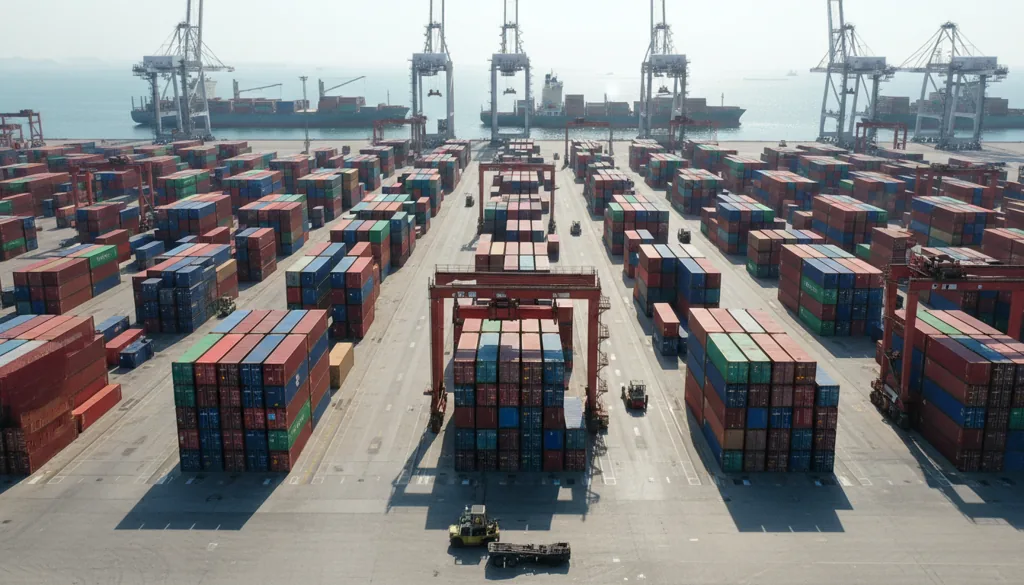
Saudi Arabia announced comprehensive rules governing customs duties suspension and tax frameworks within its Special Economic Zones and bonded areas.
Saudi Arabia’s Zakat, Tax and Customs Authority (ZATCA) has issued rules for bonded zones, where goods can be stored and handled without immediate customs duty and tax payments.
The rules cover imported goods, goods for export and logistics work inside these areas. They were issued on Jan. 26, 2024, and set out licensing, operator duties and ZATCA’s powers over the zones.1
In short, the rules delay payment while goods remain in a bonded zone. The importer or exporter still carries the cost of customs declarations, possible guarantees and any tax due when goods enter Saudi Arabia for sale.
The system is aimed at companies that store goods before re-exporting them, or move goods into the Saudi market later. It can improve cash flow because duties and taxes are not paid at the first arrival of a shipment.
What Saudi Arabia’s bonded zones cover
A bonded zone is a special customs area for storing goods and carrying out logistics work. Customs duties and taxes are suspended until the goods enter the local market or leave Saudi Arabia again, according to ZATCA’s rules.1
Same goods, two customs positions
| Question | Inside the bonded zone | Released to the Saudi market |
|---|---|---|
| Customs duties and taxes | Suspended | Due on release |
| Customs control | Under ZATCA supervision | Ends |
| Permitted activity | Sorting, storage, preparation | Free circulation and sale |
| Payment timing | Deferred while goods remain | At first arrival |
The arrangement covers importers, exporters and logistics companies. Goods can remain under customs control while a company sorts, stores or prepares them for another destination.
That delay matters most for goods that are not intended for immediate sale in Saudi Arabia. A shipment moving through the Kingdom can stay in the zone without creating the same immediate payment as a shipment released for local circulation.
The zones remain under the supervision of ZATCA and the management of a licensed company operating the zone or warehouse. The operating company therefore has a direct role in controlling goods and logistics activities.2
The central benefit is suspension of duties and taxes while goods remain in the approved area. That does not erase the charges. It postpones them until the goods are released into the Saudi market, unless another rule applies.
How licensing and control will work
The rules cover the licensing of bonded zones and the activities allowed inside them. They also set conditions for licence applications, along with requirements for operators and the facilities they manage.1
Two layers of control
A company cannot treat an ordinary storage site as a bonded zone simply because goods are waiting there. The site must operate under the approval and controls established by ZATCA.
The licensed operating company is responsible for running the zone. Its role sits alongside ZATCA’s inspection and supervisory powers, creating two layers of control over the stored goods.
This matters for small businesses using a third-party warehouse. The warehouse operator’s licence and procedures can affect whether goods remain under suspended payment, and whether a shipment can move out of the zone without an unexpected customs charge.
The rules also cover logistics operations, not only passive storage. Sorting, handling and other approved activities can take place, but the goods remain subject to the zone’s controls while they are not released to the Saudi market.
When VAT becomes payable
Saudi VAT, or value-added tax, is normally charged when goods are imported. The import event is separate from any later sale of the same goods inside the Kingdom, so a company can face import VAT before it sells the product.3
What the VAT base includes
| Component | In the VAT base? |
|---|---|
| Customs value | Included |
| Customs duties | Included |
| Excise tax | Included |
| Other charges | Included |
| VAT itself | Excluded |
The customs declaration records the goods, their tariff code, origin, description and value. ZATCA uses that information to calculate customs duties, excise tax and VAT as part of the electronic declaration.3
For goods placed in a customs warehouse, transit arrangement or other duty-suspension arrangement, VAT is also suspended while the goods are not released for free circulation. VAT becomes due when customs releases the goods into the Saudi market.3
ZATCA may require a cash or bank guarantee equal to the VAT that would become payable on release. This can turn a tax delay into a financing cost if the company must tie up cash or obtain a bank guarantee.
The customs value used for VAT is not just the invoice value. It includes the customs value, customs duties, excise tax and other charges, but it excludes VAT itself.3
If the company later releases the goods for local sale, the suspended amounts become relevant at that point. If the goods leave Saudi Arabia under the required export process, the tax result can be different.
What exporters and re-exporters must prove
Supplies of goods held under customs suspension can receive VAT at a zero rate, meaning VAT is charged at 0%. The supplier must keep enough evidence to show where the goods were located when the sale took place.3
Evidence behind the 0% rate
Goods moved from Saudi domestic circulation into a free zone can also receive VAT at 0%, if ZATCA accepts the transfer under its procedures. Location records therefore matter as much as the commercial invoice.
Re-exported goods can qualify for the same zero rate when the export conditions are met. Re-export means sending imported goods out again, sometimes after repair, restoration, processing or another permitted operation.
The customs declaration for a re-export is not the same as the declaration for goods originally produced in Saudi Arabia. The distinction affects the paperwork used at the border and the evidence held by the exporter.3
A shipment leaving the Kingdom without a sale can still count as an export for customs purposes. For VAT purposes, however, the treatment depends on the rules for moving the company’s own goods outside the GCC, the Gulf Cooperation Council area.3
The practical effect is clear for goods passing through a bonded zone. The company needs records showing the goods’ movement and location, because a zero rate depends on proving that the shipment met the export conditions.
Declarations, licences and special cases
Every shipment entering or leaving Saudi Arabia must be covered by a customs declaration. The supplier or its representative files the declaration electronically, and a customs broker can act as that representative.3
The declaration must identify the goods and include their tariff code, country of origin, description and value. It can also include storage, transport and other charges collected through the customs process.
The importer’s tax identification number must appear in the declaration. An importer must also hold a licence to import, although an unlicensed person can complete the process through an agent or representative.3
The importer pays VAT and customs duties shown on the declaration unless an approved arrangement changes when payment is made. A taxable person may apply to pay import VAT through its VAT return instead of paying ZATCA when the goods enter.
That option is not automatic. ZATCA can reject the application or cancel approval if it sees a risk that VAT will not be paid, or if the company has unpaid VAT obligations.3
Some goods have separate treatment. The guideline lists diplomatic and military imports, returned goods, and certain personal luggage and household items among the customs-duty exemptions that can also be exempt from VAT.
Personal, non-commercial goods brought by travellers can be free of import duties and VAT when their value does not exceed SAR 3,000, subject to other customs conditions.3 That traveller exemption is separate from the bonded-zone rules and does not cover ordinary commercial shipments.
The same guidance says goods that only have a zero customs duty rate are generally still subject to VAT. A customs duty exemption therefore does not automatically mean that the importer owes no VAT.
The bonded-zone rules give Saudi Arabia a way to delay payment while goods are stored or moved for re-export. Their value for a small trader will depend on the operator’s licence, the quality of shipment records and the point at which the goods are released into the local market.
Sources
- ↩ ZATCA Issues Bonded Zones Rules in The Kingdom of Saudi Arabia https://zatca.gov.sa/en/MediaCenter/News/Pages/news-1185.aspx
- ↩ Bonded Zones Regulation under ZATCA https://zatca.gov.sa/en/RulesRegulations/Taxes/Pages/Bonded-Zones.aspx
- ↩ Guideline on Imports and Exports under VAT Provision https://zatca.gov.sa/en/HelpCenter/guidelines/Documents/Guideline-on-Imports-and-Exports-under-VAT-Provision.pdf