

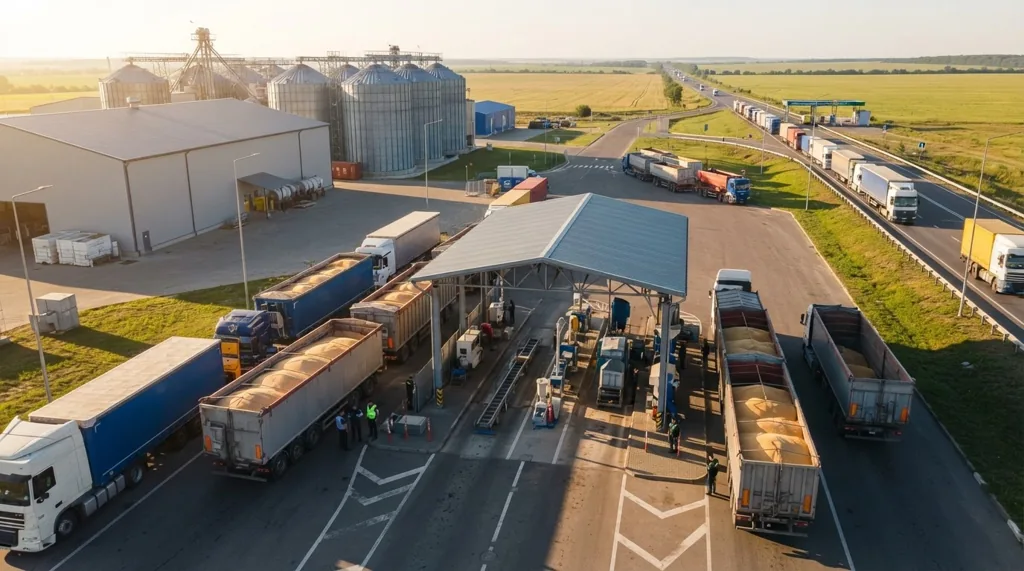
Ukraine has amended its inspection framework to impose enhanced state control on food products of non-animal origin and feedstuffs of non-animal origin entering its customs territory.
Ukraine has updated its list of plant-based foods and animal feeds that face tighter checks at the border. The change brings Ukraine’s import controls closer to the European Union’s and has applied since 16 October 2026.
The Ministry of Agrarian Policy and Food made the change through Order No. 10, dated 1 September 20261. The order amends the list of foods and feeds of non-animal origin, meaning products not made from animals, whose shipments face stronger state checks on entry to Ukraine1. Importers of these goods must now work from the updated list.
| At a glance | Details |
|---|---|
| What was published | Order No. 10 amending the list of plant-based foods and feeds under stronger import checks |
| Published on | 1 September 2026 (order date) |
| Who must comply | Importers of foods and feeds of non-animal origin into Ukraine |
| Effective date | 16 October 2026 |
| Next milestone | The EU source list is reviewed at least every 6 months |
What did Ukraine change?
The order changes the list of foods and feeds whose shipments face stronger state checks when they are brought into Ukraine1. These are goods of non-animal origin, meaning foods and feeds not made from animals.
The State Service of Ukraine on Food Safety and Consumer Protection announced the update on 22 October 20261. Its Kyiv office published an updated list of products and feeds together with the order1.
Why Ukraine is following the EU
The order aims to align Ukraine’s import control rules with EU practice1. It also aims to protect human and animal health1.
The changes reflect an EU update, Commission Implementing Regulation (EU) 2026/1941. That regulation amends an older EU rule, Implementing Regulation (EU) 2019/17931. Experts from EU4SaferFood, an EU-funded food safety project, helped the ministry draft the order1.
How the EU rules work
The EU’s 2019/1793 regulation sets temporary, tighter checks on some plant-based food and feed from certain non-EU countries2. It targets risks such as mycotoxins, which are poisons made by moulds, as well as pesticide residues, microbial contamination and Sudan dyes2.
The European Commission must review these lists at intervals of no more than six months2. It uses alerts from the Rapid Alert System for Food and Feed (RASFF), the EU’s food safety warning network2. It also uses the results of border checks reported by member states2.
The 2026/194 update was adopted on 28 January 20262. It responded to new alert notices and to check results from the first half of 20252.
What the EU update changed
The EU regulation sets the share of shipments that must get identity and physical checks. These are inspections of the goods themselves, beyond the paperwork. Some examples from the EU update are below2.
| Product and origin | EU check rate after the update |
|---|---|
| Seem beans and helmet beans from Bangladesh | 30% of shipments |
| Packed palm oil from Côte d’Ivoire | 30% of shipments |
| Strawberries from Egypt | 20% of shipments, newly listed |
| Oranges from Egypt | 10% of shipments, down from 20% |
| Capsicum peppers from Rwanda | 50% of shipments |
| Calcium carbonate from India | 30% of shipments |
The EU also dropped several products where checks showed good compliance2. These included nutmeg, vanilla and cloves from India, and some preserved turnips from Lebanon2.
The food safety service’s notice does not say which of these EU entries Ukraine copied exactly. The updated Ukrainian list is the binding reference for importers.
What changes for importers
Firms that bring plant-based foods or feeds into Ukraine are directly affected. A product on the list faces stronger state checks at the border1.
The order was written to take account of EU changes1. The EU reviews its own list at least every six months, so further EU changes are likely to follow2.
Key terms in plain words
| Term | Meaning |
|---|---|
| Non-animal origin | Food or feed not made from animals, such as fruit, grains or spices |
| Stronger state checks | Extra border inspections for shipments seen as higher risk |
| Identity and physical checks | Inspecting and sampling the goods, not just the documents |
| Mycotoxins | Poisons made by moulds that can grow on crops |
| RASFF | The EU’s Rapid Alert System for Food and Feed, which flags unsafe products |
Order No. 10 has been in force since 16 October 2026, and importers must follow the updated list now1.
Sources
- ↩ ДПСС : Головна https://www.google.com/url?opi=89978449&q=CAESYQHEIkXXvKzRDBrwMz-SM2FdbmtD6f8JucZMyS0Bhji7V-Bx_tgvjfFlUCsmwUEywkhX8gLVUqGhiXfglNUcNyNjzPiItpKSZUbJjPCp_jdCgAy-FEE9LDpRyzT-2d7bulc&sa=U&uoh=3&ved=2ahUKEwj99Mj-24-YAxUyn5UCHbP1I3wQFnoECAkQAg&usg=AOvVaw0RiOFEELu-4zu9EpnEoFrY
- ↩ Implementing regulation – EU – 2026/194 – EN – EUR-Lex https://eur-lex.europa.eu/eli/reg_impl/2026/194/oj/eng