

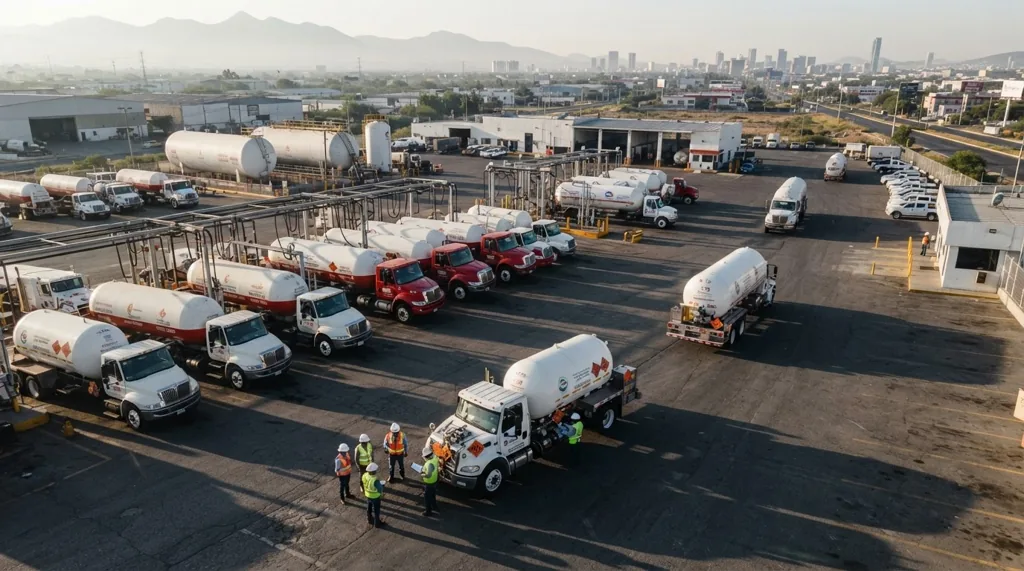
Mexico’s ASEA put emergency standard NOM-EM-009-ASEA-2026 into force on Oct. 6, 2026, setting safety rules for LPG delivery by tank truck and cylinder vehicle.
ASEA, Mexico’s federal safety and environment regulator for the oil and gas sector, has issued an emergency standard that sets safety rules for companies delivering liquefied petroleum gas (LPG) by tank truck and cylinder delivery vehicle, in force from Oct. 6, 20261.
The standard, NOM-EM-009-ASEA-2026, was published in the Diario Oficial de la Federación, Mexico’s official gazette, on Oct. 5, 20261. It runs for six months1.
In short, every firm that delivers LPG to homes and businesses by truck must now meet a single national set of safety rules. These cover daily vehicle checks, tank testing, speed limiters, on-board safety equipment and driver training.
What does the ASEA emergency standard require?
The standard sets technical specifications and safety, operational and environmental requirements for regulated firms that distribute LPG by tank truck and delivery vehicle2. It covers each vehicle from the start of operation, through operation and maintenance, to the end of its working life2.
ASEA’s announcement lists the main general safety measures1:
- daily inspections of each delivery vehicle
- tests on fixed tanks to check their mechanical integrity
- checks on valves, equipment and fittings
- an integrity file for each vehicle
- a computer speed governor or a pedal-signal speed limiter module
- written operating procedures
- classroom and hands-on training for drivers
The integrity file is a set of documents that proves where a truck or delivery vehicle came from, its safety features and its condition2. The standard includes an appendix with a daily visual inspection checklist2. A further appendix sets safety conditions for the engine and chassis of the trucks2.
What equipment must LPG trucks carry?
Each delivery unit must carry a portable fire extinguisher holding at least 9 kilograms of dry chemical powder1. Units must also carry a rubber-headed hammer, a static strap long enough to reach the ground, a hand lamp and wheel chocks1.
On-board safety equipment
| Item | Requirement |
|---|---|
| Fire extinguisher | At least 9 kg dry chemical powder |
| Tools | Rubber-headed hammer, hand lamp, wheel chocks |
| Static strap | Long enough to reach the ground |
| Warning signs | Portable signs for tank truck unloading |
| Placard | Identification placard on cylinder delivery vehicles |
The static strap is an accessory that discharges static electricity built up as the vehicle moves2. Wheel chocks are blocks that lock the tires when the vehicle is parked2. Tank trucks must carry portable warning signs for use while unloading gas1. Cylinder delivery vehicles must display an identification placard1.
Which LPG distributors must comply?
The standard applies across Mexico’s national territory and is mandatory for regulated firms in two activities2:
- Tank truck delivery: from loading at the distribution plant or storage site, through the journey, to the connection point at the customer’s installation, plus parking of the truck
- Cylinder delivery: from receiving portable and transportable cylinders at the plant or storage warehouse, through the journey, to delivery at the customer’s site, plus parking of the vehicle
Both activities are listed in the standard’s scope section2. The standard does not apply to tank trucks that lack a transfer system and are used only to transport LPG2. Separately, ASEA published NOM-EM-008-ASEA-2026, covering LPG transport by tank truck and semitrailer, on Oct. 2, 20261.
Which rules apply only in metropolitan areas?
Some requirements apply only to tank trucks that load or supply LPG in Mexico’s metropolitan zones2. These are the rules on dry-disconnect devices, couplings built from two valves that let gas flow in both directions when connected2. An appendix to the standard defines the boundaries of the metropolitan zones covered2.
Distributors outside those zones still must meet every other part of the standard. Operators that serve both city and rural routes will need to track which of their trucks load or deliver inside the listed zones.
Why did ASEA issue an emergency rule?
The standard says LPG delivery by truck is high-risk2. LPG is highly flammable, expands sharply when it turns from liquid to gas, and its vapors are heavier than air2. Those vapors collect in low areas and raise the risk of fire or explosion if gas escapes2.
The standard cites multiple accidents that have caused loss of life, property damage and harm to the environment2. It links those events to human error, poor driver training and mechanical failures, among other factors2. The results have included road crashes, rollovers, tank leaks, fires and explosions2.
Mexico’s Quality Infrastructure Law lets regulators issue emergency standards directly to prevent imminent harm or reduce existing harm2. Such standards last no more than six months and may be extended once for an equal period2.
How does this replace the earlier LPG standard?
ASEA issued an earlier emergency standard, NOM-EM-007-ASEA-2025, on Oct. 3, 20252. That rule covered the same activity and cancelled NOM-007-SESH-2010, an older standard on LPG vehicles2. ASEA extended it by six months in a notice published on April 1, 20262.
From the first emergency rule to the new one
Since then, a working group finished drafting a permanent standard for LPG distribution by tank truck and delivery vehicle2. CONASEA, the national standards committee for the hydrocarbons sector, approved the draft for public consultation2. Before it becomes final, ASEA must review public comments, present the answers to CONASEA, publish the final text and wait out the minimum lead time before entry into force2.
The new emergency standard fills that gap. ASEA says it is meant to prevent LPG delivery from taking place without rules to prevent, control and reduce its risks2.
Summary of NOM-EM-009-ASEA-2026
The table sets out the main points of the emergency standard.
| Key Dimension | Details |
|---|---|
| Regulating Authority & Jurisdiction | ASEA, Mexico’s oil and gas safety and environment agency; applies nationwide2 |
| Scope & Who Must Comply | Regulated firms delivering LPG by tank truck or cylinder delivery vehicle2 |
| Exclusion | Tank trucks without a transfer system used only for LPG transport2 |
| Core Mandate / Key Change | Daily inspections, tank testing, integrity file per vehicle, speed limiters, operating procedures, driver training1 |
| Required On-Board Equipment | Fire extinguisher of at least 9 kg dry chemical powder, hammer, static strap, hand lamp, wheel chocks1 |
| Metropolitan Zone Rules | Dry-disconnect device rules apply only to tank trucks loading or supplying in listed metropolitan zones2 |
| Key Dates & Implementation Milestones | Published Oct. 5, 2026; in force Oct. 6, 2026; valid for six months1 |
| Enforcement | ASEA has powers to regulate, supervise and sanction safety in the hydrocarbons sector2 |
The standard took effect on Oct. 6, 2026 and is valid for six months1. Under the Quality Infrastructure Law, ASEA may extend it once for up to six more months while it completes the permanent standard2.
Sources
- ↩ La ASEA publicó la NOM-EM-009-ASEA-2026 para la distribución de Gas LP por medio de auto-tanque y vehículo de reparto | Agencia de Seguridad, Energía y Ambiente | Gobierno | gob.mx https://www.gob.mx/asea/prensa/la-asea-publico-la-nom-em-009-asea-2026-para-la-distribucion-de-gas-lp-por-medio-de-auto-tanque-y-vehiculo-de-reparto
- ↩ DOF – Diario Oficial de la Federación https://dof.gob.mx/nota_detalle.php?codigo=5800282&fecha=05/10/2026