

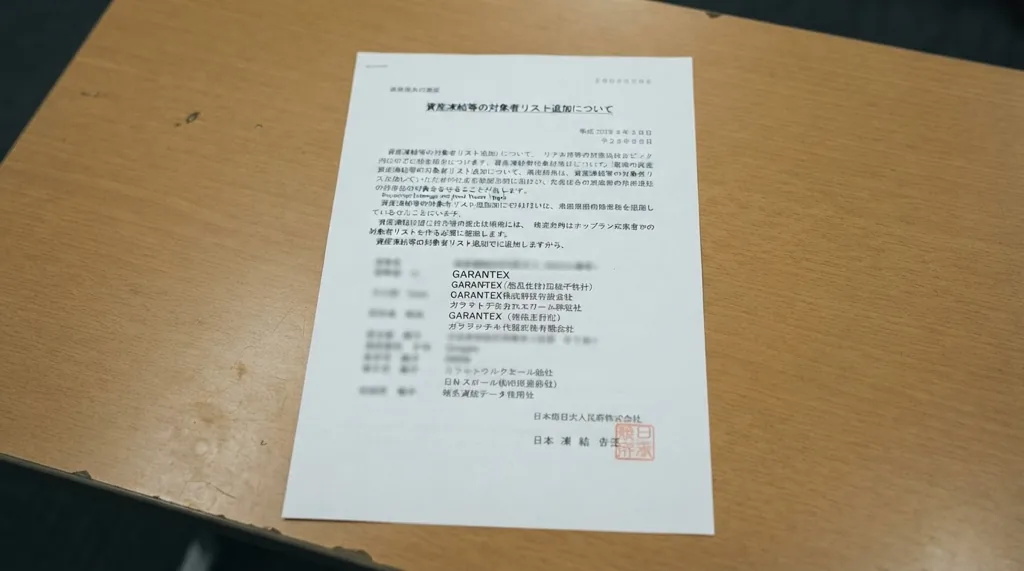
Japan froze the assets of 33 Russian entities, including crypto exchange Garantex, and 9 individuals, and restricted services to 35 vessels from Oct. 2, 2026.
Japan on Oct. 2, 2026 froze assets of 33 Russian entities, including crypto exchange Garantex, and 9 people, and restricted services to 35 vessels1.
The measures are made under the Foreign Exchange and Foreign Trade Act, the Japanese law that controls cross-border payments, capital flows and trade2. They rest on a Cabinet Understanding, a decision approved by the cabinet, also dated Oct. 2, 20262.
In short, Japanese banks, payment firms, shippers and exporters can no longer deal with the newly listed Russian firms, people and vessels without a government permit. Paying a listed party without permission, including in crypto assets, is a criminal offence.
Which Russian entities and people did Japan list?
The joint announcement by the Ministry of Foreign Affairs, the Ministry of Finance and the Ministry of Economy, Trade and Industry covers 33 entities and 9 individuals3. They are named in a Ministry of Foreign Affairs Notice issued on Oct. 21.
Who and what the Oct. 2 measures cover
The list, attached to the announcement, numbers the new entities 370 to 4023. Most are defence and industrial firms. They include:
- Kaluga Research Institute of Radio Engineering JSC
- Alabuga Development OOO and Alabuga Machinery LLC
- Uraldronzavod LLC and Joint Stock Company Kolomensky Zavod
- the Lobaev Foundation, a weapons technology fund
The 9 individuals, numbered 760 to 768, are mostly company directors3. They include Dmitry Lelikov, listed as deputy general director of Rostec, and Vasily Brovko, listed as a director of Rostec3.
Why does the Garantex listing matter for crypto firms?
The last entity on the list, number 402, is Garantex Europe OU, also known as Garantex3. The list gives its locations as St. Petersburg and the Federation East Tower in Moscow City3.
The Ministry of Finance says any payment to a sanctioned party needs the minister’s permission in advance4. That covers every form of payment, including payment in crypto assets4. Crypto exchanges and other payment providers in Japan therefore fall under the same ban as banks when a transfer would reach Garantex.
What does the asset freeze require of Japanese banks?
The freeze works through two permit requirements2:
- payments to listed parties need government permission
- capital transactions with them, meaning deposit, trust and loan contracts, need permission too
In practice, a bank cannot open a deposit, lend money or hold assets in trust for a listed party without a permit. The same applies to any firm sending money to one of the 42 newly listed names.
Which vessels face Japan’s new shipping restrictions?
The measures also cover 35 specific vessels, identified in the Notice by their IMO numbers, the unique numbers ships carry for life3. The press release calls this a restriction on service transactions for specific vessels2.
Asset freeze and vessel rules compared
| Question | Listed people and firms | Listed vessels |
|---|---|---|
| How many | 33 entities, 9 individuals | 35 vessels |
| What needs a permit | Payments to listed parties | Services set by finance ministry notice |
| Capital deals covered | Deposit, trust and loan contracts | Loans and debt guarantees |
Two permit requirements apply. Providing the services specified in a Ministry of Finance Notice to these vessels needs permission2. Loan and debt guarantee contracts linked to the sale, purchase, lease or charter of the vessels also need permission2.
This reaches insurers, lenders, ship brokers and other maritime service firms that work with these ships. The Ministry of Finance has published guidance for maritime transport businesses on the new service rules4.
Which exports are now banned?
Exports to 4 entities outside Russia and Belarus are now banned2. The list names one company in Turkey, Solid Tarim Inovasyon Anonim Sirketi, and three in the United Arab Emirates: Amegino FZE, Auto Parts East FZCO and MOTO Export DWC LLC3.
Japan is also adding a ban on exporting to Russia items that could help strengthen Russia’s industrial capacity2. The announcement does not list the goods in its text.
What are the penalties for breaking the payment rules?
A payment made without permission can bring up to 3 years in prison, a fine of up to 1 million yen, or both4. When three times the value of the deal exceeds 1 million yen, the fine can reach three times that value4.
When do the vessel rules apply to existing contracts?
The vessel rules apply from Oct. 2, 20261. Contracts signed before that day get a short grace period2. Work done under them is exempt only if it is carried out before Nov. 1, 20262.
Vessel rules: the dates that bind
That means shipping and finance firms with existing deals involving the 35 vessels must wind them down or obtain a permit before Nov. 1, 2026.
Sources
- ↩ ウクライナ情勢に関する外国為替及び外国貿易法に基づく措置について : 財務省 https://www.mof.go.jp/policy/international_policy/gaitame_kawase/gaitame/economic_sanctions/20261001212931.html
- ↩ Measures based on the Foreign Exchange and Foreign Trade Act regarding the situation surrounding Ukraine | Ministry of Foreign Affairs of Japan https://www.mofa.go.jp/press/release/pressite_000001_02701.html
- ↩ 20261002press_russia.pdf https://www.meti.go.jp/policy/external_economy/trade_control/01_seido/04_seisai/downloadCrimea/20261002press_russia.pdf
- ↩ ウクライナ関連情報 : 財務省 https://www.mof.go.jp/policy/international_policy/gaitame_kawase/gaitame/ukraine_info.html