

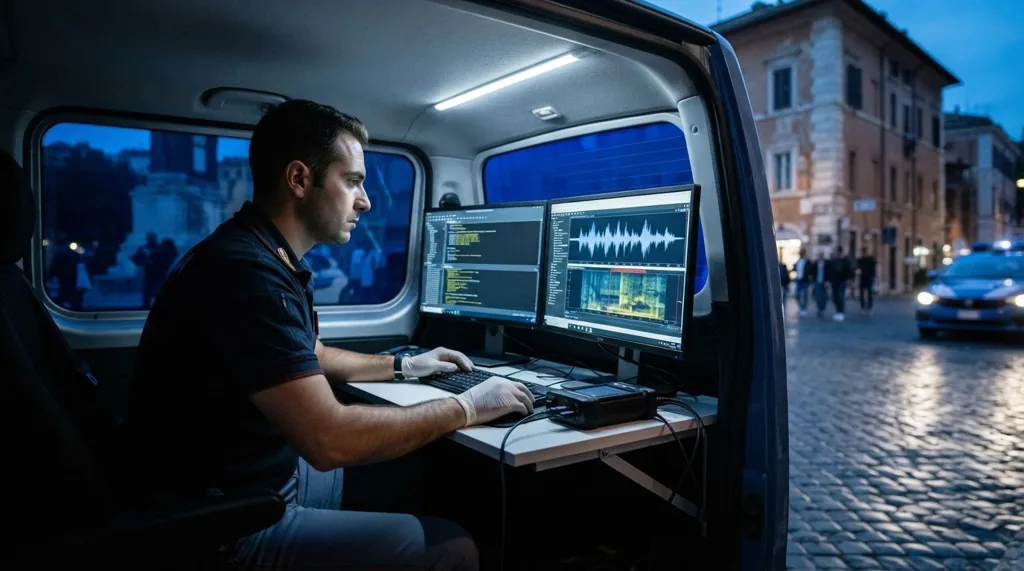
Italy has brought Legislative Decree 160/2026 into force from Sept. 30, 2026, creating an AI security crime, limits on police biometric AI and new rules for AI damages claims.
Italy’s government has brought into force, from Sept. 30, 2026, a legislative decree that sets rules for police use of artificial intelligence, creates a new crime for failing to secure AI systems, and changes how people harmed by AI can claim damages1.
The measure is Legislative Decree No. 160 of Sept. 9, 2026, published in the Official Gazette, General Series No. 214, on Sept. 15, 20261. It adapts Italian law to Regulation (EU) 2024/1689, the European Union’s AI Act, adopted on June 13, 20241.
In short, Italy has added national rules on top of the EU AI Act in three areas: what police may do with AI, when misuse of AI becomes a crime, and how victims can sue. Companies that build, sell or run AI systems in Italy now face possible criminal and corporate liability, and an easier path for damages claims against them and their insurers.
What does Italy’s Decree 160 cover?
The decree has 22 articles in three parts, according to Normattiva, the government’s official database of laws in force2. Part one, articles 1 to 10, covers AI use by the police2. Part two, articles 11 to 20, holds the criminal provisions and the civil court tools for damages caused by AI2. Part three, articles 21 and 22, holds transition and budget rules2.
Decree 160 articles by part
The decree uses powers granted by Law No. 132 of Sept. 23, 2025, Italy’s national AI law, under its article 243. That article asked the government to write specific rules for police use of AI and for the unlawful building and use of AI systems3.
The government first approved a draft on June 10, 20264. The draft then went to parliamentary committees, the regions and the relevant authorities for their opinions4. The details below on each article come from the Senate budget office’s reading note on that draft, Government Act No. 4183. That draft also had 22 articles on the same three subjects3. The final text keeps this structure2.
What is the new AI security crime?
Article 12 adds a new offence to the criminal code, article 437-bis3. It punishes the failure to adopt security measures in AI systems, and the unlawful tampering with such systems3.
Article 15 extends this risk to companies themselves. It adds the new offence to Legislative Decree No. 231 of 2001, the law that holds companies liable for certain crimes committed in their interest3. A second offence joins the list: article 612-quater, the unlawful spreading of content generated or altered with AI3.
This means a company, and not only an employee, can face proceedings when these crimes occur. Crime-prevention compliance programmes kept under the 2001 law now face two new predicate offences, the crimes that trigger corporate liability.
Article 14 also widens an existing seizure power. Prosecutors may already seize online profiles used to commit crimes; under the decree this now covers content generated with AI as well3.
How do the AI damages rules change for businesses?
Part two also gives people harmed by AI new tools in civil courts3. The reading note lists them by article:
- Article 16 sets which courts hear AI damages cases3.
- Article 17 sets rules on evidence3.
- Article 18 creates a presumption of the causal link, so the claimant does not have to prove every step of how the AI caused harm3.
- Article 19 makes a system’s compliance with the AI Act relevant in liability cases3.
- Article 20 gives victims a direct claim against the insurer that covers a firm’s AI liability3.
New tools for AI damages claims
A presumption of causation shifts weight in court toward the injured party. Article 18 deals with how the burden of proof is shared between the parties3. Compliance records under the AI Act therefore become evidence a firm may need in a damages case. Insurers writing liability cover for AI products also become direct defendants.
When can Italian police use real-time facial recognition?
Article 8 sets when police may use AI for real-time remote biometric identification in public places3. Biometric matching may only run against a defined reference database of lawfully gathered images and identity data3. Databases built by untargeted scraping, the mass harvesting of faces from the internet or camera footage, are banned3.
At the draft stage, the government said real-time use needed a judge’s approval4. It allowed use only to prevent specific, serious threats to public order and security, or to search for missing persons and victims of kidnapping, trafficking or sexual exploitation4. The request had to state the purpose, duration, area, people, databases and technology4.
The draft capped each approval at 15 days, unless a judge extended it with stated reasons4. In urgent cases a faster procedure applied. If its conditions were not met, use had to stop, the data had to be deleted and the results could not be used4.
Article 9 requires the data controller to carry out an assessment of the impact on fundamental rights before such use3. Article 13 adds a parallel procedure for real-time identification inside criminal investigations, as new article 359-ter of the code of criminal procedure3.
What do venues and event organisers face?
Article 10 allows AI facial recognition after a crime has been committed, using video surveillance systems already installed under the law3. The draft limited this to crimes already committed or attempted, and to identifying suspects on objective, verifiable evidence4. The Interior Ministry’s Public Security Department is the data controller3.
Two police uses of facial recognition
| Question | Real-time (article 8) | After a crime (article 10) |
|---|---|---|
| When allowed | Serious threats, missing persons, victims | After a crime, even attempted |
| Who signs off | A judge, up to 15 days | Interior Ministry as data controller |
| Scraped face databases | Banned | Uses existing legal cameras |
Private operators have a role. Managers of sites with public-order needs, and organisers of events with the same needs, may install and maintain these systems at their own cost3. They then lend the systems free of charge to the questura, the provincial police headquarters, which takes full and exclusive control of them3.
The budget office notes that article 10 does not force anyone to install new cameras3. It only allows AI to be added where the law already provides for surveillance systems3.
Article 1 states that the police part creates no new obligations beyond those in the AI Act3. Police staff must receive AI training through their own academies, under article 63.
Which AI contracts get transition time?
Article 21 sets transition rules for AI systems already under contract, still in development, or already used for police purposes on the day the decree took effect3. Article 22 states that the public bodies involved must apply the decree with their existing staff and budgets3.
From draft to law
The decree has been in force since Sept. 30, 20261. From that date, AI suppliers with police contracts already signed or systems still in development move onto the transition rules in article 213.
Sources
- ↩ Gazzetta Ufficiale https://www.gazzettaufficiale.it/atto/serie_generale/caricaDettaglioAtto/originario?atto.codiceRedazionale=26G00179&atto.dataPubblicazioneGazzetta=2026-09-15&elenco30giorni=true
- ↩ DECRETO LEGISLATIVO 9 settembre 2026, n. 160 – Normattiva https://www.normattiva.it/uri-res/N2Ls?urn:nir:stato:decreto.legislativo:2026-09-09;160
- ↩ Legislatura 19ª – Dossier n. 384 | Senato della Repubblica https://www.senato.it/show-doc?leg=19&tipodoc=DOSSIER&id=1513700&idoggetto=0&part=dossier_dossier1
- ↩ Comunicato stampa del Consiglio dei Ministri n. 177 | www.governo.it https://www.governo.it/it/articolo/comunicato-stampa-del-consiglio-dei-ministri-n-177/32050