

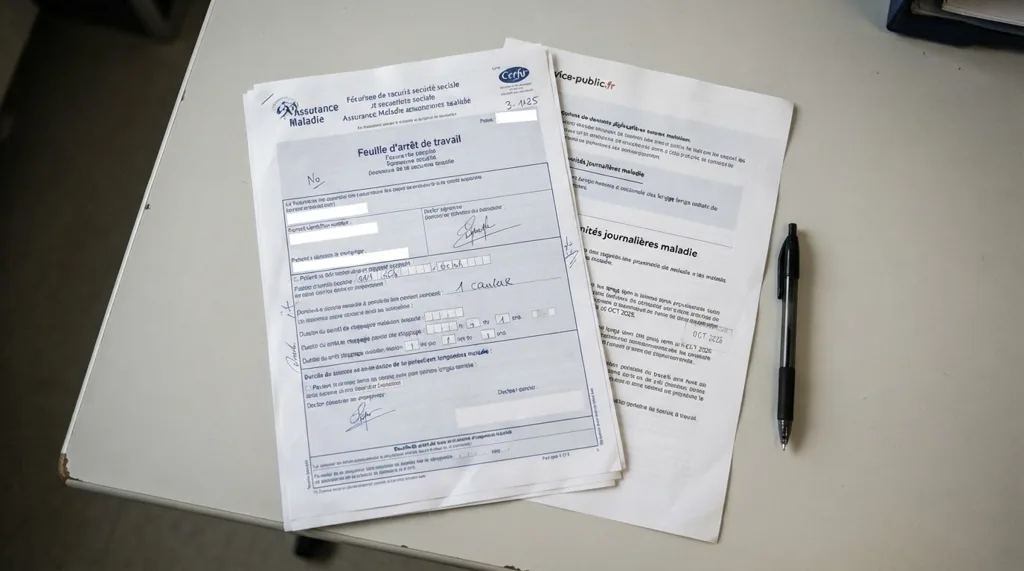
France will cut daily sick pay for long-term illnesses not fully covered by health insurance from three years to one, starting 15 October 2026.
France will cut state sick pay for some long-term illnesses from three years to one. The shorter limit applies to sick notes issued from 15 October 2026.
Two decrees published in France’s official journal on 18 September 2026 set the change1. It affects people with a long-term illness that the national health insurance does not cover at 100%2. Workers already off sick for more than 6 months on 15 October 2026 keep the old three-year limit1.
| At a glance | Details |
|---|---|
| What was published | Decree No. 2026-866 and Decree No. 2026-867 of 16 September 2026 |
| Published on | 18 September 2026 |
| Who must comply | Employers, health insurance funds and insured workers with a long-term illness not fully covered |
| Effective date | 15 October 2026 |
| Next milestone | Ongoing sick leave reaching 6 months after 15 October 2026 falls under the new limit |
What changes on 15 October 2026?
Decree No. 2026-866 cuts the maximum period of daily sick pay from 3 years to 1 year for certain long-term illnesses2. Daily sick pay is the cash benefit the national health insurance pays to a worker who cannot work.
The cut applies to a "non-exempt" long-term illness1. This is a condition that justifies more than 6 months off work but does not need expensive treatment1. Care for it is reimbursed at the usual health insurance rates1.
Who keeps the three-year limit?
People with an "exempt" long-term illness keep a maximum of 3 years of daily sick pay1. An exempt illness is a serious condition lasting more than 6 months that needs expensive treatment, with care covered at the maximum rate1.
This group includes workers with a disease on the official list of conditions needing long and costly treatment2. It also includes serious illnesses outside that list, or several illnesses together, when the health insurance medical service recognises them2.
Who is covered by the two decrees?
The first decree covers people in the general scheme and the agricultural scheme1. It also covers clergy members and employees of notaries1.
The second decree, Decree No. 2026-867, extends the rules to self-employed workers, public officials and magistrates1. It also covers ministers of religion1.
How the transition works
The new one-year limit applies to two groups of sick leave1:
- sick leave prescribed from 15 October 2026
- sick leave already under way that reaches 6 months after 15 October 2026
Workers who have been off for more than 6 months by 15 October 2026 stay under the old rules2. They can receive daily sick pay for up to 3 years2.
Returning to work and a new pay period
A worker with a non-exempt illness can get a new one-year pay period for the same illness. To qualify, the worker must have returned to work for at least 1 year2.
For exempt illnesses, a worker who returns to work for at least 1 year can get a new three-year pay period2.
A new penalty for unjustified sick leave
Decree No. 2026-866 also deals with abuse of the system2. From 19 September 2026, a person can be penalised for trying to obtain sick leave that their health does not justify2.
This adds to existing penalties for people who claim health insurance benefits they are not entitled to2. The government’s labour law website does not state the size of the new penalty.
A separate cut for workplace accidents
A different decree, No. 2026-909 of 30 September 2026, lowers the pay ceiling for daily benefits after a workplace accident or occupational disease3. It applies to work stoppages from 1 November 20263.
The yearly salary used to calculate those benefits is capped at 1.8 times the minimum wage3. Employees earning more will see lower benefits, and employers who keep paying salaries will pay a larger top-up3. For ordinary sick leave, the ceiling is 1.4 times the minimum wage3.
Key terms in plain words
| Term | Meaning |
|---|---|
| Daily sick pay | Cash the national health insurance pays each day a worker is off sick |
| Long-term illness (ALD) | A condition needing more than 6 months off work or long treatment |
| Exempt long-term illness | A serious illness with costly treatment, covered at 100% |
| Non-exempt long-term illness | A long illness without costly treatment, reimbursed at normal rates |
| Official journal | The French government publication where new laws and decrees appear |
| Occupational disease | An illness caused by a person’s work |
The one-year limit on daily sick pay for non-exempt long-term illnesses takes effect on 15 October 20262.
Sources
- ↩ Compensation -Sick leave: reduction in the compensation period for certain long-term leave | Service Public https://www.service-public.gouv.fr/particuliers/actualites/A19066?lang=en
- ↩ Indemnisation en cas d’arrêt maladie : ce qui change au 15 octobre 2026 – Code du travail numérique https://code.travail.gouv.fr/actualite/indemnisation-arret-maladie-ce-qui-change-au-15-octobre-2026
- ↩ Work stoppage -Accidents at work and occupational diseases: decrease in the ceiling for calculating daily allowances | Service Public https://www.service-public.gouv.fr/particuliers/actualites/A19080?lang=en