

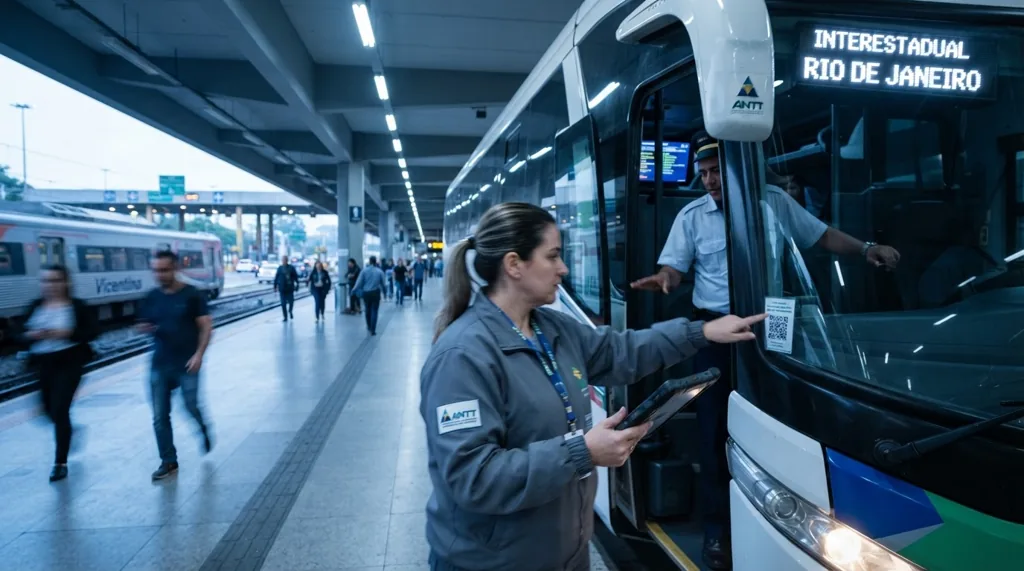
Brazil’s transport regulator requires bus, rail and toll road firms to offer free 0800 lines, human agents and seven-day replies within 120 days.
Brazil’s land transport regulator has rewritten the customer service rules for interstate buses, passenger trains and federal toll roads. Operators get 120 days to offer free 0800 lines, live human agents and answers to complaints within seven days.
The National Land Transport Agency (ANTT), Brazil’s regulator for buses, railways and federal highways, issued Resolution 6.091 on 8 October 20261. It appeared in the official gazette on 9 October and takes effect 120 days after publication. It replaces Resolution 3.535 of 10 June 2010, and the agency plans further sector-specific rules on top of it1.
| At a glance | Details |
|---|---|
| What was published | Final resolution setting general customer service rules |
| Published on | 9 October 2026 |
| Who must comply | Interstate and international bus operators, passenger rail operators, federal toll road concessionaires |
| Effective date | 120 days after publication |
| Next milestone | ANTT may add sector rules, including by company size |
What is the new customer service rule?
The resolution covers the customer service channel, known in Brazil as SAC, of every regulated passenger and road business1. SAC means the phone, online and in-person channels that handle questions, complaints, disputes and cancellations. Channels used only to sell tickets or services are excluded1.
From consultation to final rules
The rules follow Decree 11.034 of 5 April 2022, the national decree on customer service channels1. ANTT opened a public consultation on updating the 2010 rules on 3 February 20262. Contributions ran from 9 February to 27 March 2026, with a public hearing in Brasília on 3 March2.
Who must comply
Four groups fall under the resolution1:
- interstate and international bus companies, under permits or authorisations
- charter bus services on interstate and international routes
- passenger rail operators on the national transport network
- companies running federal toll roads under ANTT concessions
Who the rules cover
| Group | Covered services |
|---|---|
| Bus operators | Interstate and international routes, including charters |
| Rail operators | Passenger trains on the national transport network |
| Toll road firms | Federal roads under ANTT concessions |
| Foreign bus firms | International routes, unless a treaty says otherwise |
Foreign bus companies on international routes must also comply, unless an international agreement says otherwise1. Operators may run the service alone, jointly or through a contractor. Hiring a contractor does not reduce the operator’s own responsibility1.
Free lines and live agents
Access to SAC must be free of charge, and the phone line must use an 0800 toll-free number1. It must accept calls from landlines and mobiles anywhere in Brazil. Channels must also be accessible to people with disabilities1.
At least one channel must run 24 hours a day, seven days a week1. Phone service with a human agent must run at least 8 hours a day, between 8 a.m. and 6 p.m., every day1. Charter and occasional rail services may pause phone lines when no service is on sale, if other channels stay open1.
| Area | What the resolution requires |
|---|---|
| Phone access | Free 0800 number, landlines and mobiles |
| Availability | At least one channel 24 hours, 7 days |
| Human agents | At least 8 hours daily, between 8 a.m. and 6 p.m. |
| Wait for a human | No more than 90 seconds |
| Transfer to right team | Within 60 seconds |
How the service must work in practice
The first phone menu must offer a human agent, complaints and cancellations1. Toll road firms must also offer emergency help there. Callers cannot be forced to give personal data before reaching a person1.
A caller who asks for a human must wait no more than 90 seconds1. Transfers to the right team must happen within 60 seconds. Staff cannot ask callers to repeat a complaint already recorded1. If the company drops a call, it must call back, give a case number and finish the service. Advertising during the wait is banned unless the caller agrees1.
Contact details for SAC must appear on tickets, receipts and baggage tags1. They must also be shown at ticket counters, inside every bus and passenger rail car, and on toll road signs1.
Deadlines for answers and records
Companies must answer each complaint within 7 calendar days of its registration1. Answers must be clear and address every point raised. Unrequested services or wrong charges must be stopped immediately1.
Each request gets one case number that works across all channels1. Customers can ask for their case history, which must arrive within five calendar days. Call recordings must be kept for at least 90 days and released within ten days on request1. Service records must be kept for at least two years1.
Cancellation requests must be processed immediately and allowed through every channel used for sales1. Customers must receive proof of the cancellation by mail or electronically1.
| Key timeframe | What happens |
|---|---|
| 5 calendar days | Customer receives case history on request |
| 7 calendar days | Company must answer the complaint |
| 10 calendar days | Call recording released on request |
| 90 days | Minimum time to keep call recordings |
| 2 years | Minimum time to keep service records |
Enforcement and penalties
The resolution sorts breaches into three groups: light, medium and serious1. Failing to keep SAC available is the most serious. Poor handling, tracking, answering or cancellation of requests counts as medium1.
For passenger rail operators, fines are set as multiples of a base unit in Decree 1.832 of 19961. A first serious breach costs 500 times the base unit, rising to 1,000 times for repeat offences1. Toll road firms face penalties under their concession rules. Penalties for bus operators will come in a separate regulation1.
| Rail breach group | Penalty |
|---|---|
| Light (service quality) | Warning, then 100 times base unit if repeated |
| Medium (handling requests) | 100 times base unit, then 500 times if repeated |
| Serious (availability) | 500 times base unit, then 1,000 times if repeated |
Key terms in plain words
| Term | Meaning |
|---|---|
| ANTT | National Land Transport Agency, Brazil’s regulator for buses, rail and federal roads |
| SAC | Customer service channel for questions, complaints and cancellations |
| 0800 number | A toll-free phone number in Brazil |
| Concessionaire | A private company running a federal road under a government contract |
| Base unit | A fixed money amount in Decree 1.832 used to calculate rail fines |
| Charter service | A bus or train hired for a specific trip, not a scheduled route |
The resolution takes effect 120 days after its publication in the official gazette on 9 October 20261.
Sources
- ↩ RESOLU«√O ANTT N∫ 6.091, DE 8 DE OUTUBRO DE 2026 https://anttlegis.antt.gov.br/action/ActionDatalegis.php?acao=abrirTextoAto&tipo=RES&numeroAto=00006091&seqAto=000&valorAno=2026&orgao=DG/ANTT/MT&codTipo=&desItem=&desItemFim=&cod_menu=5408&cod_modulo=161&pesquisa=true
- ↩ Audiência Pública 001/26 – Normas Gerais sobre o Serviço de Atendimento ao Consumidor – SAC — Agência Nacional de Transportes Terrestres – ANTT https://www.gov.br/antt/pt-br/eventos/audiencia-publica-001-26-normas-gerais-sobre-o-servico-de-atendimento-ao-consumidor-sac