

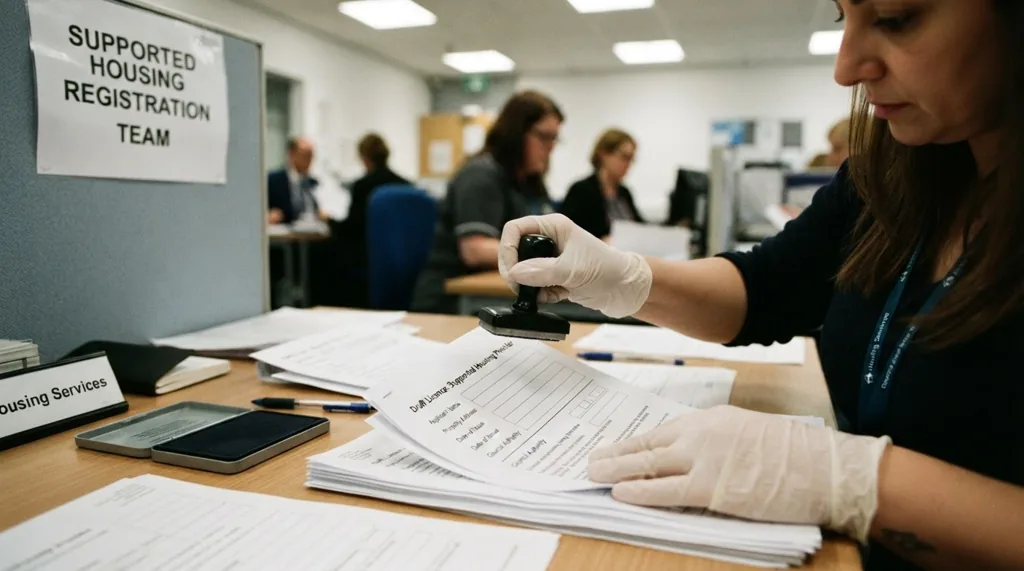
England’s housing ministry published draft rules requiring supported housing providers to hold a council licence. Comments close 10 December 2026.
England’s housing ministry has published draft rules requiring supported housing providers to hold a council licence. Providers, councils and residents can comment until 10 December 2026.
The Ministry of Housing, Communities and Local Government (MHCLG) released the draft Supported Housing (Licensing) (England) Regulations 2027 on 15 October 20261. The rules would apply to people who control or manage supported housing in England, meaning homes that combine accommodation with care or support for vulnerable people2. The consultation runs for 8 weeks, and the responses will shape the final regulations to be put before Parliament2.
| At a glance | Details |
|---|---|
| What was published | Draft regulations and a technical consultation |
| Published on | 15 October 2026 |
| Who can comment / Who must comply | Councils, supported housing providers, landlords, managing agents, residents and their advocates |
| Feedback deadline / Effective date | 10 December 2026, 11:59pm |
| Final rules / Next milestone | Regulations laid before Parliament for approval by both Houses |
What is supported housing licensing, and why does it matter?
The Supported Housing (Regulatory Oversight) Act 2023 set up a new framework to oversee supported housing across England2. It followed long-standing concerns about the quality and value for money of some providers, especially in the exempt accommodation sector2. The draft covers all supported housing that meets the Act’s definition, which mirrors the definition used in Housing Benefit rules2.
The government consulted on the design of licensing in 2025 and published its response in April 20262. That response confirmed a locally led licensing system in every council area in England2. Under the Act, the licensing authority is the local housing authority for each designated district3.
What the draft rules require
Anyone who controls or manages supported housing in a designated district must hold a supported housing licence4. Councils must take all reasonable steps to make sure providers in their area apply4. Applications must be made in writing, signed, and sent to the council where the housing is located4.
| Area | What the draft rules require |
|---|---|
| Applicant details | Names and contacts for the applicant, licence holder, service manager and any nominated individual4 |
| Property details | Addresses, types of housing, and the number and type of homes4 |
| Other licences | Details of any existing house-sharing licence and its expiry date4 |
| Care | Details of any care provider and confirmation it is registered4 |
| Past conduct | Any banning order against the licence holder, manager or nominated individual4 |
| Declaration | A signed statement that the information is complete and correct4 |
A council may grant a licence only if accommodation and support standards are met and the housing is safe and suitable2. Management must be appropriate, and the licence holder must be judged fit and proper2. Where an application covers several properties and only some qualify, the council must offer a reduced application covering just those2.
Who is checked, and how
The fit and proper person test aims to ensure that people running supported housing are suitable to serve vulnerable people2. Licence holders must be of good character, capable of running supported housing and financially sound2. They must also have no history of serious misconduct in supported housing2.
Organisations and partnerships must name a nominated individual as their main contact with the council2. Extra checks, including enhanced criminal record checks, apply where services reach vulnerable people2. Grounds for unfitness include insolvency restrictions, convictions under the regulations and inclusion on barred lists2.
Exemptions and fees
Some types of supported housing can apply for an exemption from licensing2. They still have to apply to the council for a notice confirming the exemption2. The categories include:
- some low-cost housing for older people
- council-owned housing
- domestic abuse refuges commissioned by councils
- certain criminal justice housing commissioned by the Ministry of Justice
- almshouses2
Councils must charge an application fee and an annual fee4. They set their own fee levels to cover their costs without making a surplus, and the government will not fix a national fee2. Councils must send proposed fees to the Secretary of State at least three weeks before publishing them4.
Transition timeline and key deadlines
The government intends the Secretary of State to designate every council area in England for licensing2. Councils would then have six months to set up their schemes2. Under the draft, a national designation cannot take effect earlier than six months after councils receive notice4.
The offence provisions would start later than the rest of the rules, to give providers time to prepare2. They would begin nine months after the main rules take effect, or three months after a nationwide designation takes effect, whichever comes first4. The draft does not yet give a start date for the main rules4.
| Key date | What happens |
|---|---|
| 15 October 2026 | Draft regulations and consultation published1 |
| 10 December 2026 | Consultation closes at 11:59pm1 |
| After the consultation | Draft guidance published, then regulations laid before Parliament2 |
| At least 6 months after notice | National designation takes effect4 |
| Up to 9 months after start | Offence provisions take effect4 |
Enforcement and penalties
The draft makes it an offence to control or manage supported housing without a licence4. Councils must explain the criminal sanctions in the notices they send to local providers4. A council that refuses an exemption must explain the right to appeal to the First-tier Tribunal and the time limit for appeals4.
An impact assessment will be published when the regulations are laid in Parliament2. Once in force, a designation cannot normally be revoked until five years after it took effect4.
Key terms in plain words
| Term | Meaning |
|---|---|
| Supported housing | Homes that combine accommodation with support or care for vulnerable people |
| Licensing authority | The local council that grants and enforces licences in its area |
| Designation | A formal notice that makes licensing compulsory in a council area |
| Fit and proper person test | Checks that a licence holder is honest, capable and financially sound |
| Nominated individual | The named person who acts as an organisation’s main contact with the council |
| Banning order | An existing legal order against a person that licence applications must disclose |
The consultation closes at 11:59pm on 10 December 20261.
Sources
- ↩ Supported housing licensing regime: consultation on draft regulations – GOV.UK — consultations / supported housing licensing regime consul… https://www.gov.uk/government/consultations/supported-housing-licensing-regime-consultation-on-draft-regulations
- ↩ Supported housing licensing regime: consultation on draft regulations – GOV.UK — supported housing licensing regime consultation on draft … https://www.gov.uk/government/consultations/supported-housing-licensing-regime-consultation-on-draft-regulations/supported-housing-licensing-regime-consultation-on-draft-regulations
- ↩ Supported Housing (Regulatory Oversight) Act 2023 https://www.legislation.gov.uk/ukpga/2023/26/section/4
- ↩ Draft_Supported_Housing__Licensing___England__Regulations_2027.pdf https://assets.publishing.service.gov.uk/media/6ace4e84a57ddfe32196abf0/Draft_Supported_Housing__Licensing___England__Regulations_2027.pdf