

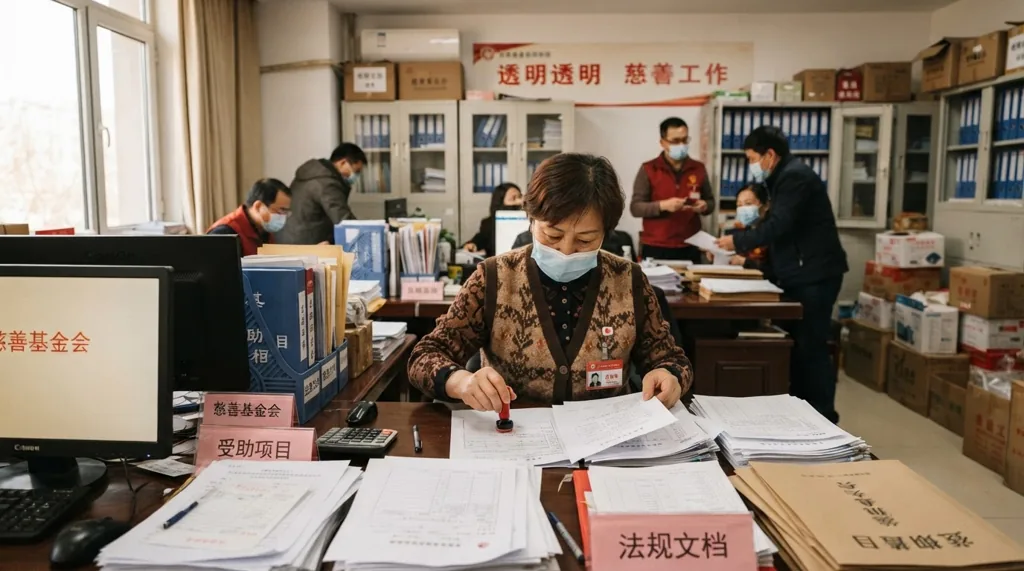
China’s State Council revised its foundation regulations, tightening registration, fundraising, governance and oversight from Jan. 1, 2027.
China has rewritten the rules for its charitable foundations, tightening how they register, raise money and govern themselves. The revised regulations take effect on Jan. 1, 2027.
Premier Li Qiang signed a State Council decree publishing the revised Regulations on the Management of Foundations1. The rules have 79 articles in eight chapters and apply to foundations doing public welfare work2. The Ministry of Civil Affairs, which registers social organizations, will now draft supporting documents, including a model foundation charter3.
| At a glance | Details |
|---|---|
| What was published | Revised State Council regulations on foundations |
| Published on | 10 November 2026 |
| Who must comply | Charitable foundations, their founders, leaders, directors and supervisors |
| Effective date | 1 January 2027 |
| Next milestone | Supporting documents, including a model foundation charter |
Why China revised the foundation rules
The current regulations were published in 20043. According to the Ministry of Justice and the Ministry of Civil Affairs, foundations now face weak internal governance, poorly regulated activities and oversight that needs strengthening3. China’s Charity Law also sets strict supervision duties for charitable organizations, including foundations3.
From the 2004 rules to the revision
The stated goal is to strengthen the credibility of foundations and promote their sound and orderly development1. Foundations doing public welfare work must follow six principles: legality, voluntariness, good faith, openness, transparency and non-profit operation1. The rules also confirm Communist Party leadership over foundation work and strengthen Party-building requirements2.
How registration changes
Civil affairs departments at the level of cities with districts and above will register foundations3. The rules set the registered capital required at each registration level3. They also define which bodies can act as a foundation’s supervising agency3.
Some foundations can now register directly, without first finding a supervising agency3. This applies to foundations that help the poor, the elderly, the disabled, the sick, orphans and students, and disaster victims3. Provincial civil affairs departments will handle these registrations, and each such foundation must name an industry authority3.
A foundation must close in certain cases, such as two years in a row without public welfare activity3. The rules also set procedures for registration changes and detail the asset settlement process before a foundation closes3.
What changes inside foundations
Founders are responsible for preparatory work before registration3. The rules list cases in which a person cannot serve as a founder or leader3. New leaders must also be publicly announced before they take office3.
Rules for founders and leaders
| Requirement | Details |
|---|---|
| Founders | Responsible for preparatory work before registration |
| Eligibility | Listed cases bar people from founder or leader roles |
| New leaders | Publicly announced before taking office |
| Conflicts of interest | Leaders and directors must avoid them |
The powers of the board, supervisors and executive body are expanded, with more detailed meeting rules3. Leaders and directors must avoid conflicts between their own interests and the foundation’s3. They must not use related-party ties, meaning links to connected people or firms, to harm the foundation, its beneficiaries or the public2.
Fundraising, donations and spending
| Area | What the rules require |
|---|---|
| Public fundraising | Foundations must hold a public fundraising qualification3 |
| Online and joint fundraising | Internet and partner fundraising is now regulated1 |
| Donations and grants | No conditions that break laws or public morality3 |
| Investment | Must be legal, safe, prudent and effective3 |
| Investment income | All income goes to public welfare purposes2 |
| Projects | Must fit the charter and be tracked3 |
Foundations must not give rewards back to donors or people connected to them3. Choosing project partners and suppliers must be open, fair and impartial, and related-party deals are strictly controlled3. When a foundation hands a project to another party, it must assess and monitor that work3.
Disclosure and enforcement
A dedicated chapter covers public disclosure of information3. Foundations must meet disclosure duties and accept public oversight, and registration authorities will guide this work3. The rules also call for industry self-regulation through sector standards2.
How regulators can act
Registration authorities gain new powers, including summoning foundation leaders for talks3. Working with finance and audit departments, they will check whether foundation income and spending are lawful3. Penalties for violations are increased, and new penalties can bar violators from certain roles3.
Key terms in plain words
| Term | Meaning |
|---|---|
| Foundation | A non-profit body that holds donated money for public welfare work |
| State Council | China’s cabinet, which issues national regulations |
| Registration authority | The civil affairs department that registers and oversees foundations |
| Direct registration | Registering without first securing a supervising agency |
| Related-party transaction | A deal with people or firms linked to the foundation’s leaders |
| Public fundraising qualification | Official permission to ask the general public for donations |
The revised regulations take effect on Jan. 1, 20271.
Sources
- ↩ China issues revised regulations on management of foundations https://la.china-embassy.gov.cn/eng/news/202611/t20261111_12057442.htm
- ↩ 公布修订后的《基金会管理条例》 – 全国哲学社会科学工作办公室 http://www.nopss.gov.cn/n1/2026/1111/c432288-40831724.html
- ↩ 中华人民共和国司法部 https://www.moj.gov.cn/pub/sfbgw/zcjd/202611/t20261110_541671.html