

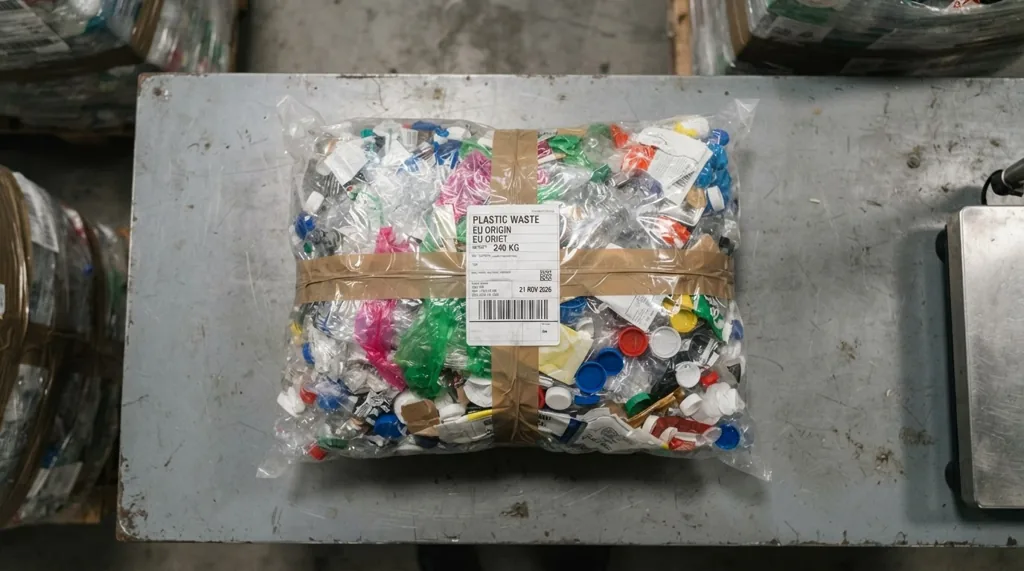
The EU banned plastic waste exports to non-OECD countries from 21 November 2026, until at least 21 May 2029.
The European Union now bans exports of plastic waste to countries outside the Organisation for Economic Co-operation and Development (OECD). The ban starts on 21 November 2026 and runs until at least 21 May 2029.
The European Commission announced the start of the ban on 20 November 20261. It comes under the EU Waste Shipment Regulation, which sets rules on moving waste across borders. Exports to OECD countries remain possible, but the Commission will check them more closely1.
| At a glance | Details |
|---|---|
| What was published | Start of a ban under the Waste Shipment Regulation (EU) 2024/1157 |
| Published on | 20 November 2026 |
| Who must comply | Companies exporting plastic waste from the EU |
| Effective date | 21 November 2026 |
| Next milestone | First list of countries allowed to receive EU waste, by end of 2026 |
What does the ban cover, and why?
From 21 November 2026, exporters may not ship plastic waste from the EU to any non-OECD country2. The ban covers clean, non-hazardous plastic waste meant for recycling as well. The Commission calls it a complete ban on such exports2.
The Commission says exporting plastic waste to these countries is likely to cause serious environmental harm there1. It also says the practice is not a sustainable way to manage waste generated in the EU. The rules aim to stop the EU from shifting its waste burden to other countries1.
According to the Commission, EU plastic waste shipped abroad has often ended up in illegal dumps, open fires or the sea2. It adds that these exports deprived Europe’s own recycling sector of materials2.
The law behind the ban
The measure comes from Regulation (EU) 2024/1157 on shipments of waste. The European Parliament and the Council adopted it on 11 April 20243. It replaced the earlier waste shipment rules, Regulation (EC) No 1013/20063.
The regulation entered into force on 20 May 20241. Its rules began to apply on 21 May 20262. The plastic export ban is one of several deadlines phased in after that date.
EU plastic waste exports by the numbers
The EU produces around 40 million tonnes of plastic waste each year1. It exports between 1 and 1.5 million tonnes of it annually. In 2025, about half of these exports went to OECD countries and half to non-OECD countries1.
| Main destination in 2025 | Plastic waste received |
|---|---|
| Türkiye | 510,000 tonnes |
| Malaysia | 276,000 tonnes |
| Indonesia | 215,000 tonnes |
| Vietnam | 137,000 tonnes |
| United Kingdom | 108,000 tonnes |
These figures come from the Commission’s announcement1. They show how much EU plastic waste has gone abroad each year.
What changes for exporters
The rules for exporters were already tightening before the ban. Since 21 May 2026, every plastic waste export needs prior notification and consent2. Under this procedure, authorities must approve a shipment before it leaves.
Exporters must also show that the receiving facility abroad handles the waste properly2. From 21 May 2027, they must arrange independent audits of those facilities. The audits must show the facilities manage waste in an environmentally sound way2.
| Key date | What happens |
|---|---|
| 20 May 2024 | Waste Shipment Regulation enters into force |
| 21 May 2026 | Prior approval needed for all plastic waste exports |
| 21 November 2026 | Ban on plastic waste exports to non-OECD countries starts |
| End of 2026 | First list of countries allowed to receive EU waste |
| 21 May 2027 | Independent audits of receiving facilities required |
| 21 May 2027 | General end of EU waste exports to non-OECD countries |
| 21 May 2029 | Earliest date the plastic ban can be lifted for a country |
How shipments to OECD countries will be checked
Exports to OECD countries are still allowed but face greater scrutiny1. The Commission is monitoring them, with particular attention to plastic waste2. If exports rise and seem likely to cause harm, it will open talks with the country concerned.
Exports will be suspended if the waste is not managed in an environmentally sustainable way2. The Commission must also check that OECD countries do not send EU plastic waste on to other countries2. On 18 September 2026, it published its assessment of plastic waste exports to Türkiye1.
What happens after May 2029
The ban lasts until at least 21 May 20291. After that, a non-OECD country can ask to receive EU plastic waste. It must notify the Commission and prove it can manage the waste in an environmentally sound way2.
Such a request can cover only clean, non-hazardous plastic waste, listed under the code B30112. Approved countries would join a list of places to which EU plastic waste may be exported.
Wider limits on EU waste exports
The plastic ban is part of a broader tightening. As a general rule, the EU will stop exporting any waste to non-OECD countries from 21 May 20271. Some non-hazardous waste may still go to countries that ask for it and show they can manage it sustainably.
The first list of countries allowed to receive EU waste will be set by the end of 20261. The list will be updated at least every two years. Countries or waste types left off the list can apply again1.
Key terms in plain words
| Term | Meaning |
|---|---|
| OECD | Organisation for Economic Co-operation and Development, an international body of member countries |
| Non-OECD country | Any country that is not a member of the OECD |
| Waste Shipment Regulation | The EU law that controls how waste moves into, out of and within the EU |
| Prior notification and consent | A process where authorities must approve a waste shipment before it is sent |
| B3011 | The code for clean, non-hazardous plastic waste sent for recycling |
| Environmentally sound management | Handling waste in a way that protects people and nature |
The Commission’s first list of countries allowed to receive EU waste is due by the end of 20261.
Sources
- ↩ EU bans plastic waste exports to non-OECD countries – Environment https://environment.ec.europa.eu/news/eu-bans-plastic-waste-exports-non-oecd-countries-2026-11-20_en
- ↩ Plastic waste shipments – Environment – European Commission https://environment.ec.europa.eu/topics/waste-and-recycling/waste-shipments/plastic-waste-shipments_en
- ↩ Regulation – EU – 2024/1157 – EN – EUR-Lex https://eur-lex.europa.eu/eli/reg/2024/1157/oj