

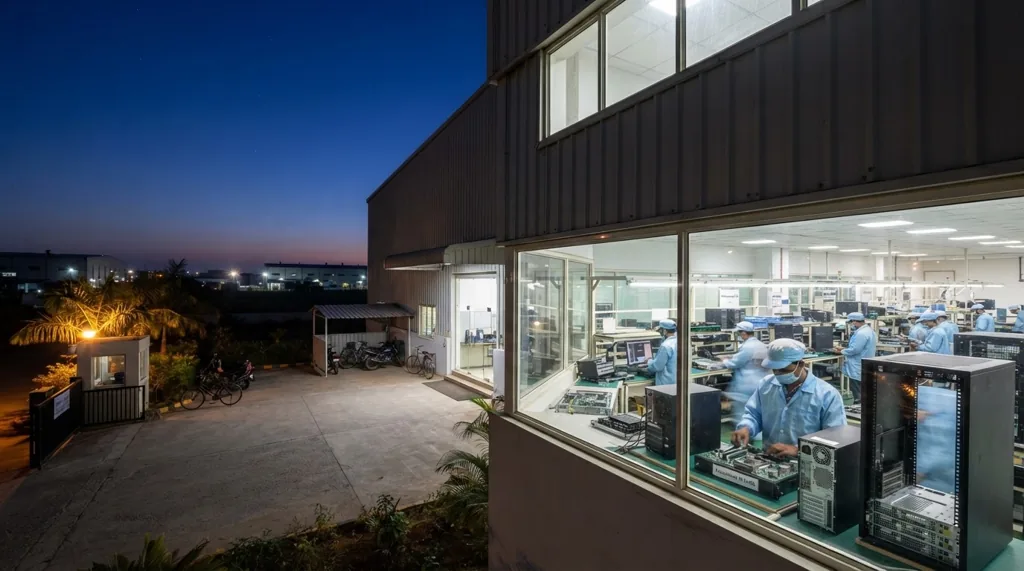
India’s IT ministry changed how suppliers count Indian-made content in laptops, PCs, servers and displays. The method applies six months after Gazette publication.
India’s IT ministry has changed how suppliers count the Indian-made share of laptops, PCs, servers and displays sold to government buyers. The new counting method takes effect six months after it appears in the Official Gazette.
The Ministry of Electronics and Information Technology (MeitY) announced the change on 20 November 20261. It revises a MeitY notification dated 7 September 2020 that set out how to calculate local content for six IT hardware products in public tenders1. Manufacturers and bidders supplying these products to central government buyers will need to use the new method once it takes effect.
| At a glance | Details |
|---|---|
| What was published | Revised method for calculating local content in six IT hardware products |
| Published on | 20 November 2026 (ministry announcement) |
| Who must comply | Manufacturers and bidders supplying these products to central government buyers |
| Effective date | Six months after publication in the Official Gazette |
| Next milestone | Publication in the Official Gazette, which starts the six-month clock |
What is Make in India procurement, and why does it matter?
The Public Procurement (Preference to Make in India) Order, 2017 is the rulebook that favours Indian-made goods in government buying2. It was issued on 15 June 2017 and applies to central government buyers of goods, services and works2. Its latest amendment dates from 19 July 20242.
The order sorts suppliers by their local content, the share of a product’s value added in India. A Class-I local supplier offers items with at least 50% local content2. A Class-II local supplier offers items with at least 20% but less than 50%2.
Unless a tender is open to global bids, only these two classes may bid2. That makes the counting method decisive. It decides which suppliers can compete at all.
Which products the new method covers
The revised method applies to six IT hardware products1. They range from personal computers to large screens.
- Desktop PCs and All-in-One PCs
- Laptop PCs
- Thin clients, simple computers that rely on a central server
- Servers
- Computer monitors
- Interactive Flat Panel Displays, the large touch screens used in classrooms and meeting rooms
For these six products, the new rules will replace the matching parts of the 2020 notification1.
How the new counting method works
The ministry calls the new approach a process-based method built on the Bill of Materials (BoM)1. A bill of materials is the full list of parts and steps that go into a product. Suppliers earn local content credit for specific manufacturing steps carried out in India.
| Activity done in India | Counts toward local content |
|---|---|
| Motherboard assembly using Surface Mount Technology | Yes1 |
| Sourcing bare printed circuit boards locally | Yes1 |
| Assembly, testing and packaging of memory and storage | Yes1 |
| Display assembly | Yes1 |
| Sourcing chassis and power modules locally | Yes1 |
| Final assembly and testing | Yes1 |
Memory here means RAM, and storage means solid-state drives (SSDs)1. Surface Mount Technology (SMT) is the standard way of placing chips directly onto a circuit board.
Extra credit for design and research
The method gives weight to eligible in-house research and development (R&D) carried out in India1. The ministry says the aim is to promote homegrown technology and innovation.
It also gives additional weight to Indian product design and intellectual property rights (IPR)1. IPR covers patents, designs and similar legal rights to an invention. A supplier that designs its product in India can therefore score higher than one that only assembles it.
Self-certification and checks
Manufacturers will report their local content using a standard calculation format and a self-certification1. The ministry says this is meant to make the figures objective and transparent. It also allows officials to verify a manufacturer’s declared figure where needed1.
How suppliers report and what is at stake
| Area | Rule |
|---|---|
| Reporting | Standard calculation format and self-certification |
| Checks | Officials can verify declared figures where needed |
| Penalty | Up to 10% of contract value if supplier drops a class |
| Excluded from count | Imported parts from local resellers, royalties paid abroad, refurbished or rebranded goods |
Getting the figure wrong carries a cost under the wider order. A buyer may impose a penalty of up to 10% of the contract value if a supplier misses its stated local content and drops to a lower class2.
The order also bars certain items from the count. Imported parts bought from local resellers, licence fees or royalties paid abroad, and refurbished or rebranded goods do not count as local content2.
Transition timeline and key deadlines
The ministry has not tied the change to a calendar date. The method takes effect six months after Gazette publication1. Until then, the 2020 notification still governs these products.
From the old method to the new
| Key date | What happens |
|---|---|
| 7 September 2020 | MeitY issues the current counting method1 |
| 20 November 2026 | MeitY announces the revised method1 |
| Gazette publication | Six-month transition period begins1 |
| Six months after Gazette publication | New method takes effect and replaces the 2020 provisions for these six products1 |
Key terms in plain words
| Term | Meaning |
|---|---|
| Local content | The share of a product’s value created in India |
| Domestic Value Addition (DVA) | The ministry’s term for local content |
| Bill of Materials (BoM) | The full list of parts and steps used to make a product |
| Class-I local supplier | A bidder whose goods have at least 50% local content |
| Self-certification | A supplier’s own signed statement of its local content figure |
| Official Gazette | The government’s official publication where rules become formal |
The new counting method takes effect six months after MeitY publishes it in the Official Gazette1.
Sources
- ↩ Press Release Page | Press Information Bureau https://www.pib.gov.in/PressReleasePage.aspx?PRID=2339142
- ↩ Public Procurement (Preference to Make in India) Order, 2017 | Department for Promotion of Industry and Internal Trade https://www.dpiit.gov.in/ministry/about-us/details/Title=Public-Procurement-(Preference-to-Make-in-India)-Order,-2017-ITMwETMtQWa