

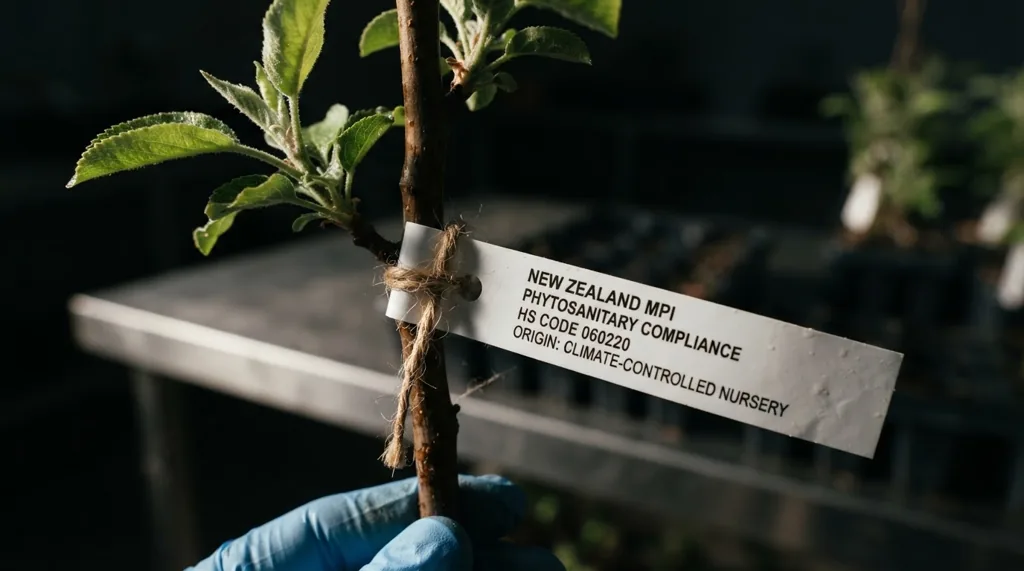
New Zealand has notified the Committee on Sanitary and Phytosanitary Measures of emergency measures and requirements for plants for planting to maintain import controls and compliance standards.
New Zealand has tightened its import rules for grapevine, daphne and pomegranate plants to keep out two serious plant diseases. The emergency changes took effect on 9 November 2026, without the usual 60-day comment period.
The Ministry for Primary Industries (MPI), New Zealand’s agriculture and biosecurity regulator, told the World Trade Organization (WTO) about the change in an emergency notice dated 10 November 20261. The rules cover all trading partners that ship Daphne, Punica (pomegranate) or Vitis (grapevine) plants to New Zealand1. MPI published the notice on its own website on 11 November 20262.
| At a glance | Details |
|---|---|
| What was published | Emergency amendments to the import rules for plants for planting |
| Published on | 10 November 2026 |
| Who must comply | Exporters and importers of Daphne, Punica and Vitis plants, from all trading partners |
| Effective date | 9 November 2026 |
| Next milestone | MPI must later review the measure and run a regular consultation |
What is the plants for planting standard?
The rules sit in the import health standard: Plants for Planting (155.02.06), formerly called Importation of Nursery Stock1. An import health standard is the official list of conditions a product must meet to enter New Zealand. This one covers whole plants, cuttings, bulbs and tissue culture brought into the country1.
The standard runs to 540 pages1. MPI had already notified the WTO of earlier proposed changes to it under notice G/SPS/N/NZL/7871. The new notice, G/SPS/N/NZL/797, adds further amendments as an emergency step1.
What changes for grapevine imports?
The first change targets grapevine berry inner necrosis virus (GINV), a virus that infects grapevines. Before, imported grapevines were checked by inspection during the growing season while in post-entry quarantine1. Post-entry quarantine is a period when newly arrived plants are held and watched before release.
That inspection is now replaced by mandatory laboratory testing1. Importers must have plants tested by PCR or high-throughput sequencing (HTS), two methods that detect a virus’s genetic material1.
MPI made the change because recent evidence shows mature grapevines in the field can carry the virus without visible signs1. Inspection alone could therefore miss infected plants.
Why the wine industry is at stake
MPI said GINV poses a significant risk to the viticultural industry, the business of growing grapes1. If the virus arrived, it could reduce grape quality and yield1.
A small pest raises the danger. The grape erinium mite, which can carry the virus, is already present in several New Zealand grape growing regions1. That makes it more likely the virus would spread if it got in.
New controls on daphne and pomegranate
The second change adds measures for Xylella fastidiosa to Daphne and Punica plants1. Xylella fastidiosa is a bacterium that damages a wide range of plants.
MPI calls it a regulated pest of high concern for both the horticulture sector and native plant species1. The ministry constantly monitors which plants it infects and where it occurs1. It added the two plant groups after the European Food Safety Authority updated its list of Xylella host plants1.
Why there was no comment period
WTO members normally get 60 days to comment on proposed changes to New Zealand’s import rules2. In a genuine emergency, MPI can skip that consultation2.
The exemption is temporary. MPI must revisit an emergency measure later and then issue a regular notification for consultation2. MPI states the new measures conform to ISPM no. 13, an international plant protection standard1.
Questions go to SPS New Zealand, MPI’s national enquiry point, at sps@mpi.govt.nz1.
Key terms in plain words
| Term | Meaning |
|---|---|
| Import health standard | The official conditions a product must meet to enter New Zealand |
| Plants for planting | Live plants, cuttings, bulbs and tissue culture meant to be grown |
| Post-entry quarantine | A holding period where imported plants are watched before release |
| PCR and HTS | Laboratory tests that find a virus’s genetic material |
| SPS notification | A notice to the WTO about rules protecting human, animal or plant health |
| Emergency measure | A rule applied at once, without the usual comment period |
The measures have applied since 9 November 2026, and MPI must later put them out for regular consultation2.
Sources
- ↩ NOTIFICATION OF EMERGENCY MEASURES NOTIFICATION OF EMERGENCY MEASURES NOTIFICATION OF EMERGENCY MEASURES http://www.spsvietnam.gov.vn/Data/File/Notice/12423/NNZL797.pdf
- ↩ World Trade Organization notifications | MPI https://www.mpi.govt.nz/import/importing-into-nz-how-it-works/access-and-trade-into-new-zealand/world-trade-organization-notifications