

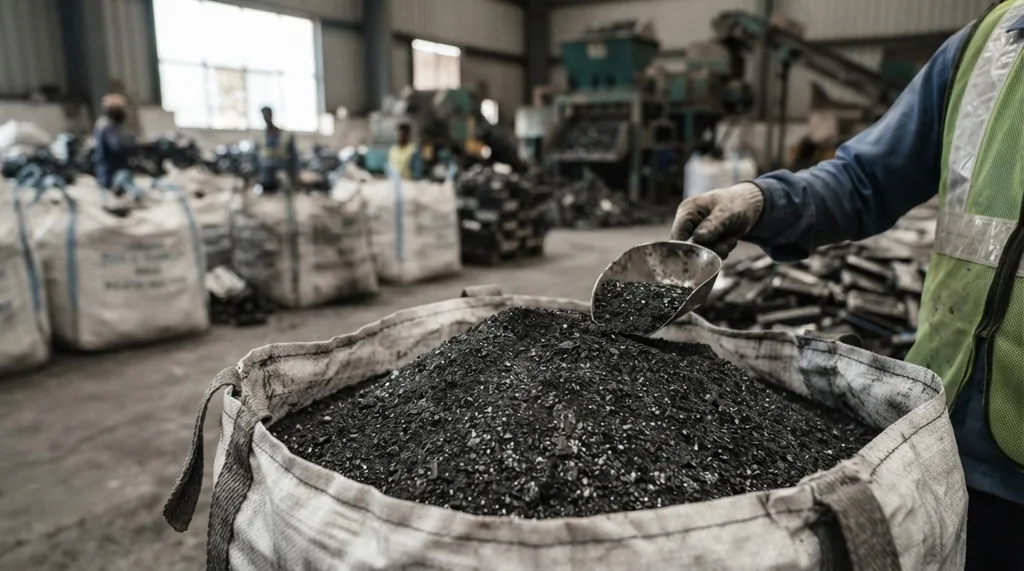
India’s trade regulator banned exports of lithium-ion battery black mass from 10 November 2026, to keep critical minerals for domestic recyclers.
India has banned exports of lithium-ion battery black mass, the powder left after shredding used batteries. The ban took effect immediately on 10 November 2026 and runs until further orders.
The Directorate General of Foreign Trade (DGFT), India’s export and import regulator, issued Notification No. 49/2026-27 on 10 November 20261. It changes the export policy for battery waste under ITC(HS) Code 85491400 from "Free" to "Prohibited"1. Exporters, battery recyclers and scrap traders are affected, and the transition rules in Para 1.05 of the Foreign Trade Policy (FTP), 2023 apply2.
| At a glance | Details |
|---|---|
| What was published | Export ban notification (No. 49/2026-27) |
| Published on | 10 November 2026 |
| Who must comply | Exporters of lithium-ion battery black mass |
| Effective date | 10 November 2026, with immediate effect |
| Next milestone | Ban stays in place until further orders |
What is black mass, and why does it matter?
Black mass is the powdery material from shredded batteries. It comes from end-of-life lithium-ion batteries and from battery manufacturing waste2. It holds recoverable amounts of lithium, cobalt, nickel and manganese2.
These critical minerals feed electric vehicles, battery making, energy storage, electronics and renewable energy2. India depends heavily on imports for several of them2. The government calls battery recycling one of the quickest ways to build a home supply2.
What the DGFT notification changes
The notification amends Schedule II of the export policy, under Chapter 85 of the trade code list1. The item’s policy moves from "Free" to "Prohibited"1. Under the new policy, this item cannot be exported.
The code covers waste and scrap of primary cells, primary batteries and electric accumulators, meaning rechargeable batteries1. It also covers spent cells and batteries that are unsorted and contain no lead, cadmium or mercury1. Lav Agarwal, the Director General of Foreign Trade, signed the notification1.
Why India is keeping battery waste at home
India’s capacity to recycle battery waste and refine minerals from it has grown considerably2. But that capacity is not fully used for lack of feedstock, the raw material recyclers process2. Exports of black mass send this resource abroad, while some domestic recyclers have had to import material2.
The ministry expects the ban to secure supply for domestic recycling and refining plants2. It also expects higher plant use, more investment and more jobs in the sector2. Greater home recovery of minerals should cut imports and the foreign currency spent on them2.
How the ban links to the recycling incentive scheme
The ban supports the National Critical Mineral Mission (NCMM), the government’s programme for securing key minerals2. That includes a ₹1,500 crore incentive scheme approved by the Union Cabinet in September 20252. The scheme funds plants that recover critical minerals from battery waste and electronic waste2.
Keeping black mass in India is meant to give these new plants enough local material2. The ministry says several major economies have taken similar steps to keep battery waste for domestic processing2.
What changes for exporters and recyclers
Exporters can no longer ship lithium-ion battery black mass out of India under this code1. The FTP’s transition rules in Para 1.05 apply to the change1. The notification does not spell out which shipments those rules cover.
Domestic recyclers stand to gain steadier access to material. The ministry also says the ban will support environmentally sound recycling of this hazardous material within India, under existing environmental rules2.
Key terms in plain words
| Term | Meaning |
|---|---|
| Black mass | Powder from shredded used lithium-ion batteries, rich in valuable metals |
| DGFT | Directorate General of Foreign Trade, India’s agency for export and import rules |
| ITC(HS) code | The product number India uses to classify goods in trade |
| Feedstock | The raw material a recycling plant processes |
| Critical minerals | Metals such as lithium, cobalt and nickel needed for batteries and clean energy |
| Transitional arrangement | FTP rules on how a policy change applies to trade already in progress |
The ban has applied since 10 November 2026 and stays in force until the DGFT issues further orders1.
Sources
- ↩ Scanned Image https://content.dgft.gov.in/Website/dgftprod/8fdc092d-832f-42d3-b9cd-be0106c20224/Notification%20No.%2049%20of%202026-2027.pdf
- ↩ Press Release: Press Information Bureau https://www.pib.gov.in/PressReleseDetailm.aspx?PRID=2335019®=3&lang=1