

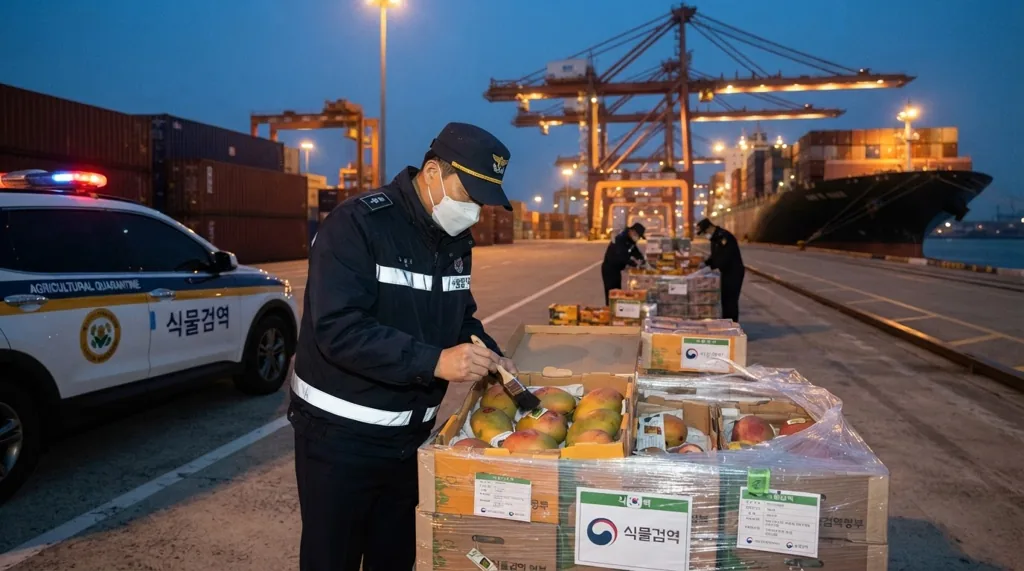
South Korea has updated its quarantine pest list by adding new pests requiring quarantine measures and regulatory control procedures to prevent the introduction and spread of harmful pests within its borders.
36 pests join Korea’s quarantine list
Listings take effect in the first half of next year.
South Korea’s plant health agency plans to add 36 pests to the list it guards against at the border. Trading partners have until 27 December 2026 to comment, and the change takes effect in the first half of next year.
The Animal and Plant Quarantine Agency (APQA), Korea’s border authority for animal and plant health, filed the plan with the World Trade Organization (WTO)1. The change applies to plants and plant products imported into Korea1. The agency says the new listings will enter into force in the first half of next year1.
| At a glance | Details |
|---|---|
| What was published | Planned addition to Korea’s quarantine pest list |
| Published on | 29 October 2026 |
| Who must comply | Exporters and importers of plants and plant products shipped to Korea |
| Feedback deadline | 27 December 2026 |
| Next milestone | Entry into force in the first half of next year |
What is a quarantine pest list, and why does it matter?
A quarantine pest list names insects, fungi, bacteria and viruses that a country keeps out at its border. Korea’s agency works under the Ministry of Agriculture, Food and Rural Affairs (MAFRA)1. It bases the list on a pest risk analysis, a scientific review of how likely a pest is to arrive and cause harm1.
The measure in brief
| Dimension | Provision |
|---|---|
| Issuing agency | APQA, under MAFRA |
| Legal basis | Articles 4 and 6, Plant Protection Act ordinance |
| Scientific basis | Pest risk analysis |
| Products covered | Plants and plant products imported into Korea |
| Category | All 36 listed as controlled pests |
The legal basis is Articles 4 and 6 of the ministerial ordinance under the Plant Protection Act1. A ministerial ordinance is a set of detailed rules a ministry issues to carry out a law. Once a pest is listed, plant shipments that may carry it face quarantine controls on arrival.
The 36 pests Korea plans to add
The notice lists 36 new quarantine pests by scientific name2. Every one is classed as a "controlled pest"2. The additions span five groups of organisms.
| Pest group | Number added |
|---|---|
| Fungi | 10 |
| Bacteria | 3 |
| Viruses | 3 |
| Thrips (tiny sap-sucking insects) | 12 |
| Beetles | 8 |
Thrips make up the largest single group, with 12 species on the list2. They include Thrips florum, Thrips orientalis and Thrips sumatrensis2. Another is Echinothrips mexicanus2.
The fungi, bacteria and viruses
The 10 fungi make up the second-largest group2. The list includes Hemileia vastatrix and Ascochyta citricola2. It also names Peronospora rubi and Phyllosticta aurantiicola2.
The bacteria are Candidatus Phytoplasma solani, Rathayibacter toxicus and Xanthomonas albilineans2. The three viruses are named with their common names in the list2. They are okra enation leaf curl virus, tomato severe rugose virus and watermelon silver mottle orthotospovirus2.
The beetles on the list
The eight beetle species belong to the order Coleoptera2. They include Plagionotus arcuatus, Xylotrechus smei and Xystrocera festiva2. Others are Ceresium unicolor and Oxymerus basalis2.
What changes for exporters and importers
The measure covers plants and plant products imported into Korea1. Once the listing takes effect, these 36 organisms join the pests Korean inspectors screen for. Plant shipments to Korea may then face checks for the new species.
Key dates
Exporting countries can raise concerns through the WTO before 27 December 20261. After that, the agency plans to bring the listings into force in the first half of next year1.
| Key date | What happens |
|---|---|
| 29 October 2026 | Notice published through the WTO |
| 27 December 2026 | Comment period closes |
| First half of next year | New listings enter into force |
Key terms in plain words
| Term | Meaning |
|---|---|
| Quarantine pest | A harmful pest a country keeps out by checking imports at the border |
| Controlled pest | The category Korea gives all 36 new pests, placing them under official control |
| Pest risk analysis | A scientific review of how likely a pest is to arrive and cause damage |
| Ministerial ordinance | Detailed rules a ministry issues to put a law into practice |
| APQA | The Animal and Plant Quarantine Agency, Korea’s border plant and animal health authority |
| WTO | The World Trade Organization, where countries notify trade rules to partners |
The comment period on Korea’s 36 new quarantine pests closes on 27 December 20261.
Sources
- ↩ Detail / SWITEC https://www.switec.info/de/notifikationen/detail/?nr=KOR/212/Add.25&id=106684
- ↩ 26_05595_00_e.pdf https://members.wto.org/crnattachments/2026/SPS/KOR/26_05595_00_e.pdf