

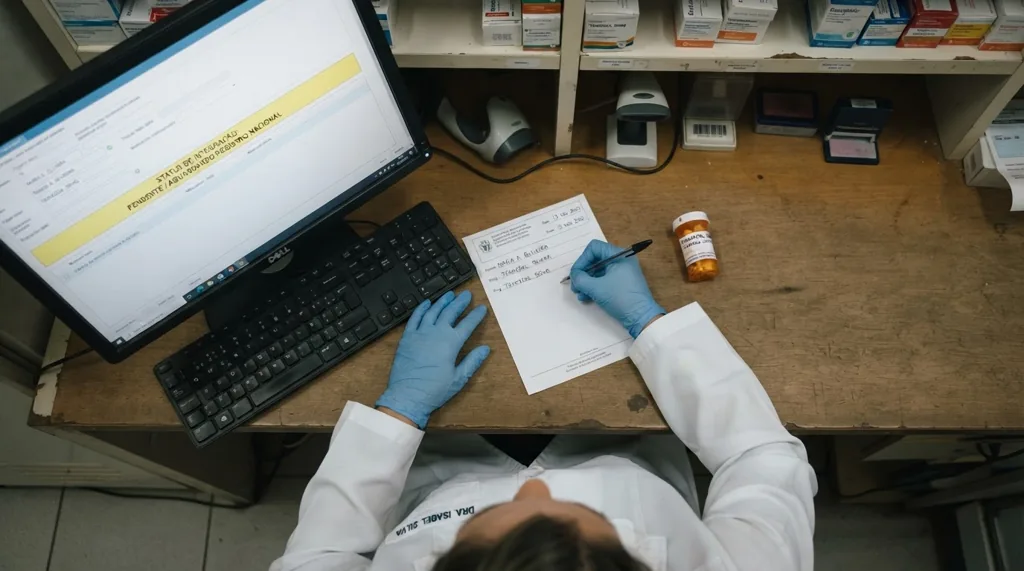
Anvisa extended to 3 March 2027 the period for issuing controlled-drug e-prescriptions without a national SNCR number.
Anvisa, Brazil’s health products regulator, has given doctors and prescription software more time to link electronic prescriptions to its national numbering system. Electronic prescriptions for special-control and retained-prescription medicines can be issued without a national number until 3 March 2027.
The change comes in Resolution RDC 1.046, dated 29 October 2026, which amends the earlier e-prescription rule, RDC 1.000/20251. Anvisa’s board approved it unanimously at a public meeting on 29 October, pushing back a deadline that would have ended in October 20262. From 4 March 2027, these electronic prescriptions must carry a number issued by the national system1.
| At a glance | Details |
|---|---|
| What was published | Resolution RDC 1.046, amending e-prescription rule RDC 1.000/2025 |
| Published on | 29 October 2026 (date of the resolution) |
| Who must comply | Prescribers, e-prescription platforms, pharmacies and drugstores |
| Effective date | Transition runs until 3 March 2027 |
| Next milestone | National number required from 4 March 2027 |
What is the SNCR, and why does it matter?
The National Prescription Control System (SNCR) is an Anvisa database that manages prescription numbers nationally2. It was created to centralise numbering and tighten control over prescriptions for specially controlled medicines2. The system was set up by RDC 873/2024 and began operating on 18 July 20243.
A new phase began on 30 September 2026, when electronic issuing linked to the system became available3. Since then, Anvisa has made more than 274 million unique numbers available for electronic prescriptions2.
Which prescriptions get more time?
The extension covers two types of prescription, often called "white prescriptions"3. The first is the special-control prescription, used for medicines on certain lists such as anabolic steroids and some other controlled substances1. The second is the retained prescription, which the pharmacy keeps after dispensing1.
Retained prescriptions include those for antimicrobials and GLP-1 agonists3. The extension does not cover Notification of Prescription forms, such as the blue and yellow forms.
What changes for pharmacies?
Pharmacies and drugstores may accept prescriptions issued without a number during the transition1. They can do so for the full validity period of each prescription, under existing controlled-drug rules1. This means a prescription issued on 3 March 2027 can still be filled after that date while it remains valid.
Under the wider rule, pharmacies must record each electronic prescription in the national system when they dispense1. They must check the prescriber’s electronic signature and confirm the number was issued to that prescriber1. Each prescription can be used only once after its use is recorded1.
Why Anvisa extended the deadline
Director Thiago Campos, who led the case, said the measure aims at a gradual and safe move to the new process2. He said prescribers, platforms and pharmacies are adopting the new tools, but rollout is still at an early stage2.
According to Campos, the extra time lets the sector finish technical and operational changes2. It also gives Anvisa a longer period to monitor system stability and reduces the risk of interrupted patient care2.
How the rules work in practice
Electronic prescriptions must be created only in prescription software linked to the national system through an API, a standard connection between computer systems1. Software that is not linked is barred from issuing them1. If a platform breaks the system’s usage requirements, Anvisa will suspend its access immediately1.
Prescribers do not need to log in to the national system themselves3. Their prescription software talks to the system on their behalf3. Paper prescriptions remain valid, and electronic issuing is not mandatory3.
| Key date | What happens |
|---|---|
| 18 July 2024 | National numbering system begins operating3 |
| 30 September 2026 | Electronic issuing linked to the system becomes available3 |
| 29 October 2026 | Anvisa board approves the extension2 |
| 3 March 2027 | Last day to issue these e-prescriptions without a national number1 |
| 4 March 2027 | National number becomes mandatory1 |
Key terms in plain words
| Term | Meaning |
|---|---|
| Anvisa | Brazil’s national health surveillance agency, which regulates medicines |
| RDC | A resolution issued by Anvisa’s board of directors |
| SNCR | Anvisa’s national system that issues and tracks prescription numbers |
| Special-control prescription | A prescription form for certain controlled medicines, such as anabolic steroids |
| Retained prescription | A prescription the pharmacy keeps, used for drugs such as antimicrobials |
| API | A standard link that lets two computer systems exchange data |
The national number becomes mandatory for these electronic prescriptions on 4 March 20271.
Sources
- ↩ ResoluÁ„o da Diretoria Colegiada Anvisa n∫ 1.000, de 11/12/2025 https://anvisalegis.datalegis.net/action/ActionDatalegis.php?acao=abrirTextoAto&tipo=RDC&numeroAto=00001000&seqAto=000&valorAno=2025&orgao=RDC/DC/ANVISA/MS&codTipo=&desItem=&desItemFim=&cod_menu=9434&cod_modulo=310&pesquisa=true
- ↩ 20ª Reunião Ordinária Pública da Anvisa: período de transição para emissão de receitas eletrônicas no SNCR é prorrogado https://www.gov.br/anvisa/pt-br/assuntos/noticias-anvisa/2026/20a-reuniao-ordinaria-publica-da-anvisa-periodo-de-transicao-para-emissao-de-receitas-eletronicas-no-sncr-e-prorrogado
- ↩ Início de nova etapa do SNCR: o que muda a partir de 30 de setembro https://www.gov.br/anvisa/pt-br/assuntos/noticias-anvisa/2026/inicio-de-nova-etapa-do-sncr-o-que-muda-a-partir-de-30-de-setembro