

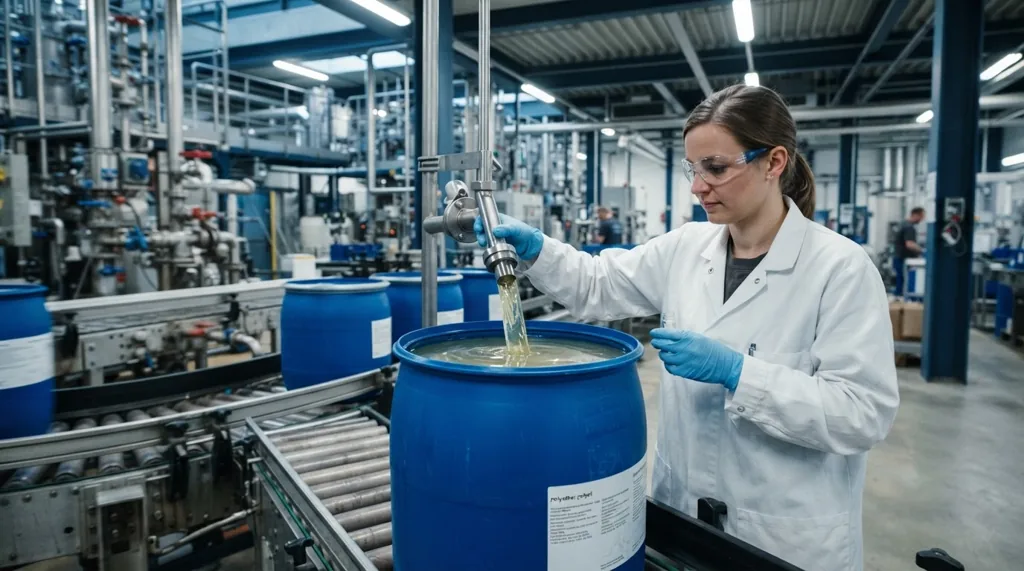
The European Commission ordered customs to register Chinese polyether polyol imports from 7 November 2026, so anti-dumping duties could be backdated.
The European Commission has ordered customs authorities to register imports of certain polyether polyols from China. Registration starts on 7 November 2026 and lets the EU charge anti-dumping duties backdated to that point if its investigation ends with duties.
Commission Implementing Regulation (EU) 2026/2409 was adopted on 5 November 2026 and published in the Official Journal on 6 November 20261. It enters into force the day after publication, and registration ends nine months after that1. The registration runs alongside an anti-dumping investigation the Commission opened on 30 June 20261.
| At a glance | Details |
|---|---|
| What was published | Implementing regulation ordering customs registration of imports |
| Published on | 6 November 2026 |
| Who must comply | EU customs authorities, EU importers and Chinese exporters of polyether polyols |
| Effective date | 7 November 2026 |
| Final rules / Next milestone | Possible definitive duties, decided at the end of the investigation |
What are polyether polyols, and why does it matter?
Polyether polyols are plastic-type chemicals, or organic polymers, made by reacting a starter substance with ethylene oxide or propylene oxide1. The rules cover products with a hydroxyl number between 10 and 520, a measure of how reactive the chemical is1. They fall under customs code ex 3907 29 20, with detailed codes 3907 29 20 35 and 3907 29 20 901.
The case started with a complaint lodged on 8 June 2026 by BASF, Covestro, PCC Rokita, Shell and Chimcomplex2. These producers represent more than 25% of EU output of the product1. They claim dumped Chinese imports have grown in volume and market share, hurting EU sales, prices and jobs2.
Which products the registration catches
The rules cover pure polyether polyols and several kinds of blends1. Blends include a single polyol holding tiny solid plastic particles, mixes of two or more polyols, and formulas with additives or catalysts1. Additives named include flame retardants, surfactants and stabilisers, but antioxidants do not count as additives1.
What the registration covers
| Dimension | Provision |
|---|---|
| Product | Pure polyether polyols and blends |
| Customs codes | 3907 29 20 35 and 3907 29 20 90 |
| Weight test | At least 50% pure polyether polyol |
| Excluded | Polyethylene glycols under code 3907 29 11 |
| Area | What the regulation says |
|---|---|
| Weight test | At least 50% of the product’s weight must be pure polyether polyol |
| Pure polyol | A single polyol that is at least 90% polyether polyol by weight |
| Origin | Products from China |
| Exclusion | Polyethylene glycols under code 3907 29 11 |
Products must be at least 50% pure polyol by weight to be covered1. Polyethylene glycols, known as PEGs, are left out of the scope1.
How customs registration works in practice
Registration means customs authorities keep a record of each covered import as it enters the EU1. The aim is to let the EU charge anti-dumping duties retroactively on those recorded imports, if the legal conditions are met1. The Commission acted on its own initiative under Article 14(5) of the EU’s basic anti-dumping law, Regulation (EU) 2016/10361.
Registration itself creates no bill today. Any future liability would come only from the findings of the investigation1. The Commission will decide whether to collect duties retroactively in the regulation that sets definitive duties, if one follows1.
How large could the duties be?
The complaint estimates a dumping margin of 101% for the period from 1 October 2024 to 30 September 20251. It also estimates an injury elimination level of 60%, the duty needed to undo the harm to EU producers1. Normally, any liability would be set at the lower of the two figures1.
The complaint’s estimates
| Estimate in the complaint | Figure |
|---|---|
| Dumping margin | 101% |
| Injury elimination level | 60% |
| Period covered | 1 October 2024 to 30 September 2025 |
The rule changes if the Commission finds raw material distortions in China1. In that case, liability could be set at the full dumping margin when a lower duty would not remove the harm1. The initiation notice says propylene oxide makes up more than 17% of production costs and faces a VAT refund withdrawal on Chinese export sales2.
The Commission stresses it cannot yet estimate the final amount1. The complaint figures are for information only and create no expectation about the actual level1.
The wider investigation and its timeline
The investigation covers dumping and injury from 1 April 2025 to 31 March 20262. To assess trends in injury, it looks back to 1 January 20222. The complainants proposed Mexico as the reference country for building a fair price, because they argue Chinese prices and costs are distorted2.
From complaint to registration
| Key date | What happens |
|---|---|
| 8 June 2026 | EU producers lodge complaint |
| 30 June 2026 | Commission opens anti-dumping investigation |
| 6 November 2026 | Registration regulation published |
| 7 November 2026 | Registration begins |
The investigation will also test whether duties would be against the wider EU interest2. If the findings support duties, a separate regulation would set them1.
Key terms in plain words
| Term | Meaning |
|---|---|
| Anti-dumping duty | An extra import tax on goods sold abroad below their fair price |
| Dumping margin | How far the export price falls below the fair price, as a percentage |
| Injury elimination level | The duty needed to remove the harm to EU producers |
| Customs registration | Customs keeps a record of imports so duties can be charged later |
| Retroactive duty | A duty charged on goods that entered before the duty was set |
| Raw material distortion | State action that pushes input prices below world market levels |
Registration of Chinese polyether polyol imports starts on 7 November 2026 and expires nine months later1.
Sources
- ↩ L_202602409EN.000101.fmx.xml https://eur-lex.europa.eu/legal-content/EN/TXT/HTML/?uri=OJ:L_202602409
- ↩ EUR-Lex – 52026XC03478 – EN – EUR-Lex http://data.europa.eu/eli/C/2026/3478/oj