

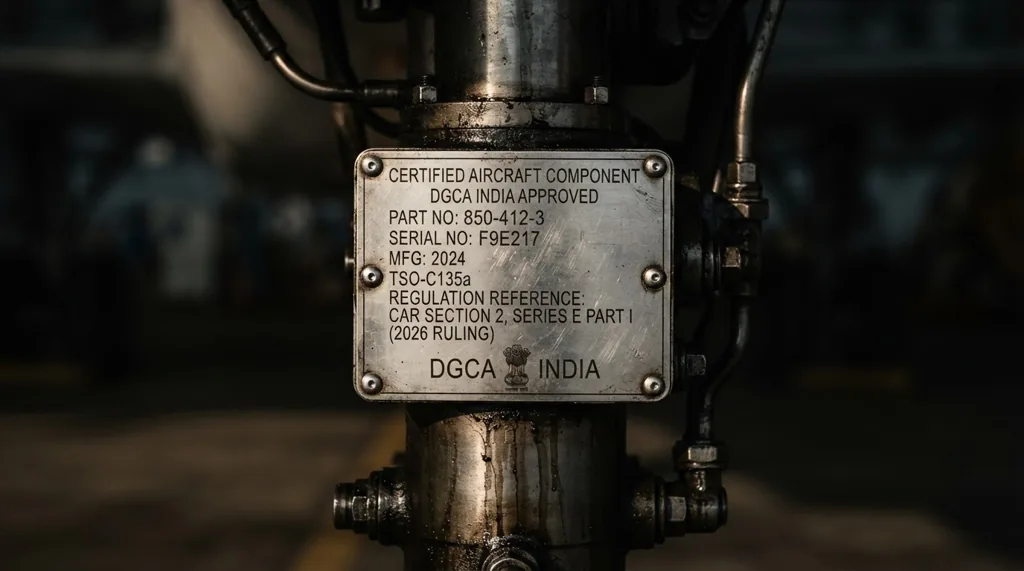
India notified the Bharatiya Vayuyan Niyam, 2026, a 220-rule aviation rulebook replacing the 1937 Aircraft Rules from 1 January 2027.
India has notified a new civil aviation rulebook, the Bharatiya Vayuyan Niyam, 2026, to replace the Aircraft Rules, 1937. The 220 rules come into force on 1 January 2027 and cover airlines, airports, pilots, engineers and aircraft makers.
The Government notified the rules under the Bharatiya Vayuyan Adhiniyam, 2024, the law that sets India’s modern aviation framework1. A government factsheet published on 4 November 2026 sets out the main provisions, from aircraft registration to fines1. The Ministry of Civil Aviation describes the rules as a restructured, consolidated framework for licensing, airworthiness and aircraft operations2.
| At a glance | Details |
|---|---|
| What was published | Final rules: Bharatiya Vayuyan Niyam, 2026 |
| Published on | 4 November 2026 (government factsheet) |
| Who must comply | Airlines, aircraft owners, airports, pilots, engineers, air traffic services and aviation manufacturers |
| Effective date | 1 January 2027 |
| Next milestone | Old Aircraft Rules, 1937 replaced on 1 January 2027 |
What is the new rulebook, and why does it matter?
The Aircraft Rules, 1937 served as India’s main aviation rulebook for decades1. They stayed in force under the 2024 law only until new rules replaced them2. The new rules comprise 220 rules in eight chapters and six schedules1.
The rules also replace Part IX of the Aircraft Rules, 19201. They repeal the Radio Telephone Operator (Restricted) Certificate and Licence Rules, 2025, with some existing rights kept1. The number of operational airports rose from 74 in 2014 to 166 as of October 20261.
| Rulebook by the numbers | Details |
|---|---|
| Rules | 220 |
| Chapters | 8 |
| Schedules | 6 |
| Licence, rating and certificate categories | 23 |
| Punishable offences | 21 |
| Offences that can be settled by paying a fee | 18 |
What changes for aircraft owners and makers
The Directorate General of Civil Aviation (DGCA), India’s aviation safety regulator, may now issue type certificates where India is the country of design1. A type certificate is official approval of an aircraft, engine or propeller design. DGCA may also accept foreign certificates under set conditions1.
The rules recognise fractional ownership, where several parties jointly own one aircraft1. Each arrangement must name who is responsible for operating and maintaining the aircraft1. Indian aircraft must display the "VT" nationality mark, followed by a hyphen and three capital letters1.
Leasing firms gain a faster exit route. Holders of an Irrevocable De-registration and Export Request Authorisation (IDERA), a document letting a lender remove an aircraft from the register, get quicker decisions1. DGCA must process eligible cancellation requests within five working days1.
Rules for crews, airports and airfares
The rules set 23 categories of licences, ratings and certificates for aviation staff1. Air traffic controllers face a maximum age of 60 for some licence privileges1. Crew members may not drink alcohol or take specified intoxicants within 12 hours before a flight1.
| Area | What the rules require |
|---|---|
| Cabin crew, 10–50 seat aeroplanes | At least one cabin crew member1 |
| Cabin crew, over 50 seats | Two members, plus one per 50 seats beyond 991 |
| Lasers near airports | Written permission needed within ten nautical miles1 |
| Wildlife hazards | Slaughter and garbage dumping restricted within ten kilometres1 |
| Weather records | Kept for at least 30 days1 |
Airlines must publish their fares digitally, and scheduled airlines must submit them to DGCA for monitoring1. Booking websites and tickets must show the total payable amount and a breakdown of taxes and fees1. In extraordinary situations, the Central Government may issue short, proportionate directions in the public interest1.
How safety oversight will work
Many operators, airports, maintenance and training organisations must run safety management systems1. These are formal processes for finding and controlling safety risks. DGCA must set up mandatory and voluntary safety reporting, and voluntary reports must be confidential and free of punishment1.
DGCA may carry out unannounced inspections of aircraft and aviation facilities1. Draft Civil Aviation Requirements (CARs), DGCA’s detailed technical rules, must usually be posted for 30 days of public comment1. That period may be shortened or waived in the public interest by written order1.
Enforcement and penalties
The rules list 21 punishable offences carrying up to two years in prison, a fine of up to ₹1 crore, or both1. Another 18 offences can be compounded, meaning settled by paying a set amount instead of prosecution1.
A new graded penalty scale has ten severity levels1. Fines range from ₹10,000 to ₹1 crore, depending on the breach and the offender’s size and category1. The rules also provide for appeals, hearings and written reasons for decisions1.
Key terms in plain words
| Term | Meaning |
|---|---|
| DGCA | Directorate General of Civil Aviation, India’s aviation safety regulator |
| Airworthiness | Whether an aircraft is safe and fit to fly |
| Type certificate | Official approval of an aircraft, engine or propeller design |
| IDERA | A document letting a lender or lessor have an aircraft removed from India’s register and exported |
| Compoundable offence | A breach that can be settled by paying an amount instead of going to court |
| Fractional ownership | Several parties sharing ownership of one aircraft |
The Bharatiya Vayuyan Niyam, 2026 takes effect on 1 January 20271.
Sources
- ↩ Factsheet Details:Factsheet Details | PIB https://pib.gov.in/FactsheetDetails.aspx?id=151161&NoteId=151161&ModuleId=16®=3&lang=1
- ↩ DG Division | Ministry of Civil Aviation https://www.civilaviation.gov.in/dg-section