

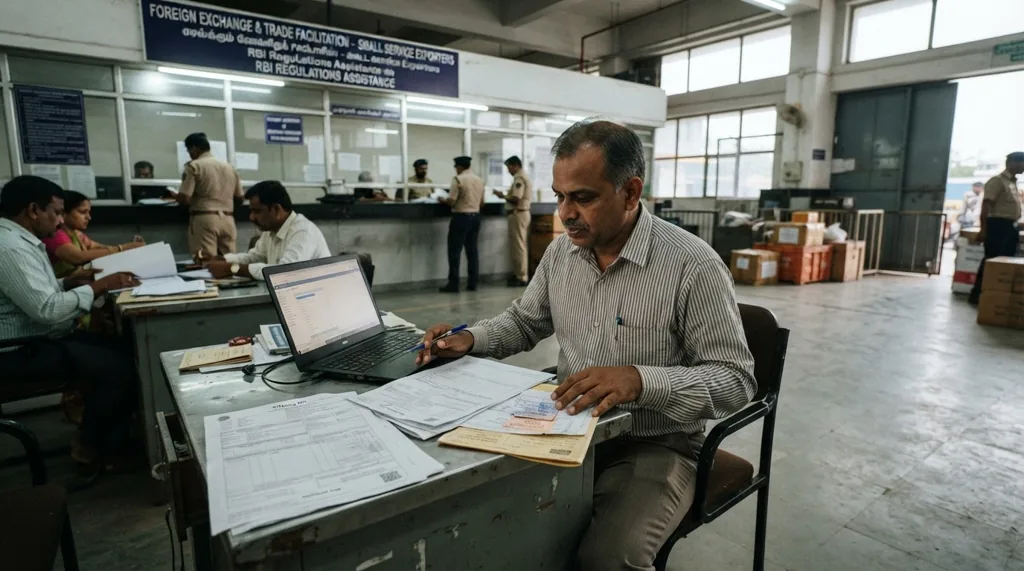
India’s central bank cut filing and tracking duties for small service exports and imports, backdated to 1 October 2026.
The Reserve Bank of India (RBI) has cut paperwork for small service exporters and importers under its foreign exchange trade rules. The changes are dated 2 November 2026 but take effect retroactively from 1 October 2026.
The RBI published the Foreign Exchange Management (Export and Import of Goods and Services) (Second Amendment) Regulations, 2026, on 2 November 20261. The changes apply to service exporters, service importers and the banks that handle their foreign payments. The notice appeared in the Official Gazette of India the same day1.
| At a glance | Details |
|---|---|
| What was published | Final amendment to India’s export and import foreign exchange rules |
| Published on | 2 November 2026 |
| Who must comply | Service exporters, service importers and authorised banks |
| Effective date | 1 October 2026 |
| Final rules / Next milestone | Already in force; no comment period announced |
What are these rules, and why do they matter?
The Foreign Exchange Management Act (FEMA), 1999, is India’s law on payments that cross its borders. The RBI issued the main export and import rules under it on 13 January 20261. Those rules came into force on 1 October 20262.
The rules require exporters to declare what they earn abroad. Banks then track each deal in central databases until the money arrives or is paid out2. The new amendment changes how small service deals are declared and tracked. It is the second change to the January rules, after a first amendment dated 22 September 20261.
What changes for service exporters
Under the main rules, a service exporter must file an Export Declaration Form (EDF)2. This form states the full value of the services sold abroad. It is due within 30 days from the end of the month in which the invoice was raised2.
The amendment creates two shortcuts. An exporter is now treated as having filed the form once it gives its bank the payment details needed to credit its account1.
- Individuals: a resident individual, meaning a person living in India, gets this treatment for any amount1.
- Companies and other non-individuals: they get it only when the payment received is ₹10 lakh or less, or the foreign currency equivalent1.
The amendment also adds a formal definition of "resident individual" to the rules1. Above the ₹10 lakh limit, firms other than individuals still file the form in the usual way.
What changes for banks tracking service imports
Banks that may deal in foreign exchange are called Authorised Dealers under FEMA2. They log imports in the Import Data Processing and Monitoring System (IDPMS), the RBI’s tracking database for import payments2.
Before the amendment, banks had to log every service import declared by the importer. They had five working days from receiving the documents1. Now banks must log a service import only in narrower cases1:
- the importer is not a resident individual, and
- the invoice or contract value is above ₹10 lakh, or the foreign currency equivalent.
The five-working-day deadline still applies to these larger imports1. Service imports by individuals, and smaller deals by firms, no longer have to be logged this way.
How it fits with the wider rules
The ₹10 lakh line already appears elsewhere in the January rules. Banks may close small export and import entries based on a simple declaration from the customer2. That applies where the shipping bill, bill of entry or invoice is up to ₹10 lakh2.
The amendment extends that small-value approach to the start of the process. Small service deals now face lighter filing and logging, not just a lighter closing step. Banks must still monitor their database entries and follow up with customers on payment2.
Transition timeline and key dates
The amendment is backdated to the start date of the main rules. It therefore applies to service deals from day one of the new rules1.
| Key date | What happens |
|---|---|
| 13 January 2026 | RBI issues the main export and import rules1 |
| 15 January 2026 | Main rules published in the Official Gazette1 |
| 22 September 2026 | First amendment issued1 |
| 1 October 2026 | Main rules and this amendment take effect1 |
| 2 November 2026 | Second amendment issued and published in the Gazette1 |
The notice is signed by N. Senthil Kumar, Chief General Manager in the RBI’s Foreign Exchange Department1.
Key terms in plain words
| Term | Meaning |
|---|---|
| FEMA | Foreign Exchange Management Act, 1999, India’s law on cross-border payments |
| Authorised Dealer | A bank licensed to handle foreign exchange deals |
| EDF | Export Declaration Form, the form stating the value of an export |
| IDPMS | The RBI’s database that tracks payments for imports |
| Resident individual | A person, not a company, who lives in India |
| ₹10 lakh | The value limit, in Indian rupees, below which a deal counts as small |
The amendment has applied since 1 October 2026, and the RBI has announced no further step.
Sources
- ↩ Notifications | Official Website of Reserve Bank of India https://www.rbi.org.in/scripts/NotificationUser.aspx?Id=13750&Mode=0
- ↩ Foreign Exchange Management Act | Official Website of Reserve Bank of India https://www.rbi.org.in/Scripts/BS_FemaNotifications.aspx?Id=13277