

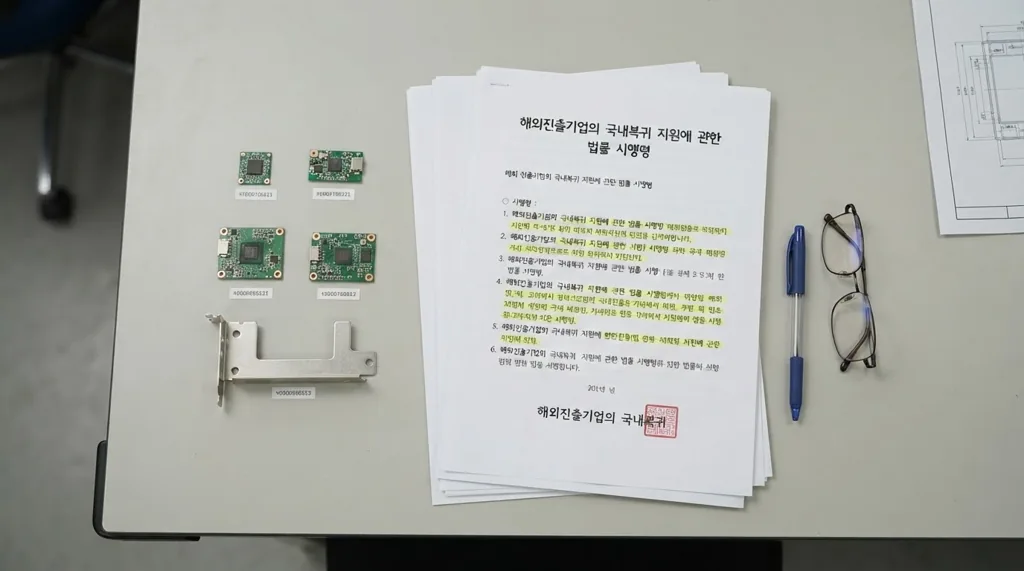
South Korea’s Cabinet approved looser returning-company rules, letting more advanced and supply chain firms get support without shrinking foreign plants.
South Korea’s Cabinet has approved looser rules for deciding which overseas firms count as "returning companies" eligible for state support. The change targets advanced industries and supply chain sectors, and lets more firms qualify without closing or shrinking their foreign plants.
The Cabinet approved an amendment to the enforcement decree, the detailed rules beneath a law, of the Act on Assistance to Korean Off-shore Enterprises in Repatriation on 3 November 20261. The amendment widens how officials judge whether products made at home and abroad are similar, and widens who can skip the requirement to restructure overseas sites1. The trade and industry ministry announced the decision the same day under the heading that firms can qualify even when their home products differ from those made abroad, if the technology and functions are similar2.
| At a glance | Details |
|---|---|
| What was published | Amended presidential decree under the repatriation support law |
| Published on | 3 November 2026 |
| Who must comply | Korean firms with overseas operations seeking returning-company support |
| Effective date | Not stated in the official briefings |
| Final rules / Next milestone | Start of the amended rules, run by the ministry’s overseas investment division |
What is a returning company, and why does it matter?
A returning company is a Korean firm with operations abroad that sets up or expands a business site in Korea. Under the law, the home site must make products or services identical with or similar to those made abroad3. The firm must also close, transfer or downsize its overseas site3.
What the law asks of returning firms
| Requirement | Standard / Details |
|---|---|
| Home site | Set up or expand a business site in Korea |
| Products | Identical with or similar to those made abroad |
| Overseas site | Close, transfer or downsize it |
| After selection | Follow the repatriation plan and report changes |
Firms that the government selects as eligible can receive real help. The state and local governments may grant tax exemptions or reductions under the tax laws3. They may also subsidize land, factory and equipment costs, and help firms obtain loans3.
The law leaves the detail of the similarity test to a presidential decree3. That is why a change to the decree alone can widen who qualifies.
What the amendment changes
The Cabinet briefing names two changes1. Both aim to boost domestic investment in advanced industries and supply chains as the global investment climate shifts1.
The ministry’s announcement says firms can be recognized as returning even when the home product differs from the overseas one2. The test is whether the technology and functions are similar2.
What changes for companies abroad
Until now, the law tied eligibility to making the same or similar products at home3. A firm planning a new product line in Korea could fall outside the support scheme. The amended decree loosens that link for firms whose technology and functions carry over2.
Eligibility, before and after the amendment
| Question | Before | After |
|---|---|---|
| Different product at home | Could fall outside support | Can qualify if technology and functions similar |
| Keeping foreign plants | Close, transfer or downsize by default | Wider group of firms exempted |
The second change matters for firms that want to keep foreign factories running. The law’s default is that a returning firm liquidates, transfers or downsizes its overseas site3. The decree now widens the group of firms exempted from that rule1.
For a selected firm, the law also sets duties. It must follow its repatriation plan and tell the ministry about changes to it3.
How it fits the government’s wider plans
The Cabinet listed the decree among 19 measures tied to the government’s national policy tasks1. It was filed under the task of protecting national interests through trade and economic security1.
The same meeting handled 1 bill, 27 presidential decrees and 6 general items1. The ministry’s overseas investment division is responsible for the decree1.
Enforcement and selection duties
The amendment does not remove the law’s safeguards. The minister can still set a deadline for a firm to finish liquidating or transferring an overseas site where that rule applies3. A selected firm that fails to follow its repatriation plan can lose its eligibility3.
Support remains discretionary. The law says the state "may" grant tax relief and subsidies, rather than must3.
Key terms in plain words
| Term | Meaning |
|---|---|
| Returning company | A Korean firm abroad that sets up or expands a site in Korea and is selected for state support |
| Enforcement decree | Detailed rules issued by the president that fill in how a law works |
| Similarity test | The check on whether home and overseas products or services are alike |
| Overseas restructuring | Closing, transferring or downsizing a foreign business site |
| Supply chain sectors | Industries that supply key materials, parts and goods to other producers |
The next milestone is the start of the amended decree, which the official briefings approved on 3 November 2026 but did not date1.
Sources
- ↩ 제47회 국무회의 브리핑 – 국무회의 브리핑 | 브리핑룸 | 대한민국 정책브리핑 https://www.korea.kr/briefing/stateCouncilView.do?newsId=148974892&pWise=sub&pWiseSub=C2
- ↩ 해외 생산제품과 달라도 기술·기능 유사하면 국내복귀 인정 – 보도자료 | 브리핑룸 | 대한민국 정책브리핑 https://www.korea.kr/briefing/pressReleaseView.do?newsId=156787751&pageIndex=1&repCodeType=&repCode=&startDate=2025-11-03&endDate=2026-11-03&srchWord=&period=
- ↩ E-book보기 | 대한민국영문법령 https://elaw.klri.re.kr/kor_service/ebook.do?hseq=70610