

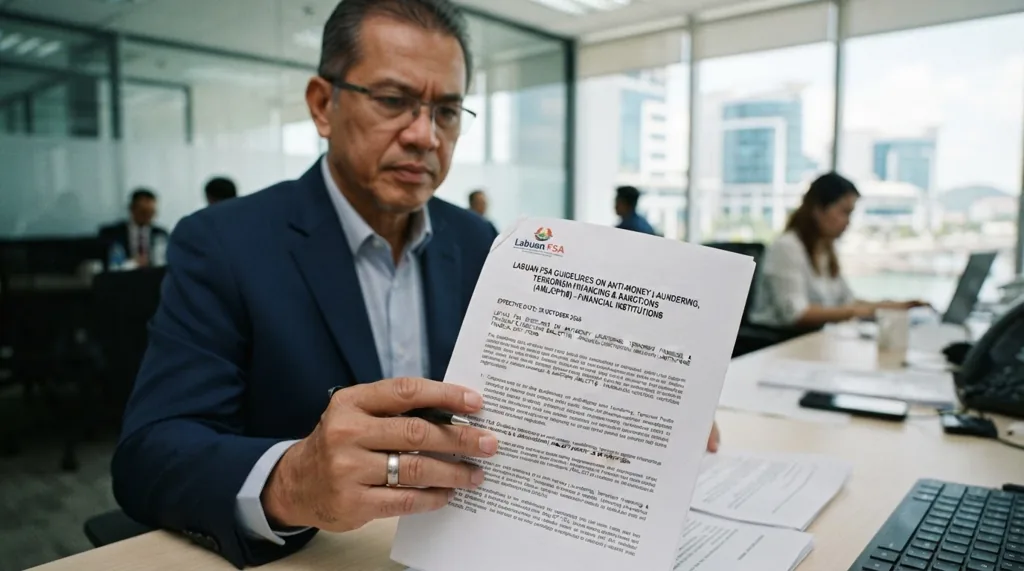
Labuan FSA issued new anti-money laundering and sanctions guidelines for Labuan financial firms, effective immediately from 28 October 2026.
Malaysia’s Labuan Financial Services Authority (Labuan FSA) has issued new anti-money laundering and sanctions guidelines for the banks, insurers and other financial firms in its offshore centre. The rules took effect on 28 October 2026, and compliance is required immediately.
The Labuan FSA regulates the Labuan International Business and Financial Centre (Labuan IBFC). Its new guidelines cover money laundering, terrorism financing, weapons proliferation financing and targeted financial sanctions1. They apply to 13 groups of licensed firms, which the guidelines call Labuan key reporting institutions (Labuan KRIs)1.
| At a glance | Details |
|---|---|
| What was published | Final guidelines on anti-money laundering and sanctions |
| Issued with effect from | 28 October 2026 |
| Who must comply | Labuan banks, insurers, trust companies, fund managers and other key reporting institutions |
| Effective date | 28 October 2026, with immediate compliance |
| Next milestone | Rules stay in force until amended or revoked |
What are the new Labuan rules?
The guidelines run to 159 pages and set out how Labuan firms must fight financial crime1. They follow international standards set by the Financial Action Task Force (FATF), the global anti-money laundering standard-setter1. They also respond to risk assessments carried out by the Labuan FSA itself1.
The document sets out four things. These are firms’ duties under Malaysia’s main anti-money laundering law, a risk-based approach to managing crime risks, sanctions duties, and the roles of boards and senior managers1.
The Labuan FSA issued the guidelines under Section 4A of the Labuan Financial Services Authority Act 19961. They also draw on the Anti-Money Laundering, Anti-Terrorism Financing, and Proceeds of Unlawful Activities Act 2001 (AMLA)1.
Who must follow the guidelines?
The rules name 13 types of licensed Labuan business1. The main groups are listed below.
| Type of firm | Covered by the guidelines |
|---|---|
| Banks | Labuan banks, investment banks and Islamic banks |
| Insurance | Life insurers and reinsurers, family takaful operators and their brokers |
| Trusts | Labuan trust companies and managed trust companies |
| Investment | Fund managers of public funds, securities licensees and Labuan exchanges |
| Other finance | Money brokers, leasing companies and development finance firms |
Firms offering digital financial services must also meet the extra digital rules in the guidelines1. The sanctions duties go wider: they apply to all Labuan financial institutions that the Labuan FSA regulates or supervises1.
Foreign branches and subsidiaries of Labuan licensees are covered too. Where a head office policy is weaker than the guidelines, the Labuan rules prevail1. Where two sets of anti-money laundering rules apply, the stricter one wins1.
What firms must do in practice
The guidelines require each firm to assess its money laundering and terrorism financing risks, and to profile customers by risk1. Firms must also assess and reduce the risk of financing weapons of mass destruction1.
Each firm needs a full compliance programme. It covers board and senior management duties, a compliance officer, staff screening, staff training and an independent audit function1.
Customer checks are a large part of the document. The guidelines set standard, simplified and enhanced checks, plus ongoing monitoring of existing customers1. Other sections cover:
- electronic identity checks, including the use of artificial intelligence and machine learning1
- politically exposed persons, meaning people with prominent public jobs, and their close associates1
- wire transfers, correspondent banking and higher-risk countries1
- suspicious transaction reports and record keeping1
How the sanctions rules work
The sanctions section covers terrorism financing, proliferation financing and other United Nations (UN) sanctions1. Firms must keep a sanctions list, screen customers and related parties, and freeze, block or reject matching funds1. They must then report each positive name match, and report matches periodically1.
For proliferation financing, the guidelines tie in a directive from Malaysia’s Ministry of Investment, Trade and Industry (MITI)1. That directive took effect on 7 June 20242. It requires firms to update their sanctions databases without delay after the UN Security Council publishes a designation2.
The directive also requires firms to screen their entire customer database, including dormant accounts, without delay after each designation2.
Enforcement and penalties
Any person who fails to comply may face enforcement action1. This includes an administrative penalty under Section 36G of the Labuan Financial Services Authority Act 19961. Other actions under that act and the AMLA are also possible1.
The guidelines also say firms must keep checking that their compliance programme stays effective as global standards change1.
Key terms in plain words
| Term | Meaning |
|---|---|
| Anti-money laundering (AML) | Rules that make firms check where customer money comes from |
| Proliferation financing | Funding the spread of nuclear, chemical or biological weapons |
| Targeted financial sanctions | Freezing money of people and groups named by the UN |
| Labuan key reporting institution | A licensed Labuan financial firm covered by these rules |
| Politically exposed person | Someone with a prominent public role, who carries higher risk |
| Beneficial owner | The real person who ultimately owns or controls a customer |
The guidelines have applied since 28 October 2026 and stay in force until the Labuan FSA amends or revokes them1.
Sources
- ↩ Guidelines-on-AMLCFTCPF-and-TFS-for-Labuan-KRIs_28102026.pdf https://www.labuanfsa.gov.my/clients/asset_717D5286-17F8-4620-B852-83CA4FFCC30C/contentms/img/documents/regulations/amlcft/guidelines/2026/Guidelines-on-AMLCFTCPF-and-TFS-for-Labuan-KRIs_28102026.pdf
- ↩ TARGETED FINANCIAL SANCTIONS RELATING TO PROLIFERATION FINANCING (TFS-PF) https://www.miti.gov.my/miti/resources/STA%20Folder/PDF%20file/2024_Directive_TFS_on_PF.pdf