

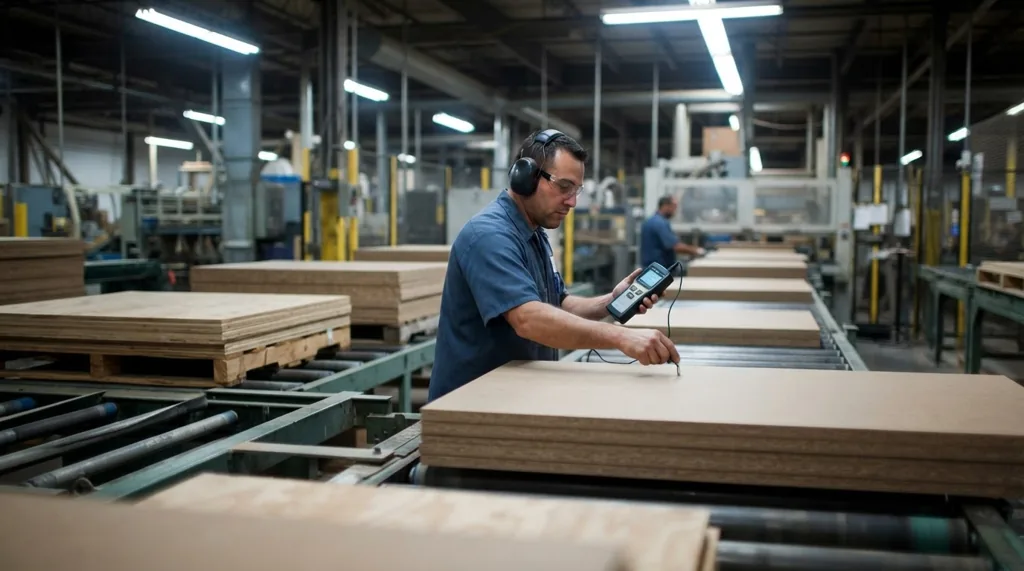
EPA has updated the testing standards wood panel makers must use to meet formaldehyde limits, effective Nov. 27, 2026.
The US Environmental Protection Agency (EPA) has updated the testing standards that wood panel makers must follow to prove low formaldehyde emissions. The final rule takes effect on Nov. 27, 2026.
The final rule was published in the Federal Register on Oct. 28, 2026. It replaces outdated editions of several industry testing and product standards in the federal formaldehyde rules for composite wood products1. It also adds one new optional test method and drops one duplicate standard1.
| At a glance | Details |
|---|---|
| What was published | Final rule updating testing and product standards |
| Published on | 28 October 2026 |
| Who must comply | Makers, importers, sellers and suppliers of hardwood plywood, medium-density fiberboard and particleboard, plus testing and certification firms |
| Effective date | 27 November 2026 |
| Next milestone | Updated standards apply from the effective date |
What is this rule, and why does it matter?
Composite wood products are panels such as plywood and particleboard, and some of them use formaldehyde1. A 2010 law, the Formaldehyde Standards for Composite Wood Products Act, created Title VI of the Toxic Substances Control Act (TSCA), the main US law on chemical safety1. That law set limits on how much formaldehyde these products may release.
EPA put those limits into practice with a final rule on Dec. 12, 20161. The 2016 rule requires hardwood plywood, medium-density fiberboard and particleboard sold or made in the US to meet the emission limits1. It covers product testing, labeling, recordkeeping and import certification1.
The rules rely on outside technical standards, written by bodies such as ASTM and the International Organization for Standardization (ISO). Those bodies revised several of their standards between 2022 and 20241. EPA says several references in its rules had become outdated, superseded or withdrawn1.
What the final rule changes
The rule makes four changes. Regulated companies must use the updated editions of the listed standards when they comply with the formaldehyde rules1.
| Change | What it means |
|---|---|
| Updated standards | Newer editions of test methods and product standards replace older ones |
| New optional test | ISO 12460-2:2024(en) becomes an extra choice for quality control testing |
| Removed standard | The British Standards Institute version BS EN ISO 12460-3 is dropped |
| Scope and definitions | Rule wording is aligned with the current standard editions |
The updated standards include several items1:
- ANSI A190.1-2022, a product standard for structural glued laminated timber.
- ASTM D5582-22, a test method that uses a desiccator.
- ASTM D6007-22, a test using a small-scale chamber.
- ASTM E1333-22, a test using a large chamber.
- ISO 12460-3:2023(E), a gas analysis method.
- PS 1-22, a voluntary product standard for structural plywood.
A new choice for quality control testing
Panel makers run regular quality control tests to check that production stays within the limits. The rule adds ISO 12460-2:2024(en), a small-scale chamber test, as one more method they may choose1. EPA describes it as similar to methods already in the rules1.
The rule also removes BS EN ISO 12460-3:20201. An identical international version, ISO 12460-3:2023, stays in the rules1. EPA says keeping both would add no technical value and could confuse companies1.
Who is affected
The rule reaches companies that make, import, sell, supply or offer these wood products in the US1. It also covers products that contain them, and firms that test or certify them1.
EPA lists sectors that may be affected1:
- Plywood and engineered wood manufacturers.
- Furniture makers, wholesalers and stores.
- Makers and dealers of manufactured homes and prefabricated buildings.
- Makers and dealers of motor homes, travel trailers and recreational vehicles.
- Building material dealers and testing laboratories.
Costs and the path to the final rule
EPA expects no additional costs for companies from the updated standards1. It calls the action routine, and the new test method is optional1. Dropping the British version is not expected to have any economic impact, because the same method remains available1.
EPA proposed the changes on Feb. 11, 20261. The public comment period closed on March 13, 20262. EPA received eight comments supporting the updated standards, and three supporting removal of the British standard1.
| Key date | What happens |
|---|---|
| Dec. 12, 2016 | Original formaldehyde rule published |
| Feb. 11, 2026 | EPA proposes the update |
| March 13, 2026 | Comment period closes |
| Oct. 28, 2026 | Final rule published |
| Nov. 27, 2026 | Final rule takes effect |
Key terms in plain words
| Term | Meaning |
|---|---|
| Composite wood products | Panels made from wood pieces or fibers bonded with glue |
| Formaldehyde | A chemical used in some wood glues that can be released into indoor air |
| TSCA Title VI | The part of US chemical safety law that limits formaldehyde from wood panels |
| Voluntary consensus standards | Technical rules written by industry and standards bodies, which EPA can adopt |
| Incorporation by reference | Making an outside standard legally binding by naming it in a rule |
| Quality control test | A routine check by a manufacturer that its products stay within the limits |
The updated standards take effect on Nov. 27, 20261.
Sources
- ↩ Federal Register :: Voluntary Consensus Standards Update; Formaldehyde Emission Standards for Composite Wood Products — 2026 21963 / voluntary consensus standards update formald… https://www.federalregister.gov/documents/2026/10/28/2026-21963/voluntary-consensus-standards-update-formaldehyde-emission-standards-for-composite-wood-products
- ↩ Federal Register :: Voluntary Consensus Standards Update; Formaldehyde Emission Standards for Composite Wood Products — 2026 02715 / voluntary consensus standards update formald… https://www.federalregister.gov/documents/2026/02/11/2026-02715/voluntary-consensus-standards-update-formaldehyde-emission-standards-for-composite-wood-products