

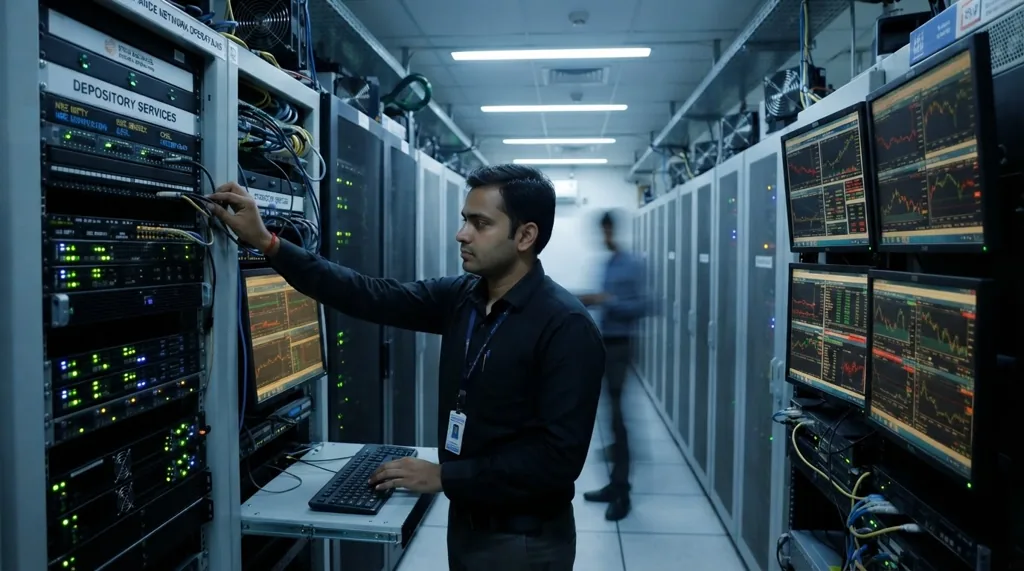
SEBI proposed letting stock exchanges and depositories enter related businesses without its prior approval, capped at 5% of net worth yearly.
India’s market regulator has proposed letting stock exchanges and depositories enter related businesses without asking its permission each time. The relief comes with a yearly spending cap of 5% of net worth and leaves clearing corporations out.
The Securities and Exchange Board of India (SEBI), the country’s securities market regulator, published the consultation paper on 22 October 20261. It would change Regulation 38(2) of the Stock Exchanges and Clearing Corporations (SECC) Regulations, 2018 and Regulation 7(c)(i) of the Depositories and Participants (D&P) Regulations, 20182. SEBI has opened its public comment portal on five numbered proposals and a draft circular3.
| At a glance | Details |
|---|---|
| What was published | Consultation paper with proposed rule changes and a draft circular |
| Published on | 22 October 2026 |
| Who can comment / Who must comply | Public can comment; stock exchanges and depositories would use the new route |
| Feedback deadline / Effective date | Not stated in SEBI’s published pages; no effective date yet |
| Final rules / Next milestone | SEBI reviews comments before deciding on final rules |
What is SEBI proposing, and why does it matter?
The paper covers market infrastructure institutions (MIIs), the bodies such as exchanges and depositories that run India’s securities markets2. SEBI proposes an "automatic route" for some of them3. Under it, an MII could take up activities related or incidental to its market role without SEBI’s prior approval3.
The route would also cover activities similar in function to one the MII already runs, if SEBI approved it before3. For exchanges and depositories, this would cut a layer of case-by-case sign-off for routine expansion.
Who gets the new route and who does not
The route is open to MIIs other than recognized clearing corporations3. In practice, that means stock exchanges and depositories could use it, while clearing corporations could not.
Which activities would qualify
SEBI lists the kinds of related activity that would qualify3. They are:
- activities carried out under SEBI’s directions
- moving shares held by the MII or a subsidiary to the MII or another subsidiary
- an operating subsidiary investing money earned from its own operations
- stakes in companies doing similar work under another Indian financial regulator, where SEBI approved the activity before
The last category lets an exchange or depository keep investing in businesses supervised by other financial watchdogs3. SEBI’s earlier approval of that activity is the condition.
The money limits: 5% cap and 1.5x floor
Where an activity involves spending money, SEBI proposes a yearly limit3. Spending in a financial year could not exceed the lower of two figures: 5% of the MII’s net worth on 31 March of the previous year, or its regulatory minimum net worth3.
A second test protects the institution’s financial cushion. After the investment, the MII’s net worth must not fall below 1.5 times the minimum SEBI prescribes3.
Safeguards attached to the route
The relief comes with conditions on how MIIs deal with the businesses they back3. Sharing of the MII’s logo and brand must be at arm’s length, meaning on normal commercial terms3. Any sharing of staff or systems needs a ring-fenced agreement that keeps resources separate.
The activity must not create a conflict of interest for the MII3. Companies the MII invests in must also meet SEBI’s fit and proper criteria, its test of honesty and soundness3.
What happens next
The proposals are not yet law. SEBI has asked for views on each of the five proposals and on any other point in the draft circular3. It will then decide whether to amend the two sets of regulations and issue the circular.
Key terms in plain words
| Term | Meaning |
|---|---|
| MII | Market infrastructure institution: a stock exchange, clearing corporation or depository |
| Automatic route | Permission to act without asking the regulator first, if set conditions are met |
| Net worth | What an institution owns minus what it owes |
| Arm’s length | Dealing on normal commercial terms, as with an unrelated party |
| Fit and proper criteria | SEBI’s test of honesty, reputation and financial soundness |
| Ring-fenced agreement | A contract keeping shared resources separate and accounted for |
The next milestone is SEBI’s decision on final rules after it reviews public comments on the 22 October 2026 paper.
Sources
- ↩ SEBI | Reports https://www.sebi.gov.in/sebiweb/home/HomeAction.do?doListing=yes&sid=4&smid=35&ssid=38
- ↩ SEBI | Consultation Paper on Review of Regulation 38(2) of the SECC Regulations, 2018 and Regulation 7(c)(i) of the D&P Regulations, 2018 for providing an automatic approval route for investment in related activities by the MIIs<a href=’https://www.sebi.gov.in/sebiweb/publiccommentv2/PublicCommentAction.do?doPublicComments=yes’ target=’_blank’ style=’color:#007ffc’> Click here to provide your comments </a> https://www.sebi.gov.in/reports-and-statistics/reports/oct-2026/consultation-paper-on-review-of-regulation-38-2-of-the-secc-regulations-2018-and-regulation-7-c-i-of-the-dandp-regulations-2018-for-providing-an-automatic-approval-route-for-investment-in-related-a-_105391.html
- ↩ SEBI | Public Comments https://www.sebi.gov.in/sebiweb/publiccommentv2/PublicCommentAction.do?doPublicComments=yes